Billd + UCC – Get Materials, Pay Later

Realty411 wants to ensure their readers have access to creative solutions to enhance and grow their real estate investment business.

One of the ways investors and contractors can maximize their resources in through the use of calculated leverage, both in financing real estate, and at times, the materials needed to rehabilitate the property. Adding value through well-thought-out updates, new appliances, upgraded flooring, trendy paint colors, and environmentally-friendly landscaping will add appreciation — leading to profits for those willing to put in the time, risk and capital. Recently, Universal Commercial Capital, one of Realty411‘s most trusted finance sponsors, partnered with Billd to offer contractors and investors up to 120-day financing for materials. For futher information, please visit: https://go.billd.com/universal-commercial-capital

Billd plus UCC

NEW: Legal Webinar for Investors/Brokers

Dear Realty411 Reader;

As real estate investors, active landlords, and realty professionals, we know how crucial it is to have direct access to experienced legal experts.

Because we are always striving to bring our readers and members value and amazing connections, we have developed a special online event on this very topic.

You are invited to join a free live 30-minute webinar sponsored by Realty411 explaining just how to obtain affordable access to high-quality attorneys and law firms.

Wednesday, September 9th at 6pm, RSVP at https://realty411legalservices.eventbrite.com

  • Have ever wanted to ask an attorney a question? Learn your rights and get expert advice –and not receive a bill in the mail?
  • Is your Will, Living Will, Healthcare Directive and Durable Power of Attorney in place and up to date? If not, we will show you a simple way–without the high price tag.
  • Do you own a business and worry about the cost of defending yourself against a lawsuit? Or just need advice to make better personal or business decisions?
  • Would like to have unlimited access to an attorney for any legal situation, no matter how small or complex?

Realty411 Special Online EventAt this special online event we will share a proven, simple way to do all of this and much more –affordably and reliably.

Feel free to also share this link with business associates, friends, and family members.

We appreciate you being part of our Realty411 network, and we know you will find this information to be valuable.

Click here to Register for September 9 at 6pm: https://realty411legalservices.eventbrite.com

CA Rehabs and ADUs are hotter than ever, EVEN in a pandemic

Dear Realty411 Reader;

This year has been like something we’ve never seen, like a clip right out of “The Twilight Zone.”

We’re not even sure Stephen King could have made this story up, but here we are in the midst of a pandemic — and the crazy thing is, buying and selling houses is still HOT, HOT, HOT.

Take it from our friend Mentor, Alton Jones. He’s a 34-year LAPD Veteran, who when he grew tired of dodging bullets, turned to rehabbing homes in the CA area part-time… and is now running a multi-million-dollar business…finding, fixing and flipping houses.

In the past 10 years, he’s learned a lot of tough lessons and has become one of the nation’s leading experts flipping houses for a profit using his team to successfully rehab and sell hundreds of houses in this time.

Alton Jones RehabstoRiches digitalThis coming September 18th – 20th, he’ll be conducting his Live, Virtual workshop where he’ll be teaching students:

  • How to Find the Good Deals You Keep Hearing About
  • Ways to Purchase Properties Without Using Your Own Money or Credit
  • How to Negotiate with Sellers
  • What to Look for When Inspecting a Property
  • How to Systematize and Automate the Rehabbing and Selling Process to Make It Faster, Easier and Safer
  • How to Make A Scope of Work, Materials List and Schedule Like a Pro
  • Where to Find the Best Contractors and Sub-Contractors
  • How to Flip Houses with Your IRA
  • How to Sell Your Houses FASTER Than Other Investors and For More Money
  • ALL THIS AND MORE, CLICK HERE!

So, if you’ve always wanted to flip houses in the CA area, but were afraid to risk losing money OR if you’ve always wanted to FIRE your boss and have the freedom to work from anywhere, even on vacation, Alton’s the guy to show you.

As part of his curriculum, he’s incorporated his latest and hottest rehab strategy, modifying existing structures into ADUs (Accessory Dwelling Units). ADUs have become all the rage in CA in just the past 2 years. Think garage to In-law suite.

Alton will show you the many ways he’s been able to navigate the treacherous waters on the ADU permitting process which can affect your buying decisions and understanding the rules that can make you lots of money or can cost you tens of thousands of dollars.

If you’re in the market in the CA area, this is a must attend event! Set aside September 18th – 20th and join Alton from the comfort of your home for this event!

Registration is only $547 for the 3 days, and you can fill the room with all the family and friends you wish — get going and be creative, because that’s what it’s about in this business.

The virtual platform has limited “ticket” capacity, so register right NOW, so you won’t have to miss it!

To your success,

Linda Pliagas, Publisher
Realty411.com & REI Wealth

UBTI and Mortgage Debt Funds

By Edward Brown

According to Investopedia, Unrelated Business Taxable Income [UBTI] is income regularly generated by a tax-exempt entity by means of taxable activities. This income is not related to the main function of the entity and prevents or limits tax-exempt entities from engaging in businesses that are unrelated to their primary purposes.

UBTI greater than $1,000 is subject to taxation. For 2019, the highest tax rate was 37%.
taxes-646509_1280

Image by Gerd Altmann from Pixabay

Most forms of passive income, such as dividends, interest income, and capital gains from the sale of capital assets, are not treated as UBTI.
Many investors use their IRAs to invest in Mortgage Debt Funds [MDF]. MDF lend money similar to a bank where they take a deed of trust as collateral for the loans they make to borrowers. Typically, income derived from MDF are not subject to UBTI even though the income derived at the MDF level is not passive in and by itself. The IRA investor, however, is a passive investor; consequently, it is not usually subject to UBTI. There are times, however, when this is not so. Ways that UBTI can be triggered for the investor in a MDF can involve a few different scenarios; if the IRA borrows on margin to purchase the MDF; if the MDF borrows within itself to generate income [called a leveraged MDF], or if the MDF ends up foreclosing on too many assets and the IRS treats the MDF as a dealer in real estate. [This last risk is relatively small, as most MDFs would not be treated as being in the business of buying and selling real estate by the IRS under normal circumstances]. The first risk [the IRA borrows to invest in the MDF] is also not a normal risk, and the investor has control over this by not borrowing to invest in the MDF]. It is the second risk that is the main one, as the MDF controls how much [if at all] it borrows.
balloon-395598_1280

Image by Thanks for your Like • donations welcome from Pixabay

Most MDFs that use leverage usually center around attempting to enhance its yield to investors. If the MDF can borrow from a bank at 5% and lend it out at 8%, there is a 3% arbitrage in favor of the MDF; however, this may possibly put undue risk in its portfolio – depending on how much leverage is used and the bank covenants required to obtain this leverage. In addition, for those investors in the MDF who use their IRAs [or 401(k)s, pension, or profit-sharing plans], this leverage may subject the income derived to create UBTI.
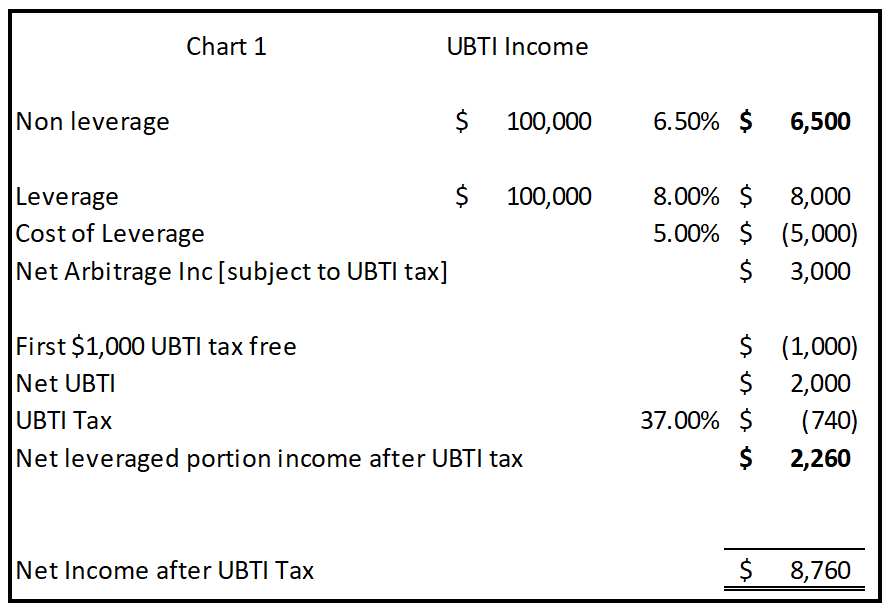
Certain key factors for the investor’s IRA are; how much the IRA has invested in the MDF [because the first $1,000 of UBTI is not taxable to the IRA, the income derived by the MDF, and how much leverage was used to produce that income. In addition, it is important the length of time that leverage was used, as the UBTI will be calculated using a formula. For example, Chart 1 shows an IRA investor having $100,000 in a MDF generating a rate of return of 6.5% [without leverage] will not have its $6,500 income subject to UBTI as no leverage was used. If the MDF chooses to leverage the Fund 50% [50% investor funds and 50% bank funds] for the entire year and can borrow at 5% and invest that portion at 8%, the net income to the IRA [after subtracting the bank interest expense and UBTI tax ] would be $8,760. chart 1
Many IRA investors may not feel that the extra $2,760 earned in this example is worth the risk. When a real estate syndication goes bad, it is usually only for one reason – leverage. If no leverage is used, then, usually, the only way for a real estate investor to lose substantially most or all of his/her investment in these types of investments [be they REITS, Limited Partnerships, Limited Liability Companies, etc.] is if the real estate taxes associated with the underlying real estate are not paid. When leverage is used, the banks have first priority over the assets. Simply, the more leverage that is used, the riskier the investment.
It is important for those investors using their retirement savings to invest in assets that can produce UBTI to ask the manager how much debt/leverage is used in the investment. A small amount of leverage is not usually taking on undue risk, especially if that leverage is used sparingly. Mark Hanf, president of Pacific Private Money, says that he likes to use a small amount of leverage, and on a very short term basis for his MDF for specific reasons; mostly, to help fund short term loans in his Fund when he is expecting payoffs on other loans or anticipated investor money flowing in. As soon as payoffs or investor money comes in, he immediately pays down line of credit [leverage]. This creates the benefit of having the ability to close deals that he might not otherwise have been able. The short-term nature of this leverage does not usually create enough UBTI income to concern the retirement investor. In addition, the short duration of the leverage puts his Fund at minimal risk; however, since the rate of interest to obtain the leverage is less than the income derived from it, his Fund still benefits from a small amount of positive arbitrage.
The retirement investor would be wise to look for Funds that conservatively use leverage in their MDF to avoid UBTI as well as undue risk. In addition, the investor should calculate the anticipated UBTI ahead of time to determine how much should be invested, as only the first $1,000 of UBTI income is tax free; The investor can then decide the risk reward of investing in a MDF that uses leverage.

edward-photo-from-2006-2-200x300

Edward Brown

Edward Brown currently hosts two radio shows, The Best of Investing and Sports Econ 101. He is also in the Investor Relations department for Pacific Private Money, a private real estate lending company. Edward has published many articles in various financial magazines as well as been an expert on CNN, in addition to appearing as an expert witness and consultant in cases involving investments and analysis of financial statements and tax returns.

Rehabbing Your Way To Millions Part 1

Copyright: merznatalia / 123RF Stock Photo

By Kathy Kennebrook (The Marketing Magic Lady)

In just about any real estate market I believe that there are a lot of great ways to make a fortune in real estate and one of those ways is to rehab and sell properties quickly. This is a strategy I implement on a daily basis in my own Real Estate Investing business.

There are some excellent resources for you to use to find vacant ugly properties to rehab and sell in virtually any price range. One of those techniques is to simply use targeted direct mail campaigns like I do to find motivated sellers of ugly vacant properties or estates.
postbox-3903569_1280

Image by Manfred Richter from Pixabay

This is a great way to find highly motivated sellers who need to sell quickly and there are great deals to be made for pennies on the dollar. Remember, your profit is made when you buy a property. Another strategy I use to find the owner of vacant ugly properties is to mail to a list of property owners with delinquent taxes that belong to out of county or out of state owners. These lists are pretty easy to come by and I offer resources for these mailing lists and others when you invest in my Marketing System. Check out my website at www.marketingmagiclady.com.
Another way to find great deals with ugly vacant properties is to work with the REO departments of your local banks. REO mean real estate owned properties. These are ugly vacant properties that the banks have taken back for non-payment of the mortgage.
These banks are generally selling properties for forty to sixty cents on the dollar in order to get rid of them quickly. Generally speaking the banks want to get these ugly houses out of their inventory since banks are in the money business, not the house business. And there are more houses available through these resources than ever before due to our current real estate market situation.

Handshakes with customer after contract signatureCopyright: alexraths / 123RF Stock Photo

You do need to be careful about the properties you are buying since you want to buy houses you can resell quickly, so there are some specific parameters I would suggest you follow. Here are examples of houses I would suggest you stay away from buying. 1. Houses on busy streets 2. Houses in war zones 3. Houses with only two bedrooms or tiny bedrooms 4. Houses needing more rehab than you can handle (like burn-outs) 5. Houses which are functionally obsolete 6. Houses on postage stamp lots 7. Houses near or across from commercial areas 8. Houses near or across from businesses or schools The whole idea is to find houses you can rehab quickly and sell at just under full retail or even more than full retail in order to sell them quickly, so you need to make sure the numbers work in order for you to get the profit you are looking for from the deal.
There are also specific things you want to do to make your house stand out from all the others in the same price range in order to get your house sold quickly; like really making kitchens and baths stand out, and adding inexpensive upgrades that homes in the same price wouldn’t normally have.
Some of these upgrades might include nicer hardware like faucets and showerheads, tile in the showers, nicer kitchen appliances, etc. Also make sure your house looks clean and attractive from the exterior. There are lots of inexpensive ways to accomplish this. These strategies will make your house stand out to the potential buyer and get it sold much more quickly.
For more information on finding motivated sellers for your real estate business and getting your houses sold quickly for more cash, make sure you visit Kathy Kennebrook’s website at www.marketingmagiclady.com. While you are there be sure and sign up for my Free monthly newsletter! Also be sure and check out Rehabbing Your Way to Millions Part II

LEARN DIRECTLY FROM KATHY KENNEBROOK AT REALTY411’S VIRTUAL WEEKEND INVESTOR EXPO, CLICK HERE!

10 Habits of Successful Real Estate Investors

By Russell Barneson

If you’re an aspiring real estate investor, building good habits will be the core foundation to your success.

From the moment you rise to the time you go to bed, outlining your day will make you more efficient and more effective at your job. Here is a game plan to implementing habits to develop to put you on your path to achieve your real estate investment goals.

Having a Schedule

time-management-1966396_1280

Image by Tumisu from Pixabay

Having a daily routine of planned activities will help you get into a rhythm. Waking up at the same time, going to the gym daily and even planning your meals are great for building structure.
Setting a schedule will help you clear your mind, giving you laser focus.
The side benefit of such a structure is you will not be worrying about whether you forgot to do something. There are many scheduling, CRM and organization tools you can install on your phone and computer, making it easier than ever to stay organized. These tools will send you reminder messages so you don’t miss an important meeting or appointment.

Find a Niche

magnifying-glass-29398 digital

Image by Clker-Free-Vector-Images from Pixabay

There is an ocean of property types and investment strategies out there.
The world is a complicated place, finding a niche helps simplify life.
Pick one type of property or strategy to invest in; this will give you an identity and make you an expert in the niche you choose. For example, if you work in rehabbing single family homes in a certain area, over time you will become an expert in this industry and will know what to look for in regards to the local market.
Developing strong relationships with property brokers, contractors and lenders will be beneficial to your success.
For example, a great relationship with a property broker may result in access to insider pocket listings unavailable on the MLS. Go with what you know! Try to stay away from projects outside your niche as this can become time consuming and bring on unnecessary risk.

Settings Goals

target-4859140_1280

Image by Megan Rexazin from Pixabay

Great real estate investors set short and long term goals. For instance, a long term goal might be turning over 1 fix and flip every month or earning $200K profit per year. A short term goal might be going to the gym every 2 days for a month. Humans thrive with goals, having a target to aim for will help you orientate yourself towards a brighter future and help you avoid complacency.

Persevere Through Down Markets

Real estate markets, like all markets, are cyclical. Like a surfer, learn to ride the highs as well as the lows.
Position yourself to withstand an unexpected downturn in the real estate market as it is inevitable.
And don’t be discouraged if you have a few bad years, stay positive and find ways to persevere.

Go to School

pexels-pixabay-267885 digital

Photo by Pixabay from Pexels

Getting higher education is a valuable tool. Becoming more knowledgeable could open up various job opportunities throughout the real estate industry.
People with degrees often get promoted and have higher incomes than those without.
According to APLU.org, high school grads earn 62% of what a college graduate earns.

Diversify

Rule No. 1: Never lose money. Rule No. 2: Never forget rule No. 1. – Warren Buffet
The number one rule of investing is preservation of capital. The easiest way to achieve this is through diversification. Don’t put all your eggs in one basket and consider partnerships if necessary to diversify into multiple projects. This will balance out your portfolio in the case one of your assets is underperforming.

Patience

Patience is a virtue. Real estate markets have been around for eons and will always be cyclical.
What is valuable today is worthless tomorrow. Avoid buying at the top of the market, and try getting into up-and-coming neighborhoods, or buying when you think a recession is at the bottom.
Therefore, don’t chase deals. Have cash reserves ready for a drop in the market, in order to capitalize on bargain deals.

Work Smarter not Harder

smart-725843_1280

Image by Fathromi Ramdlon from Pixabay

Know your priorities and limitations. Be efficient and do one thing well, outsource the tasks you struggle with. Don’t scoff at the idea of getting some outside help. When blocked on something ask for feedback. Not a web developer? Don’t try to build everything yourself. Trim the fat and focus on your money makers.

Create Passive Income

Creating passive income helps you leverage your time and is one of the most powerful income generating strategies in the world. If you have a solid rental business setup and organized, you will have a lot more time to focus on developing other businesses or living a more fulfilling life.

Hire the Right Team

pexels-fauxels-3184291 digital

Photo by fauxels from Pexels

An expert is a person who has made all the mistakes that can be made in a very narrow field. – Niels Bohr
Paying employees a little more than competitors can be beneficial in the long run. Hiring competent people to make difficult decisions on your behalf will not only benefit your business but also give you more time to do the things you love. Additionally, turnover in any business can be costly due to the training time for new employees, so it’s best to find great employees and stick with them.

About the Author

russell-barneson Pic digital

Russell Barneson runs Sales & Marketing at Crescent Lenders and is a real estate investor and operator of his own vacation rental business. He is passionate about the topic of real estate investing and helps real estate investors from across the USA obtain private money financing. Having the experience of running and operating a real estate business himself, as well as helping other investors get capital for their projects, gives him unique insights. Russell is a sports fanatic and in his spare time he loves to travel, surf, play sports, and have the occasional beer. For more information, visit: https://www.cresentlenders.com

High Performance Success Virtual Summit

Hello, Come Join Us at the High-Performance Success Summit on August 22nd and 23rd 2020. The High-Performance Success Summit is dynamic event taught by leaders in every field. Learn from the Top Real Estate and Business Experts on how to implement new business-critical strategies and ideas to boost your Small Business!

Reserve your seat today. http://hpssuccess.com/lp

Here are the updated topics for the event:
  • Top 3 Secrets Of Raising Private Money
  • How To Attract More Motivated Sellers and Stand Out In A Crowded Market
  • How To Find Real Estate In Under Six Minutes
  • Top real estate strategies for the new economy even if you have little or no money
  • Negotiation Riches – Stop Losing Thousands on every deal!”
  • How Develop Beast Mindset, Habits and Belief System
  • 5 Steps Process on how to Network with Influencers
  • Get Organized, Get Customers, Get Paid
  • How Create Your Own Virtual Events
  • Networking with Infuencers
HP Virtual summit 2
Click the link below to see our full line up of Business and Real Estate experts that will be speaking at the High-Performance Success Summit Virtual Summit on August 22nd and 23rd, 2020

Reserve your seat today http://hpssuccess.com/lp

P.S. I can’t wait to see you on the inside, Join Us! http://hpssuccess.com/lp Sincerely, Jason Burke CEO of the High Performance Success Summit Phone number- 702-300-6690

Wealth Building Workshop coming to your living room!

wealth bldg workshop
Great news: We are hosting a virtual four-hour Wealth-Building Workshop where you can discover how alternative investing with self-directed IRAs could potentially help you reduce taxes and boost your financial future all from the comfort of your living room! You simply do not want to miss this informative online event, be sure to register today.

REGISTER NOW

Virtual Wealth Building Workshop Wednesday, August 19 | 6 PM – 10 PM (PDT) REGISTER TODAY FOR FREE

To Your Wealth, Equity Trust
Copyright © 2020, All rights reserved. Mailing address is: Equity Trust Company 1 Equity Way Westlake, Oh 44145

Don’t Miss The Deadline To Balance Your Real Estate Portfolio

By Bill Mencarow

Savvy real estate investors balance their portfolio with real estate notes (trust deeds or mortgages); real estate for appreciation, real estate notes for income.

My name is Bill Mencarow.  While my wife Alison and I were on the staff of the US Congress in Washington, we started to invest in real estate and later discovered notes (trust deeds and mortgages).  We still love real estate, and since then we’ve bought and sold lots of it, and lots of notes.
thepapersource
We then started The Paper Source, an educational resource for note investors and those who want to be.  For many years we have hosted the annual Paper Source Note Symposium which attracts several hundred investors. Because of virus restrictions we can’t hold it live this year.  Instead, it will be at your house!  (That is, it will be online.)
pexels-andrea-piacquadio-3769717
Photo by Andrea Piacquadio from Pexels
* Our speakers are people who DO what they teach. Over three days you will learn from some of the most experienced people on the planet (full-time note investors, tax and asset protection attorney, self-directed IRA experts, to name just a few) – and absolutely NO sales pitches. *  There will be presentations for beginners on up. *  You will get NON-EXPIRING access to all the speakers’ videos and MP3 audios. Tom Henderson, whom many call “The Note Professor” (and you will too, once you hear him) recently told me, “Bill, this is the deal of the century!  Can you believe all these speakers for only $97.00? And be able to watch at anytime on any device?!”
invitation-2508607_1280
Image by Gerd Altmann from Pixabay
This is my invitation to join us for the online Note Symposium Oct. 1-3.  Please CLICK HERE to see all that it offers.  The $97.00 registration includes admission to the event and lifetime access to the videos and MP3s. And that’s not all.  If you register by this Friday, Aug. 21, you will receive a one year subscription (or renewal) to THE PAPER SOURCE JOURNAL, the only publication for real estate note investors, which sells for $79.00. Every month you’ll get news affecting your investments, including court decisions, scam warnings, tips and techniques on everything from finding notes, negotiation, recasting them to double and triple your yields, and much more. Cheers, Bill W. J. Mencarow, President, The Paper Source, Inc.
Remember to register by this Friday to receive the $79 bonus. Your registration includes access to all the speakers’ videos and MP3 audios which will NEVER expire – you will be able to watch and/or listen anytime now or in the future.  CLICK HERE for more information and to register.  And please don’t miss the Friday deadline!
Feel free to contact me with any questions.  My personal email is[email protected] and my cell is 830-285-5926.

How FHA Benefits Buyers, Sellers, and Brokers

By Rick Tobin

Since 1934, FHA has insured over 34 million home mortgages nationwide. For buyers, sellers, and advising real estate brokers or other licensees, they should all learn more details about how the use of FHA mortgage loans can help each of them to buy and sell properties at potentially a faster and more profitable pace today.

Easier Mortgage Underwriting Guidelines for FHA Loans

pexels-lukas-684385 digital
Because FHA mortgages are insured by the federal government in case of future default or foreclosure risks, mortgage lenders are more likely to offer much easier loan approval requirements for their interested borrowers. Let’s take a look below at some of the best FHA mortgage loan benefits that include:
  • Loan-to-value loan amounts up to 96.5% LTV for owner-occupied properties.
  • FICO credit score allowances as low as 580 for some lenders up to 96.5% LTV loans.
  • Sellers, family members, and other interested parties may be able to contribute up to 6% of the sales price towards closing costs, prepaid expenses, discount points, and other financing costs or concessions to greatly reduce total out-of-pocket cash contributions for the buyer.
  • Borrowers who invest at least 10% towards a down payment may qualify with a FICO credit score as low as 500 in some cases.
  • Debt-to-income (DTI) ratio limit allowances that may exceed 50% for borrower applicants.
  • Interest rates for FHA loans are usually priced at or better than the most attractive interest rates for loans that aren’t government-insured, which allows borrowers to qualify for much larger loan amounts.
  • Maximum loan amount limits for one unit ($765,600), two unit ($980,325), three unit ($1,184,925), and four unit ($1,472,550) properties are much higher now in 2020 than most people realize.

FHA Loan Amount Limits for 2020

Each year, the Federal Housing Finance Agency (FHFA), Federal Housing Administration (FHA), and the Department of Veteran Affairs (VA) revise their maximum loan limits for one-to-four unit residential properties by county regions across the nation.
limits digital
The FHFA establishes the baseline conforming loan limit that meets or “conforms” to certain qualifying underwriting guidelines that are established by the two largest secondary market investors or Government-Sponsored Entities (GSE’s) named Fannie Mae (Federal National Mortgage Association) and Freddie Mac (Federal Home Loan Mortgage Corporation).
After a mortgage company, wholesale lender, or bank funds a loan, they usually need to sell it off into the secondary market to Fannie Mae, Freddie Mac, or to another secondary market investor so that the financial institution doesn’t run out of money. As a result, the lender will underwrite and approve borrower’s loan applications that both meet their own guidelines as well as the secondary market investor’s requirements. If not, the financial institution might be stuck with the funded loan, and will not be able to transfer it to another secondary market investor.
A conforming loan that is saleable or transferable to Fannie Mae or Freddie Mac and FHA loans are typically based upon median home prices in each county region. California, and other expensive states to live in that are typically near ocean locations or prime metropolitan regions, have “high-cost” county loan limits that can reach as high as 150% of the baseline mortgage limit that is derived from local median home prices in that same county region. FHA has a minimum loan amount or floor limits that go as low as $331,760 for a one-unit property (single-family home, condominium, townhome, etc.) as of January 2020. FHA has maximum loan amount limits that rise to as high as $765,600 in pricier county regions in California that include: * Alameda * Contra Costa * Los Angeles * Marin * San Benito * San Francisco * San Mateo * Santa Clara

Maximum Residential (One-to-Four Unit) Loan Limits in 2020

real-estate-3297625_1280
For so long as the owner lives in one of the units for a duplex, triplex, or fourplex property, the same owner may qualify for the maximum residential LTV ranges just like he or she would for a single-family home. Many times, the adjacent tenant or tenants will pay enough in monthly rent to cover the owner’s monthly mortgage payment. Single (single-family home, condo, townhome) – $765,600 Duplex (two units) – $980,325 Triplex (three units) – $1,184,925 Fourplex (four units) – $1,472,550

Mortgage Insurance Premium (MIP) Fees

Because FHA mortgage loans tend to be at higher loan-to-value levels up to 96.5% LTV, these government-insured loans will include a mortgage insurance premium fee when the LTV exceeds 80% of the purchase price or appraised value for a refinance. The pooled insurance fee payments will act as future protection against any default risks. Generally, the MIP funding fee equals 1.75% of the loan amount that’s due at the time of closing. The official title for this MIP funding fee is the Upfront Mortgage Insurance Premium (UFMIP). Many times, the borrower can add this MIP finance charge to the loan amount if all underwriting guidelines are met and approved by the lender.
pexels-karolina-grabowska-4386393 digi
Additionally, there will be an annual mortgage insurance premium (MIP) fee that varies depending upon factors such as the loan-to-value and loan amount size. Loans with a higher LTV range at 96.5% are generally considered much riskier than loans with lower 90% LTV ranges. As a result, the annual MIP fee percentage amounts will differ and range from a low of 80 basis points or .80% (at or below 90% LTV for loan amounts below $625,500) to as high as 105 basis points or 1.05% (at or above 95% LTV for loans greater than $625,500). Please note that 15-year FHA mortgages generally have lower interest rates and much lower annual MIP fees to as low as 45 basis points or .45%. Source: https://www.hud.gov/sites/documents/15-01MLATCH.PDF

FHA Monthly MIP Payment Example

Let’s quickly review a fictional $600,000 home purchase deal for a borrower who wants an FHA mortgage that’s fixed for 30 years with the lowest down payment possible:
  • Purchase price: $600,000
  • Maximum 96.5% LTV with just 3.5% down: $579,000
  • Upfront Mortgage Insurance Premium (UFMIP): $10,132.50 (1.75% of $579,000)
  • Annual MIP fee: $4,921.50 (.85% of $579,000)
  • Monthly MIP fee paid: $410.12 ($4,921.50 / 12 months)
The monthly MIP fee is paid in addition to the homeowner’s principal, interest, property taxes, and homeowners insurance. The faster that the homeowner can eliminate this monthly MIP fee requirement, the more affordable the future monthly payments will become for the borrower.

FHA Streamline Refinances

percent
Two or three years after buying a property with a 96.5% LTV FHA loan, a borrower may be able to qualify for the FHA Streamline refinance program if the new loan amount will be at 80% or below of the most recent estimated market value. Over the past several years, many homes have appreciated at 7% to 10% per year. If so, it may only take a few years for a property owner to reduce their LTV range from 96.5% with monthly MIP requirements to 80% LTV or below with no monthly MIP payments. Ironically, these “fast track” refinance programs may allow the borrower to not provide any formal documentation for their current income, credit scores, or even need a formal updated appraisal. If the monthly MIP payment can be eliminated with the new FHA Streamline loan, the borrower may also get a partial refund of their upfront MIP payment that was due at closing when the home was purchased.
A new FHA Streamline loan could save a borrower $500 to $1,000 per month, depending upon how much their interest rate is reduced, their loan amount, and whether or not their monthly insurance premium was eliminated.
Whether you are a buyer, seller, or a real estate broker, the FHA loan option might be the best financing option of them all for the parties involved. This is especially true as both the 30-year and 15-year fixed mortgage rates hover at or near all-time record lows!
Rick-Tobin-Professional-Pic-sharper

Rick Tobin

Rick Tobin has a diversified background in both the real estate and securities fields for the past 30+ years. He has held seven (7) different real estate and securities brokerage licenses to date, and is a graduate of the University of Southern California. Rick has an extensive background in the financing of residential and commercial properties around the U.S with debt, equity, and mezzanine money. His funding sources have included banks, life insurance companies, REITs (Real Estate Investment Trusts), equity funds, and foreign money sources. You can visit Rick Tobin at RealLoans.com for more details.