
Why Zoning Due Diligence is Mission-Critical for Industrial and Logistics Properties

By Alan Hall

Defined by tight delivery windows, 24/7 operations, and increasingly sophisticated tenant demands, zoning due diligence has become one of the most consequential components of a successful acquisition or development of an industrial or logistics property. Yet it remains among the most underestimated.

Stakeholders often assume that if a property “looks industrial,” zoning will support industrial operations. As many buyers and lenders discover the hard way, this assumption can derail closings, delay occupancy, and expose owners and tenants to long-term operational and financial risks.

“Industrial assets tend to look deceptively simple,” said Alan Hall, vice president of Zoning Solutions at LightBox. “But zoning determines whether a facility can actually operate as intended, expand over time, or even survive a tenant change. That risk is easy to overlook until it’s too late.”


Industrial and logistics properties carry unique zoning hazards that differ materially from typical commercial assets. Heavy truck circulation, outdoor storage requirements, specialized operating hours, and rapidly evolving design standards all collide with local zoning codes that were often drafted decades ago with vastly different industrial profiles in mind. This mismatch creates fertile ground for surprises, many of which can only be identified through meticulous, expert zoning analysis.

“Industrial assets are attractive because the economic value proposition feels straightforward,” said Carl Groner of Palisades Property Trust. “But the zoning issues tied to use, access, and entitlement are often far more complex than they appear. What looks like a simple box can contain constraints that limit current operations or eliminate future value-added potential.”

The risks become most apparent in a handful of recurring scenarios. Below are two of the most common and consequential zoning pitfalls, along with examples of how they can derail a transaction or impair an asset’s long-term performance.

Non-Conforming Use: The Silent Deal-Killer

Among the zoning risks that catch industrial buyers off guard, non-conforming use is both the most common and the most dangerous, often hiding behind years of uninterrupted operations and assumed compliance.

A surprising number of warehouses, manufacturing plants, and logistics hubs operate legally only because they pre-date current zoning regulations. These uses may be “grandfathered,” but they often lack replacement rights meaning the right to rebuild or resume operations after a change in use, operational modification, vacancy, or casualty.

Consider this scenario:

A buyer acquires a distribution center operating as a legal non-conforming use. The tenant intends to modernize the facility with improved dock configurations, expanded trailer parking, and upgraded mechanical systems. Following closing, the tenant applies for building permits only to discover that even minor modifications trigger zoning compliance requirements. Suddenly, the municipality determines that the use is not permitted under current zoning and cannot be expanded or altered.

The consequences cascade quickly:

  • Operating restrictions may limit hours, truck intensity, or sub-uses essential for tenant viability.
  • Lender concerns emerge when the use cannot be legally confirmed, reducing collateral certainty.
  • Asset value falls sharply because future leasing is constrained by entitlement risk.
  • Insurance complications arise if the structure cannot be rebuilt in its current configuration following a casualty loss.

What initially appeared to be a straightforward acquisition becomes a distressed asset scenario—all because the underlying zoning status was not fully vetted prior to closing.

Truck Circulation and Access Requirements: Geometry Meets Regulation

A second area where zoning problems routinely surface involves truck circulation and access standards. Municipalities increasingly impose turning-radius standards, access spacing from intersections, and designated truck routes.
These requirements can render an otherwise attractive industrial property functionally obsolete, especially for modern logistics tenants who rely on high-volume, fast-turnaround truck activity.

Scenario to consider

Imagine a cross-dock facility on a site constrained by public roads and adjacent development. During due diligence, everything appears operationally sound—ample pavement, multiple ingress points, and a history of industrial use. But a zoning compliance review uncovers that the existing truck entrances fail to meet current spacing requirements from the nearest intersection. Under today’s code, the site would be required to relocate its primary truck access point dozens or even hundreds of feet, an impossible reconfiguration given the surrounding built environment.

The fallout can be substantial:

  • Loss of truck access may render the facility unusable for Class A logistics operations.
  • Retrofits if even feasible, can require costly easements, road widening, or signalization improvements.
  • Municipal approvals may trigger a formal site-plan amendment, reopening issues such as screening, landscaping, and parking requirements.
  • Tenant agreements tied to throughput capability may be breached, exposing ownership to claims or vacancy risk.

Truck-related zoning issues often hide in plain sight. Without a dedicated zoning expert, buyers may not recognize that minor-seeming dimensional standards or access regulations can completely undermine the operational viability of the facility.

Why Experienced Zoning Providers Are Essential

“Zoning diligence for industrial assets isn’t a box-checking exercise,” Hall noted. “It’s about understanding how real-world operations intersect with codes that were often written for a very different era of industrial use.”

Experienced zoning analysts know where problems typically hide: sub-use restrictions, outdoor storage limitations, overlay districts, parking ratios, and unverified Certificates of Occupancy, to name just a few. They also understand how jurisdictions apply their codes in practice, which can be as important as what the code says on paper.

Goner noted that experienced zoning providers play a critical role in identifying and managing these risks early in the transaction process. At Palisades Property Trust, that work is handled through LightBox’s PZR zoning due diligence platform.

“PZR is best in class at clearly characterizing complex zoning issues,” Groner said. “That clarity allows us to sidestep pitfalls early in the process and move forward with confidence, even when a site presents regulatory challenges.”

In a capital environment where speed matters and entitlement risk is difficult to price, the cost of overlooking zoning issues far outweighs the investment in a thorough review. Industrial investors, developers, lenders, and corporate occupiers have learned that the most profitable deals are often the ones with the fewest surprises—and zoning-related surprises are among the costliest.


Zoning Due Diligence Protects Industrial Asset Value

As industrial and logistics facilities evolve to meet modern supply-chain demands, zoning risk is rising in parallel. A property may appear to be an ideal acquisition target, but without expert zoning due diligence, buyers cannot be confident they can legally operate, expand, or re-lease the asset.

The message for the market is clear: zoning is no longer a procedural step in diligence. It is a strategic discipline that protects value, enables operations, and determines whether industrial assets can adapt over time.


Alan Hall, Senior Account Executive at LightBox PZR.

Alan Brings over 20 years of commercial due diligence experience and a wealth of experience in sales leadership roles in the commercial real estate industry. Alan led national sales for Old Republic Commercial Due Diligence Services, a nationwide provider of all third-party Due Diligence Services. Prior to that he managed the central U.S. as a Qualified Intermediary for OREXCO 1031, Old Republic National Title’s IRC § 1031 Exchange company.


The One Investment That Can’t Be Hacked, Deleted, or Bankrupted 🔒

Heyyy Friend! Happy Day!

My friend and trusted land banking expert, Marcella Silva, is putting together an informational webinar on the one investment that never goes out of style — and I’d love for you to be there.

It’s called “The Basis of All Wealth,” and I’m hosting it on July 16th at 11am Pacific.

Here’s why I think this matters right now:

Most portfolios today are built on things that only exist as numbers on a screen. Stocks. Apps. Crypto. They can crash overnight, get hacked, or simply disappear.

But land?

Land is the ultimate “un-hackable” asset. Everything — every building, every road, every community, every data center — needs it. And they aren’t making any more of it.

In this session, we’re going back to basics:

• Why land is the ultimate inflation-proof asset

• How to position yourself in the path of tremendous growth where you own the asset everyone needs

• Why strategic land banking means owning a real asset that has No Tenants, No Toilets, and No Termites

• How investors are using Self-Directed IRAs and 1031 Exchanges to make their money work even harder

👉 Save your seat here: https://dirtisgold.com/events/

Register even if you can’t attend live — the replay will go straight to your inbox.

See you there! ✨


Next Issue!


Since 2007, Realty411.com has assisted top companies expand their visibility and grow their business. Contact us for a complimentary marketing session: CLICK HERE.

Transform Your Money Mindset to Unlock Financial Freedom and Success

By Beth Harris

For busy professionals and parents managing bills, savings, and big family decisions, the hardest financial success challenges often start long before a spreadsheet. Negative money beliefs like “I’m just not good with money,” “more income will fix everything,” or “saving means missing out” can steer everyday choices off course and quietly undermine long-term financial goals. When those stories run the show, even solid plans get replaced by avoidance, quick comfort spending, or perfectionism that stalls action. A money mindset transformation begins by recognizing these patterns clearly and consistently.


Understanding Money Biases and Beliefs

Your money mindset is shaped by two forces working together: cognitive biases and emotional money beliefs. Biases like immediate gratification, overconfidence, loss aversion, and reacting too strongly to headlines can steer choices even when you “know better.” One clue is how common overconfidence is, since as many as 80% of drivers consider themselves to be above average.

This matters because you can’t out-budget a brain that keeps rewriting the rules under stress. When you spot the pattern in real time, you can pause, choose a smaller next step, and stay consistent.

Imagine a bonus arrives and you plan to save it. A sale triggers instant reward, news sparks panic, and a recent loss makes “playing it safe” feel urgent, so the plan disappears. With this foundation, career moves can become a practical lever for lasting financial confidence.

Use a Career Reset to Raise Income and Rebuild Confidence

Once you’ve named the beliefs and biases shaping your money decisions, you can choose a change that proves a new story about what you’re capable of. A job or career shift can be a powerful mindset reset because it forces you to match your income with your values and long-term goals, rather than staying in a role that quietly reinforces scarcity or self-doubt. When you map roles that better fit where you want to go, you start seeing earning power as something you can build, not something you’re simply “given.” That shift often brings more than a bigger paycheck: it rebuilds confidence, expands your sense of opportunity, and makes investing in yourself feel practical instead of indulgent.

Education can be part of that reset, especially when online degree programs make it easier to keep earning while you study full-time or manage family responsibilities. For example, an accredited online MBA can strengthen leadership, strategic planning, financial management, and data-driven decision-making, skills that translate across many business environments and can support a higher-earning path. With that career direction in view, the next step is to turn your new mindset into small, repeatable actions you can practice day by day.

Weekly Money-Confidence Rituals That Stick

These habits turn a fresh money mindset into repeatable proof you can trust yourself with finances. When you practice them daily or weekly, confidence grows from evidence, not willpower.

Two-Minute Money Self-Talk Scan
What it is: Practice being aware of your self-talk when you feel money stress.
How often: Daily
Why it helps: You catch scarcity scripts before they drive impulsive choices.

Weekly “Win and Lesson” Money Log
What it is: Write one win and one lesson from your money week.
How often: Weekly
Why it helps: It trains progress focus instead of perfectionism.

24-Hour Pause for Unplanned Buys
What it is: Delay non-urgent purchases and add them to a wish list.
How often: As needed
Why it helps: It creates space for values based decisions.

Automatic “Pay-Yourself-First” Transfer
What it is: Schedule a small transfer to savings right after payday.
How often: Every payday
Why it helps: Consistency builds identity as a saver.

Spending Guardrails You Can Repeat
What it is: Use self-control strategies like cash limits for flexible categories.
How often: Weekly
Why it helps: Guardrails reduce decision fatigue and prevent drift.

Apply the Earn-More/Save-More Playbook This Month

Mindset shifts stick faster when you can point to real-world wins: a little more income, a little less waste, and a clear plan for what the difference is for. Use the steps below to create quick momentum without relying on willpower.

1. Run a 30-minute “money leak audit”: Pull the last 30 days of spending and highlight anything that didn’t support your real priorities, subscriptions, delivery, impulse buys, bank fees. Choose one leak to pause for 30 days and redirect that exact amount to a specific goal. This works because it turns “spending guilt” into a clean experiment, which pairs well with the weekly ritual of dropping shame and focusing on behavior you can repeat.

2. Build a one-page “default budget” you can follow on autopilot: Set three numbers: (1) bills you must pay, (2) a weekly spending limit for flexible categories, and (3) a minimum automatic transfer to savings or debt. Then simplify categories to 5–7 buckets so you can review in 10 minutes each week. Autopilot reduces decision fatigue, which helps you manage money emotions before they become “I blew it, so why try?” spirals.

3. Create a side-income sprint with a tiny offer and a deadline: Pick one skill you already use at work or home (writing, organizing, tutoring, basic design, handy tasks) and package it into a simple, fixed-scope offer you can deliver in 2–4 hours. Set a goal to land one paying client in 14 days by sending 10 tailored messages to your network and posting one clear “here’s what I do + price + availability” note. Small, fast wins build tolerance for discomfort, the same muscle you’re strengthening in your confidence rituals.

4. Ask for more at your main income source (without making it awkward): Draft a one-page “value recap” with 3–5 measurable outcomes you’ve delivered, then propose either a raise, additional hours, or a new responsibility with a pay bump. If a raise isn’t possible, ask for something concrete that still improves cash flow like a stipend, overtime access, or schedule changes that enable a side gig. Treat this as practice in replacing limiting beliefs with evidence: you’re not “bad with money,” you’re building earning power.

5. Set one financial goal and break it into milestones you can hit weekly: Choose a goal that matters this month, $500 starter emergency fund, $300 toward a trip, an extra debt payment, and convert it into 4 weekly targets and 2–3 “if-then” rules. A planning approach like breaking down larger goals keeps the goal from feeling vague or overwhelming, which reduces panic spending and makes progress visible.

6. Add a “shared scoreboard” check-in if money is a household topic: If you share bills or goals, agree on one shared view of accounts, balances, and targets, then do a 15-minute weekly review: what changed, what’s coming up, what one action will help. The stat that families tracking finances together report stronger goal follow-through is less about the tool and more about reducing misunderstandings and keeping priorities aligned.

Money Mindset Questions People Ask Most

Q: What does the “money mindset” actually change in my day-to-day finances?
A: It changes the choices you make when you feel stressed, bored, or behind. A helpful mental state can make it easier to follow a plan you already know is smart. Start small by deciding one default rule, like “I wait 24 hours before nonessential purchases.”

Q: How do I shift my mindset if I’m living paycheck to paycheck?
A: Focus on control, not perfection: one bill paid on time, one fee avoided, one small buffer built. Pick a tiny weekly target you can repeat, even if it is $5 saved or one call to negotiate a bill. Consistency builds confidence faster than big promises.

Q: Why do I feel like “I blew it” after one bad spending day?
A: That all-or-nothing feeling is common and it is a cue to reset, not quit. Write a one-sentence recovery plan: “I pause extras for 3 days and transfer $10 to my goal.” Then treat the slip as data about triggers, not a character flaw.

Q: When should I prioritize debt payoff versus savings?
A: Many people do best with both: a small emergency cushion plus steady debt payments. A starter buffer helps you avoid new debt when life happens. Choose one number for each, automate it, and adjust after two pay cycles.


Build a Long-Term Financial Success Mindset With One Trackable Step

It’s easy to know what to do with money and still feel stuck because old stories, fear, or guilt keep steering the wheel. The way forward is a long-term financial success mindset built on reflection on money beliefs and practical application of mindset principles in daily choices. When that approach is practiced consistently, it becomes easier to sustain money mindset changes, recover faster from setbacks, and keep motivation for financial growth rooted in progress rather than perfection. Change the belief, then prove it with small actions repeated. Choose one step to take now and track it for 30 days with a simple weekly check-in. That steady rhythm builds resilience, stability, and more confident decision-making over time.


Beth Harris

As the founder of businesstipscenter.com, Beth Harris knows a thing or two about making smart business decisions. She founded her company with the goal of providing entrepreneurs with an all-access platform full of business resources and tips. Beth understands that every day brings new opportunities to make the best decisions possible for your business. That’s why she’s dedicated to making it happen.

MARK…. MY WORDS – A PRIVATE MONEY MORTGAGE BROKER’S DIARY OF DIFFICULT DEALS (Part 2)

By Mark Robbins, J.D.

CHASE BANK AND THE SOLO 401K

Another loan that stands out on my personal list of accomplishments was a non-recourse loan for an investor who owned a 32-unit apartment building in Los Angeles that he had purchased with his Solo 401(k) some years earlier. The property was worth about $4 million at that time, in 2011. He needed to refinance a non-recourse loan of approximately $1.4 million to cover his debt and loan expenses.

The issue at that time was that there weren’t many, if any, non-recourse commercial lenders for multifamily properties owned in a retirement account. One lender I knew who handled non-recourse multifamily property loans in general (for your average investor) was Chase Bank. I communicated my client’s situation to their loan origination department and was initially turned down because they said they didn’t issue these loans for properties held in a 401(k). The typical nature of a 401(k) means there are other employees who might be involved in the ownership, which makes it too complicated to issue a mortgage.

However, once they realized the ownership was through a Solo 401(k), they reconsidered the transaction. It took a good three months to get the loan approved through the bank’s legal department. I was told this was the first time Chase Bank had approved a multifamily loan for a Solo 401(k), and, as far as I know, they never approved another one.

On top of that, I got my client an interest rate of 4.5% for five years. My client called me almost five years later to thank me again for getting him that loan and told me he had paid it off. His building was free and clear and worth a lot more money! Chalk one up for the small investor, thanks to LRG’s persistence and resourcefulness!


Moving on, finding business is always challenging. I listed my company with a number of IRA custodian firms as a broker for non-recourse loans, as previously mentioned, so I did get referrals from time to time that way. These loans tended to be small and usually were limited to one-to-four-unit properties. The previously described loan was the largest non-recourse loan I had ever done until 2025, when I completed one for a client who owned 45 homes in his IRA. Therefore, those loan types tended to be much smaller, typically in the $50,000 to $200,000 range. I was grateful that I developed this specialty. I was the only broker in the U.S. for a while doing them. It provided a good, steady income stream for the first seven or so years they were available before they became more common and were offered by as many as a half-dozen non-recourse lenders or specialty firms.

Throughout my two decades in commercial real estate financing, a difficult residential loan request has seemed to find me every once in a while. This has just been a pattern that I’ve embraced since it still falls squarely within the category of helping people solve their real estate financing challenges. Here’s one of those unique situations.

100% FINANCING FOR A RESIDENTIAL PURCHASE?

LRG had a client in 2012 who rented one unit of a duplex in San Francisco for eighteen years. The duplex was owned by the son of the woman who lived in the other unit. Over nearly two decades, this couple helped the older woman with many chores on numerous occasions. When the woman passed away, the young couple asked the son if they could buy the property.

The son lived in Japan and was sympathetic to the couple’s desire to own the property. The challenge was that the couple didn’t have any money for a down payment to purchase it. The son was so grateful to LRG’s clients for helping his mother all those years they lived there that he reduced the price of the property from one million dollars to six hundred thousand dollars.

LRG was able to engage a private lender who was willing to accept the owner’s reduced sales price of six hundred thousand dollars for the couple. The lender, in turn, provided a six-hundred-thousand-dollar loan to enable the clients to complete the purchase of the San Francisco duplex. This 100% financing arrangement is an extremely rare occurrence in the world of residential lending. It certainly wasn’t a loan that a bank would have approved. Hence, another unique problem solved by LRG!


PACIFICA LAND LOAN

In 2013, I was referred a land loan by another commercial mortgage broker I knew from prior dealings. She had no interest in handling this type of loan. The client was one of two partners who owned valuable acreage in Pacifica, CA, just south of San Francisco. The property consisted of about sixty acres bordering Highway One on the east side of the road. This was a good thing since they wouldn’t have to deal with the Coastal Commission regarding its development.

Their plan was to develop fifteen one-acre lots on the highest part of the property overlooking the Pacific Ocean and build fifteen executive-style homes of approximately four thousand square feet each. The clients also planned to donate the remaining acreage to the Golden Gate National Recreation Area (GGNRA) and receive a substantial tax write-off.

The challenge was more than twofold. First, when the clients purchased the land, the sellers carried back a loan of approximately one million two hundred thousand dollars. The elderly sellers wanted to be repaid and divest themselves of this burden. They were threatening to foreclose. My clients had only a limited amount of time to obtain a new loan, or the sellers would take the property back and sell it.

Second, if that wasn’t enough of a challenge, the property was not fully entitled or permitted by the county for the construction of the executive homes.

This deal taught me how to finance land loans. I went on to finance several of them over the following decade, but finding financing for this project was quite an exercise in overcoming rejection and the negative attitudes many lenders had toward land loans in general. I was simply too stubborn to give up.

After working on the loan for two to three months, I came across another broker who knew a private lender I wasn’t aware of. That’s one thing about this business. There’s always another possible lender out there that you don’t know about or haven’t found yet, and it can turn out to be the right lender for the deal.

The lender my associate introduced turned out to provide the solution we needed. The client had also pursued several financing options on his own, to no avail, and they were running out of time. The situation had become desperate if they were going to pay off the sellers and keep the land for development.

The result was a loan with some very harsh terms: an interest rate of 15% and 8 points—5 points to the lender and 3 points to my company. The lender provided a loan of one million three hundred fifty thousand dollars. This paid off the sellers and helped cover all closing costs.

It was another hard-fought battle that ended successfully. It almost didn’t happen, but everything came together in the end. Once again, the personal satisfaction of helping my clients salvage this property was something that’s hard to put a price on, not to mention completing a very difficult loan transaction that no one else had been able to accomplish. We also earned a fair fee for the work we had done.


19 HOMES IN MILWAUKEE

Another unique situation found its way to my desk. The client who was referred to me owned nineteen houses in Milwaukee, Wisconsin. They were under the threat of foreclosure if he didn’t pay off the original sellers who had carried back the financing when he purchased the properties.

LRG obtained a $700,000 loan through a private lender in Georgia, which paid off the existing debt and the real estate taxes owed. Suffice it to say, LRG saved the day.

This was one of the few transactions in which the client couldn’t afford to pay LRG’s fee at the close of escrow. There wasn’t enough money to pay the two percentage points the client had agreed to pay at the outset when requesting the loan. The client was an honorable man. He was grateful for what LRG was able to accomplish for him and appreciated the diligence it took to secure the loan. He paid the fee over the course of one month after the close of escrow until it was paid in full.

As the reader can tell, these real estate transactions are unique and demand a great deal of persistence to find a solution. I can say from my many years of experience dealing with all types of specialized real estate transactions that, for every successful escrow closing, there are ten or more deals that don’t make it. Not only do those disappointing deals fail to reach the funding stage, but they’re also wrought with frustrations and disappointments too numerous to count.

At the end of the day, all we can do is be satisfied with the home runs we hit, not the strikeouts we experience. The strikeouts, hopefully, make you stronger and more adept at succeeding in what you do and how you do it.


Meet Mark Robbins

Mark Robbins has pioneered non-recourse financing for IRA investors since leveraged financing became available to the public through a small bank in the Midwest in 2004. Since that time only a few select banks even offer these loans. He has established and maintained relationships with these lenders over the past twenty years.

Mark has obtained non-recourse loans, per IRS regulations, for numerous real estate investors in more than 30 states including Hawaii. Mark is a preferred provider for many of the IRA servicing companies including the Equity Trust Company, uDirect IRA, the Provident Trust Group, Entrust and many other IRA custodial and administrative providers for clients who require non-recourse financing for their IRA funded real estate investments.

Mark graduated from New York University in Bronx, New York with a B.A. in History and Western State College of Law in Fullerton, California with a Juris Doctorate (J.D.). Mark is an entrepreneur and has operated several different businesses over the past forty years including a division of a major commodities investment firm, his own hi-tech executive search company and presently a commercial real estate mortgage brokerage company known as Lending Resources Group Inc. that he founded in 2007.

He has been a real estate investor and developer having designed and built four homes since 1982. He became a mortgage banker in 2002 with Bank of America and went on to work for CTX Mortgage, a division of the home building company, Centex Corp., in Dallas. Mark was recruited to start an in-house mortgage division for a popular townhome development company in San Francisco in 2006. That firm dissolved in the wake of the financial crisis in 2007=2008. During his tenure in mortgage banking, Mark has generated more than $120 million in residential and commercial mortgages for homeowners and investors nationwide.

If you have any questions about how to invest your IRA in real estate, please contact Mark at 415-309-1803 or by email: [email protected]. You can also reference his website at: www.lendingresourcesgroup.com.

FacebookTwitterShare

Southern California’s Historic Housing Boom: Canyon Lake & Long Beach Spotlights

By Rick Tobin

Did you know that approximately 25 million people, or 63% of California’s 40 million residents, live in the 10 counties located in Southern California (San Luis Obispo, Kern, Santa Barbara, Ventura, Los Angeles, Orange, San Diego, Riverside, San Bernardino, and Imperial)?

San Bernardino County is the largest county in the nation by land size that spans over 20,100 square miles. Los Angeles County is the most populous county in the nation, with more than 10 million residents.

There are few places more beautiful in the entire world than the Southern California region. It’s been said that the three most important factors that cause home prices to rise are due to “location, location, and location.” California’s historic price boom over the past 55+ years is more proof why as it will be shared next with more details.


The Extreme Dollar & California Home Seesaw Ride

As the dollar’s purchasing power falls, home values tend to rise. Most of the dollar’s decline in value took place during the 55-year time period that followed President Nixon’s removal of the dollar from the gold standard starting in 1971.

The purchasing power of the dollar has fallen by -87% between 1971 and 2026. $100 in 1971 fell to an equivalent purchasing power in these years: 1981 ($45), 1991 ($30), 2001 ($23), 2011 ($18), 2021 ($15), and 2026 ($13). What you could purchase for $100 in 1971 is now similar to what you can buy for $13 in 2026.

Because real estate is an exceptional hedge against inflation and an imploding dollar somewhat like an inverse seesaw, California median home prices increased by a whopping +3,361% during the same time period between 1971 and 2026.

By Q2 2026, the statewide California median single-family home price reached $930,260, as per various sources like CAR (California Association of Realtors) and NBC. When compared to the historical statewide median price of $26,880 in 1971, California home prices rose a staggering +3,361% higher, while representing a home price increase of about $903,380.

To put these numbers into better perspective, if you adjust 1971’s home prices for cumulative national inflation over the same time period, which is roughly 833%, a comparable home would’ve cost somewhere between $250,000 and $270,000 today. Yet, the actual appreciation of California home prices far outpaces general inflation at a pace of 2,528% higher (3,361% – 833%) between 1971 and 2026.

As such, California truly is the “Golden State” in more ways than one.

California’s Safer Gated Communities

California and Florida were the two states that created the master-planned home communities behind gates starting with the Temple Terrace, Florida community, which was America’s first master-planned golf course community built in 1925. Shortly thereafter, Rancho Santa Fe in San Diego County followed in 1927 here in Southern California.

Gated golf course communities were later truly perfected in Riverside County, California out in the Greater Palm Springs or Coachella Valley region starting with the opening of the Thunderbird County Club in Rancho Mirage in 1951.

Did you know the popular Ford Thunderbird car was named after this country club because the Ford Chairman at the time named Ernest Breech was a golf club member? Thunderbird Country Club was also the credited birthplace of another form of transportation called the motorized golf cart.

Famous celebrity residents and members at Thunderbird included Lucille Ball and Desi Arnaz, Bing Crosby, Bob Hope, Frank Sinatra, Dean Martin, Clark Gable, Gerald and Betty Ford, and Perry Como.

Later, gated communities were built all across Coachella Valley that were designed around golf courses, tennis courts, and small lakes.

Both celebrities and non-celebrities began to truly appreciate the privacy and feelings of safety that gated communities offered them.


California’s Very Few Gated Cities

Most gated communities are just very large HOAs (Homeowners Association) or POAs (Property Owners Association filled with homes and vacant lots) instead of actual separately gated cities. However, there are a few exceptions to this rule.

Technically, there may only be three gated cities in California as follows:

1. Canyon Lake (Riverside County): It’s the largest gated California city, right between Lake Elsinore and Menifee, with their own beautiful lake, golf course, fire department, and soon-to-be brand-new police department that’s scheduled to open up for business in August 2026, following their ribbon-cutting event on Friday, July 31st at 4 pm PST at the Canyon Lake Towne Center.

2. Hidden Hills (Los Angeles County): An entirely gated, incorporated city in the Santa Monica Mountains that’s best known for horse trails, lack of streetlights, and celebrity residents.

3. Rolling Hills (Los Angeles County): It’s located on the beautiful Palos Verdes Peninsula, just north of Long Beach and San Pedro. Every single property there is zoned as a ranch with mandatory horse trails.

Other regions often mistaken as “gated cities” include Coto de Caza in Orange County, which is technically a Census-Designated Place (CDP) rather than an incorporated gated city, and Bradbury Estates in Los Angeles County that’s partially gated.

Because many coastal Southern California homes are priced in the millions, a larger number of residents are moving to the Inland Empire (Western Riverside County, especially) instead of packing up and moving out of state hundreds or thousands of miles away from family and friends. To learn more details, this is a very interesting 8-minute video: Why Everyone is Moving to the Inland Empire.

So-Cal City Spotlight: Canyon Lake (“A Bit of Paradise”)

Source: Canyon Lake Insider

Let’s first learn why Canyon Lake is attracting so many new residents and businesses from the President and CEO of the Canyon Lake Chamber of Commerce named Johnny Pineda:

“Canyon Lake continues to stand out as one of Southern California’s most desirable communities because it offers far more than beautiful homes, it offers an exceptional lifestyle. Buyers are drawn to its private lake, resort-style amenities, strong sense of community, and convenient access to surrounding employment centers, making it an attractive place to live, invest, and raise a family.

For business owners, Canyon Lake provides a loyal, engaged customer base and a Chamber of Commerce committed to fostering economic growth through meaningful partnerships and community involvement. It’s a community where quality of life and long-term value go hand in hand.”

The Origins and Evolution of Canyon Lake

Canyon Lake was first established back in 1968. The original architect for Canyon Lake designed it after my old hometown of Huntington Harbour.

Lots could be purchased as low as $5,000 to $10,000 as my family knows firsthand because my father purchased a $5,000 lot so that we could pull our ski boat from Huntington Beach to Canyon Lake and water ski there.

Let’s take a closer look at how this region grew in size over the past 58 years:

* Late 1960s to 1970s (Development): The Kaiser Land Development Company began developing and marketing the area as a country estate and recreational destination. Vacant lots started to sell at prices between $14,000 to $25,000 during the 1970s and beyond.

* 1980s to 1990s (Growth): As both the I-15 highway corridor and Inland Empire expanded, Canyon Lake transformed from a vacation destination into a primary commuter hub. By the mid-to-late 1980s, single-family homes were selling somewhere within the $130,000 to $230,000 price range.

* The 2000s Boom & Crash: Home values really started to appreciate in Canyon Lake just like most of the rest of California between 2002 and 2006 or 2007 near the previous housing market peak. The median home price broke the $300,000 mark by 2003 and later peaked near $425,000 in 2005. Subsequent to the housing bust meltdown following 2008, prices fell nearly 50% back into the $200,000 price range by 2009 to 2011. California home prices fell -41.7% from peak-to-trough between 2008 and 2012, so Canyon Lake’s losses were worse than median statewide losses.

* 2012 – 2019 (Recovery): The housing market began to stabilize before later shooting skyward throughout the 2010s years. By 2018, the Canyon Lake median home sales price reached almost $414,000.

* 2020 – 2026 (Pandemic & Record Low Rate Surge): Home prices began to really increase as more coastal Southern California residents, who could no longer afford multi-million dollar fixer uppers by the beach, discovered Canyon Lake and moved out here in large numbers. Canyon Lake median home prices fluctuated between $750,000 and to more than $900,000. Some new home listing prices today for large waterfront homes are in the $4 to $5 million dollar price range.

Canyon Lake effectively offers affordable waterfront living in Riverside County that’s within a 1-hour to 1.5-hour driving distance for residents to places like Huntington Beach, Newport Beach, Laguna Beach, Los Angeles, San Diego, and to the Palm Springs region east of Canyon Lake.

Canyon Lake was just ranked #2 on the 8 Best Lake Towns in the U.S. for Retirees list in June 2026 by Travel and Leisure.

The adjacent Canyon Hills master-planned community, which first broke ground in 2001, is another very nice community that has almost the same number of 11,000 to 12,000 residents as Canyon Lake.

While being more affordable than Canyon Lake and located in the city of Lake Elsinore (largest freshwater lake in Southern California), most of the Canyon Hills homes are newer and development continues onward to this day. Canyon Hills has also been the fastest-growing home development community in Riverside County over the past 25 years.

On the other side of Canyon Lake is the city of Menifee with upwards of 125,000 residents, which was just ranked as the only “boom town” located in Southern California by SmartAsset because of their +29% growth rate over the past five years.

Thanks to the old real estate theory known as the principle of progression, the higher-priced waterfront homes in Canyon Lake are helping the adjacent home values in Canyon Hills and Menifee move higher due to being so close to this prime location with multi-million dollar homes.

For more details about the latest real estate trends in these three booming regions, please follow my Facebook page entitled Real Estate Insights for Canyon Lake, Menifee, and Lake Elsinore.

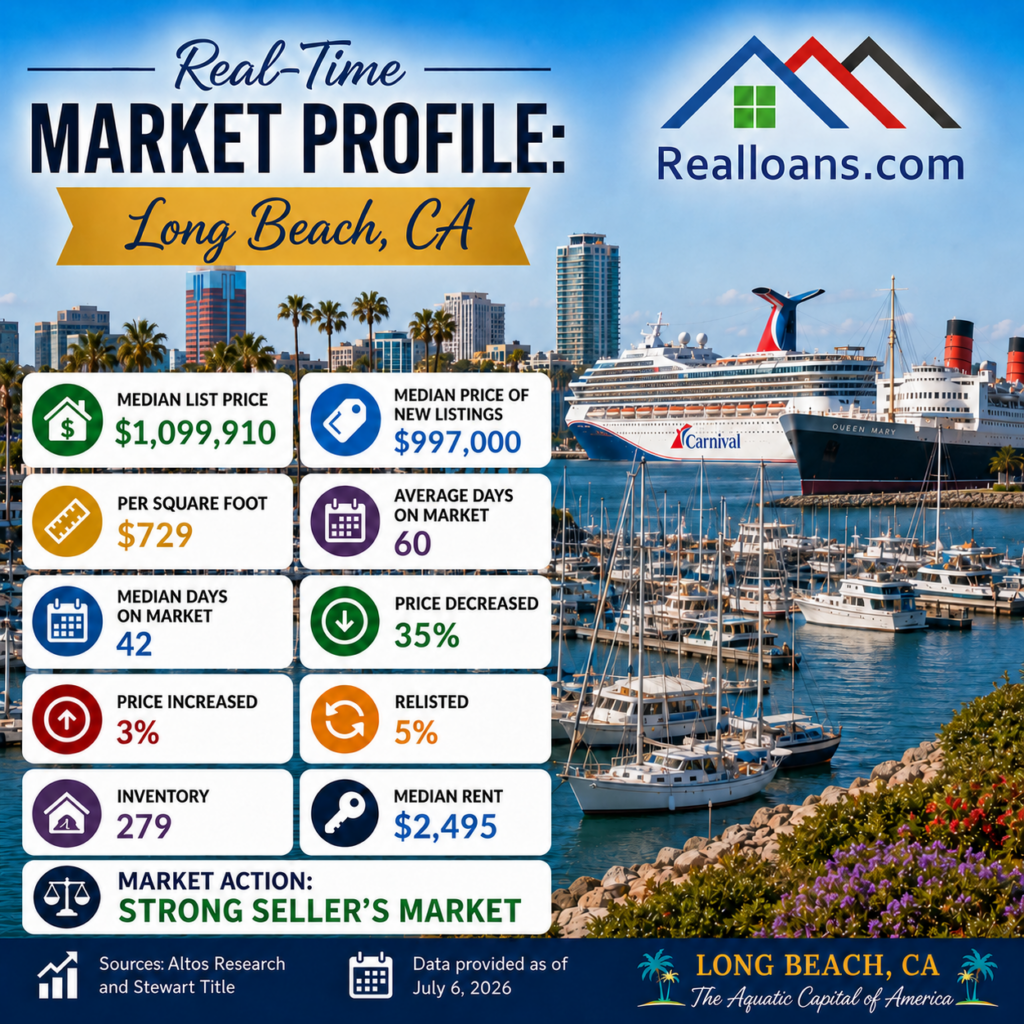
So-Cal City Spotlight: Long Beach (“Aquatic Capital of America”)

Could Long Beach be considered as the most “affordable unaffordable beach city” in Southern California? How can this seemingly contradictory “affordable unaffordable” oxymoron be true at the exact same time?

Let’s take a closer look at the amazing city of Long Beach:

The Top 4 Most Unaffordable Housing Regions in the World

The Top 4 Least Affordable Housing Regions in the World (home price-to-household income ratio) are all located in California:

1. San Jose
2. Los Angeles
3. Long Beach (2nd largest city in Los Angeles County after the City of Los Angeles and 7th largest in the state)
4. San Diego
Source: Remitly

The Top 7 largest California cities are: 1. Los Angeles, 2. San Diego, 3. San Jose, 4. San Francisco, 5. Fresno, 6. Sacramento, and 7. Long Beach.

The most densely-populated area in America is in the Los Angeles-Long Beach-Anaheim metropolitan region, with more than 13 million residents.

Long Beach’s Household Income

While Long Beach is one of the most beautiful regions in the world with a very diverse economy, their home prices are somewhat reasonable as compared with nearby coastal regions in Seal Beach, Huntington Beach, Newport Beach, and Palos Verdes.

This is partly because the median household income range in Long Beach is somewhere within the $87,000 to $91,000 range for one, two, or more worker occupants in the same household.

This is a core reason why Long Beach was listed as the #3 most unaffordable housing regions in the entire world on a home price-to-household income ratio basis.

Long Beach and San Pedro (both described as the Port of Los Angeles) are the shipping port capitals here in America. In early 2026, Long Beach processed more shipped goods than any other port in North America.

Long Beach will host at least 11 different sporting events in 2028 when the Los Angeles Olympics takes place. As a result, new construction continues onward at a rapid pace with venues such as the Long Beach Amphitheater (largest waterfront venue on the West Coast with an 11,000 person capacity) that just opened in June 2026, which is right adjacent to the historic Queen Mary ship.

Quality of Life, Prime Locations, and Massive Home Price Gains

Southern California residents benefit from living in one of the most scenic locations on the planet, right adjacent to the world’s largest body of water called the Pacific Ocean. Yet, they also can grab their snow skis or snowboards and drive up to Big Bear Mountain in San Bernardino County on the same day when they surfed a wave earlier in the morning by the Huntington Beach Pier.

Some of the most amazing golf courses in the nation are located in Southern California, especially in the Newport Coast at Pelican Hills, Torrey Pines in La Jolla, Riviera Country Club in Pacific Palisades, Canyon Lake Golf & Country Club, or at more than 100 different golf courses in the Coachella Valley (Palm Springs, Palm Desert, Rancho Mirage, La Quinta, etc.).

I’m not sure that any other home region in America had a better +3,361% home price gain between 1971 and 2026 than Southern California. Even if there were a region with a more impressive home price percentage gain, it’s highly doubtful that their year-round climate and quality of life were better than in Southern California.

To learn more details about the benefits of living and investing in Southern California, please join my So-Cal Real Estate Club where we primarily meet in Canyon Lake, Long Beach, and online.


Rick Tobin has worked in the real estate, financial, investment, and writing fields for the past 30+ years. He’s held eight (8) different real estate, securities, and mortgage brokerage licenses to date and is a graduate of the University of Southern California.

Rick provides creative residential and commercial mortgage solutions for clients across the nation. He’s also written college textbooks and real estate licensing courses in most states for the two largest real estate publishers in the nation; the oldest real estate school in California; and the first online real estate school in California.

Please visit his website at Realloans.com for financing options, join his investment group at So-Cal Real Estate Investors, and follow his new So-Cal Real Estate TV channel for more details.


Rick Tobin
Realloans (Real Estate Loans)
https://realloans.com/
Phone or Text: (760) 485 – 2422
NMLS 1934868
Equal Housing Opportunity / Equal Housing Lender
To quickly apply online: Loan Application
For our real estate course: Learn Real Estate

Please follow our new real estate channel (watch on television, computers, and phones): So-Cal Real Estate TV

Our Facebook business pages: Realloans, Inside Los Angeles, Inside Pacific Palisades, Inside Long Beach, Inside Huntington Beach, Inside Orange County, Inside La Jolla, Inside San Diego, Inside Lake Elsinore, Inside Temecula Valley, Inside Coachella Valley, and So-Cal Real Estate Investors.

Here are some of my articles: The Fall of 2025 and Rise of New Opportunities, The Intersection of Declining Home Sales and Creative Marketing, Are Lower Rates on the Horizon?, Weather Extremes, Homes, and Insurance Risks, The California Gold Rush Boom, and Are You Focused on Commercial Real Estate?

Please join my So-Cal Real Estate Investors group that meets at Canyon Lake Golf & Country Club, Shoreline Yacht Club in Long Beach, and online: So-Cal Real Estate Investors.

Be a VIP Guest at Our In-Person Summit on Sept. 26th in Costa Mesa, Calif.

Join Investors from Across the Country-
Learn In Person in Southern California!

Make sure to join us for Realty411’s NEW Summit where the latest knowledge, strategies and information on real estate investing is shared. Realty411’s News, Trends & Strategies Summit is a one-day impactful conference designed to help guests achieve success in real estate and beyond.

Join us on Saturday, September 26th, starting at 10 AM. DOORS OPEN AT 9:30. Be sure to attend this one-day complimentary event featuring timely REI insight, top educators, and active local and out-of-state investors.

Parking and admission are FREE. Real estate investors, agents/brokers, private lenders, entrepreneurs, property managers, wealth builders and business owners…this event is designed just for YOU. This event will be in multiple rooms with a vendor area. Network with real estate exhibitors and connect with company professionals. Our network of like-minded business wants to help YOU succeed.

Realty411’s News, Trends & Strategies Summit is being held at:

CROWNE PLAZA COSTA MESA ORANGE COUNTY
3131 Bristol St, Costa Mesa, CA 92626
The venue is near John Wayne Airport.

Tell your associates, friends & family to register as our VIP GUEST.

A VIP ticket with this SPECIAL LINK includes: coffee/tea, multiple magazines, delicious food, and a private virtual session after the in-person event. This VIP ticket is only available for a LIMITED time — Please reserve your spot now!


Network with Fantastic Companies and Like-Minded Real Estate Investors from throughout California and the Nation at Realty411’s Latest Event!

Join Real Estate Investors, Real Estate Professionals, Wealth-Builders and Entrepreneurs from Throughout California & Out of State in beautiful Costa Mesa.

Our REALTY411.com Summit is where the latest knowledge, strategies, and information on real estate investing is shared. Be sure to reserve your tickets to our latest special event: “Realty411’s News, Trends & Strategies Summit”. This one-day impactful conference is designed to help guests achieve success in real estate investing and beyond.

Be sure to attend this one-day complimentary event featuring timely REI insight, top educators, and active local and out-of-state investors. Friends, join us early for best seating and networking.

Parking and admission are FREE.

Real estate investors, agents/brokers, private lenders, entrepreneurs, property managers, wealth builders and business owners… this event is just for YOU.

If you are serious about personal finance, join us to learn about top markets, success strategies, insider tips, and so much more. The latest edition of Realty411 magazine will be available, as well as past editions, too.

SELF PARKING FOR THIS EVENT IS FREE ONSITE- Plus, there is plenty of parking with overflow parking available nearby.

Watch our promo video: https://youtu.be/LkAAfTRCrWc


Since 2007, Realty411.com has assisted top companies expand their visibility and grow their business. Contact us for a complimentary marketing session, CLICK HERE.

NEW Virtual Session: Create Income You Will Never Outlive – Key Insight on Retirement Planning

Thank you for being a member of our network. Our mission is to provide our readers with valuable insight to help them navigate the journey of life, business, and investing.

With this in mind, get ready for an ONLINE educational review on Retirement Planning on June 11th at 6 PM PT / 9 PM ET. For this virtual session, our educator will provide key insight on creating an income to help professionals retire safely and securely.

Overview

Learn from Kris Miller, CEO of Legacy Wealth, as shares important information about retirement planning. Don’t outlive your income, register for this webinar.

Kris Miller, LDA — Legacy Wealth Strategist & Founder, Healthy Money Happy Life

For 36+ years, she’s guided 6,000+ families, safeguarding over $2.5 Billion—and not a single client has lost a dime due to market downturns.

Kris Miller is the author of the #1 bestselling book, “Ready for PREtirement: 3 Secrets to Safe Money and a Fabulous Future.”

Kris is the founder of Healthy Money – Happy Life, and she teaches hard-working people like us how to protect our money and ensure that we’ll have enough to live well even if we choose to retire.

The secrets she has to share are rarely discussed outside the 1%. But you don’t have to be a billionaire… yet, to take advantage of what Kris is going to share with us today.

Her promise is practical and transformative: create income you can never outlive, align money with purpose, and live your legacy now—no matter the market.

Proof: 6,000+ families protected • $2.5 Billion safeguarded • Not a single client has lost a dime due to market downturns.

Virtual Session Details:
📅 Date: Thursday, June 11th, 2026
⏰ Time: 6:00 PM PT / 7:00 PM MT / 8:00 PM CT / 9:00 PM ET

How Smart Upgrades Can Boost Your Rental Income and Property Value

By Beth Harris

For investment property owners managing older units, competitive listings, and limited cash for renovations, the hardest part is deciding what to upgrade without eroding returns. The core tension is real: increasing rental property appeal often means spending money upfront, while investment property value challenges punish the wrong choices for years. ROI-friendly property improvements require a sharper filter than “looks nice,” because every cost-effective property upgrade has to earn its keep in rent, retention, and resale. The payoff is a clearer way to spot improvements that tenants notice and the market rewards.


Prioritize Upgrades That Tenants Notice (and You Can Justify)

If you’re trying to make your rental look better without sacrificing ROI, the win is picking upgrades that photograph well, live well, and hold up to real tenant wear. Use this menu as a “spend where it shows” checklist, starting with fast, controllable improvements and moving toward higher-impact refreshes.

1. Install durable, continuous flooring in high-traffic zones: Replace mixed, dated surfaces with one tough material through the main living areas to make the home feel larger and newer. For flooring installation options, consider luxury vinyl plank (water-resistant, easy repairs by replacing a plank), mid-grade laminate (budget-friendly but watch moisture), or refinished hardwood (best when the subfloor is already solid). Prioritize entry, living room, and hallways first, where scuffs and photos both matter most.

2. Upgrade lighting for brightness and consistency (not just “new fixtures”): Swap mismatched bulbs for one color temperature throughout and add brighter LED bulbs where rooms feel dim. In kitchens and baths, add task lighting, under-cabinet strips or a brighter vanity bar, to reduce shadows and improve the “clean” feel during showings. If budget allows, add a dimmer in living areas and a motion sensor at exterior doors for convenience and security.

3. Add storage solutions renters can feel on day one: Focus on “missing basics” that cause clutter: coat hooks by the entry, a shelf and rod in every closet, and a medicine cabinet or over-toilet cabinet in small baths. In kitchens, add pull-out trash, a few deep drawers (or drawer inserts), and one pantry-style cabinet if there’s dead wall space. Storage is a quality-of-life upgrade tenants notice immediately, and it reduces wear from overcrowded spaces.

4. Tackle energy efficiency upgrades that lower complaints and turnover: Start with air sealing (weatherstripping doors, sealing attic penetrations), a smart or programmable thermostat, and low-flow fixtures, changes that are inexpensive and quick to verify. If you’re replacing equipment anyway, prioritize HVAC tune-ups, clean dryer venting, and attic insulation where it’s thin. Keep a simple one-page “utility saver” sheet in the unit so tenants use features correctly and don’t blame the property for high bills.

5. Refresh the kitchen with “minor remodel” moves you can price rationally: Instead of gutting, think: paint or refinish cabinets, add modern pulls, install a durable backsplash, and upgrade the sink/faucet to a cohesive finish. If counters are the eyesore, choose one midrange surface that’s easy to clean and hard to chip. A minor kitchen remodel can be a strong value play, especially when you’re fixing the things tenants touch every day.

6. Modernize the bathroom where hygiene and function are obvious: Re-caulk and re-grout, replace yellowed fans, and upgrade the vanity light and mirror for a cleaner look. If the tub/shower is stained but sound, consider refinishing rather than replacing. When you remodel, keep materials simple and replaceable; many reports show a midrange bathroom remodel is projected to bring back 70% of the costs, which supports choosing “durable and neutral” over luxury.

7. Improve landscaping for tenant appeal and easier maintenance: Aim for “neat, not fussy”: edged beds, trimmed shrubs, fresh mulch, and a tidy path to the front door. Replace finicky plants with hardy, drought-tolerant options and add solar path lights for evening showings. If there’s a small patio, define it with gravel or pavers, outdoor usability can justify rent bumps without big interior demolition.

8. Protect your finishes with small, high-ROI durability upgrades: Add doorstops, better bath fans, washable paint in hallways, and quality faucet/shower valves that won’t drip after a year. Use transition strips, corner guards, and kick plates where damage is predictable. This keeps your “after photos” looking good longer and reduces the surprise repairs that can eat the extra rent you worked to earn.

A practical rule: spend first on what tenants see and touch daily, then on what reduces ongoing headaches. When you’re planning upgrades that involve appliances, plumbing fixtures, or HVAC components, it also pays to think through how you’ll handle breakdown risk so the new cash flow isn’t derailed by an expensive repair.

Stabilize Cash Flow After Renovations With Repair-Cost Protection

Once you’ve made tenant-pleasing upgrades, the next threat to your returns is a surprise breakdown that wipes out a month (or more) of cash flow. A home warranty can be a smart investment for a rental property when you’re trying to avoid costly repairs to appliances or major home systems after refreshing finishes and fixtures. Rather than absorbing an unexpected bill when the dishwasher quits or the HVAC fails, you can use home warranties as a layer of protection that helps keep your maintenance budget, and rental income, more predictable. Home warranties are customizable annual service plans that cover repair or replacement of major home systems and appliances, with optional add-ons to help homeowners manage unexpected repair costs due to normal wear and tear.

From there, the key is weighing the likelihood of breakdowns against what you’ve set aside for maintenance so you can decide whether this kind of coverage pencils out before you tackle timing, costs, and risk planning in more detail.


Rental Upgrade Questions Landlords Ask Most

Q: What upgrades usually give the best cost versus value for rentals?
A: Start with durability and daily-use improvements like lighting, flooring that holds up to traffic, and simple kitchen and bath refreshes. Prioritize anything that reduces complaints, speeds turnover, or lowers operating costs. Before spending big, estimate payback using expected rent lift plus fewer vacancy days.

Q: How can I phase renovations between tenants without losing a month of rent?
A: Batch work into a tight “turn window” by lining up contractors before move-out and ordering materials early. Do the messy, high-impact jobs first, then schedule punch-list items after the new lease starts only if they won’t disrupt living. Offering a modest rent credit can be cheaper than an extended vacancy.

Q: What actually drives tenant satisfaction more than fancy finishes?
A: Fast, reliable service often matters more than premium materials. Research comparing physical attributes with service delivery suggests responsiveness can outweigh appearances, so set clear repair timelines and communication habits.

Q: How do I keep upgrades from getting erased by surprise repairs?
A: Build a maintenance calendar and reserve fund, then inspect key systems seasonally. Simple routines that preserve property value reduce costly emergencies and protect your new finishes.

Q: When should I delay an upgrade instead of doing it now?
A: Delay when you cannot recover the cost through rent, retention, or reduced operating risk within a reasonable period. If the current item is safe and functional, put the money toward higher-priority fixes and plan the upgrade for the next turnover.

Turn Smart Upgrades Into Higher Rent and Stronger ROI

When budgets are tight and vacancies are expensive, it’s easy to overspend on the wrong improvements, or postpone updates until returns slip. The better path is the research-backed mindset covered here: treat upgrades as a targeted investment property enhancement summary, prioritize tenant-facing value, and apply improvement strategies that match your renter profile and payback window. Done well, increasing rental income potential pairs with fewer headaches, stronger leasing demand, and maximizing property ROI while landlord confidence building grows with each measured win. The best upgrades are the ones your tenants notice and your numbers confirm. Choose one to three projects with a one-weekend-to-one-month scope, set a firm budget, and schedule the work. That discipline builds a more resilient asset that performs through market shifts.


Beth Harris

As the founder of businesstipscenter.com, Beth Harris knows a thing or two about making smart business decisions. She founded her company with the goal of providing entrepreneurs with an all-access platform full of business resources and tips. Beth understands that every day brings new opportunities to make the best decisions possible for your business. That’s why she’s dedicated to making it happen.

Understanding Risks of Affiliate In-House Brokerage Referrals or Kickbacks

By Rick Tobin

In today’s world, there are seemingly monopolies growing in almost every field where a product or service is offered. If so, it’s the consumer who ends up paying more money due to less competition.

Whether it’s one, two, three, five, or 10 companies or corporations controlling the market share for products or services like soda drinks, electric cars, electricity, AI technologies, ice cream, banking, or real estate, the declining number of competition for many of these mega-corporations worth billions or trillions can keep the prices higher than normal for consumers.

As most of us see firsthand on a daily basis, inflation rages onward as the dollar’s purchasing power keeps declining, and the prices paid for products or services skyrockets. Who doesn’t want to pay less money for a product or service instead of seeing corporations create more record profits?


Increasing Litigation Concerns for Employers and Agents

We’re starting to see more and more lawsuits filed across the nation that are making similar claims about unfair monopoly-like control of various product or service sectors. Additionally, there are anti-steering violation allegations being made that may include the same in-house real estate brokerage ownership of affiliate companies that are also financially benefitting, while consumers are paying higher costs as a result.

For example, this recent lawsuit filed against Rocket Mortgage by the law firm Hagens Berman on behalf of numerous consumers focuses on potential anti-steering and kickback violations with larger lenders, brokerage firms, and their third-party affiliates. One core claim made in this lawsuit was that Rocket was possibly paying referrals to agents for buyer mortgage applicants in exchange for steering them towards Rocket.

Hagens Berman, which also represented home sellers in a class-action lawsuit against the National Association of Realtors that alleged real estate brokerage companies were conspiring to inflate real estate commissions and later settled in 2024 for $418 million, has yet to prove anything in court against Rocket as of this publication date. In a court of law, one is innocent until later proven guilty or the case settles out of court.

There are other lawsuits out there being filed against real estate brokerage firms, insurance offices, and other companies that are making claims that the client’s best interests aren’t being protected because they may be paying much higher mortgage rates and fees that are split amongst the affiliate businesses under the same corporate ownership interests.

If the parent company is named as a defendant in a lawsuit, the odds are quite high that the employed individual real estate agent who worked directly with the unhappy client will be named in the costly lawsuit as well.

Anti-Steering Risks and In-House Affiliates

Anti-steering laws, primarily under the Truth-in-Lending Act (TILA/Regulation Z) and the Dodd-Frank Act, prohibit mortgage originators from steering borrowers towards loans with less favorable terms to gain higher compensation or profits. Brokers are required to present loan options with the lowest interest rate, points, and fees that are the safest for their borrower clients.

If you can visualize someone “steering” in a car, or leading them by a figurative hand, to an affiliate third-party lender owned by their same employing broker, while knowing that the rates and fees are generally higher than nearby independent mortgage brokers, this is an easy way to simplify it.

Let’s take a closer look at Reg Z regulations:

From the Federal Reserve’s website:
Regulation Z: Loan Originator Compensation and Steering

“The Truth in Lending Act

The Truth in Lending Act (TILA) is implemented by the Board’s Regulation Z (12 CFR Part 226). A principal purpose of TILA is to promote the informed use of consumer credit by requiring disclosures about its terms and cost. TILA also includes substantive protections. For example, the act and regulation give consumers the right to cancel certain credit transactions that involve a lien on a consumer’s principal dwelling.

Regulation Z also prohibits specific acts and practices in connection with an extension of credit secured by a consumer’s dwelling.

Prohibitions related to mortgage originator compensation and steering

Regulation Z prohibits certain practices relating to payments made to compensate mortgage brokers and other loan originators. The goal of the amendments is to protect consumers in the mortgage market from unfair practices involving compensation paid to loan originators.

The prohibitions related to mortgage originator compensation and steering apply to closed-end consumer loans secured by a dwelling or real property that includes a dwelling.”

Anti-Discrimination Claims

Now, let’s focus on how potential monopolies and the control of in-house third-party services in sectors like the real estate, insurance, and mortgage fields can drive prices higher for consumers in spite of the potential violation of RESPA, the Fair Housing Act, the Sherman Anti-Trust Act of 1890, and other federal and state regulations.

To simplify for the Fair Housing Act (Federal Fair Housing Act of 1968), it originated as part of the Civil Rights Act (Title VIII). This Act prohibits discrimination in the sale, rental, financing, or housing based on race, color, religion, gender, national origin, familial status, or disability.

As per the Fair Housing Act, the higher charging of rates or fees for real estate commissions, mortgage brokerage fees, insurance, or other third-party affiliate services offered by the same parent umbrella-like corporation can be alleged by some to be discriminatory as well as fraudulent.

As I’ve shared before, I’ve written numerous real estate licensing courses in most states as well as college textbooks for the two largest real estate publishers in the nation as well as for the oldest and best-known real estate school in California.

Lawsuits filed that allege the violation of discrimination can later lead to millions of dollars’ worth of future courtroom judgments. It’s very wise to research any potential state or federal violation risks associated with referring a client to an affiliate business, while profiting at the same time with undisclosed financial gains, in order to minimize your financial and legal risks.

I’ve often asked for many years the following question, “How do so many large real estate brokerage offices own and control affiliate in-house mortgage, escrow (a key description is usually “independent” and “neutral”), insurance, and/or inspection businesses and not potentially violate various anti-monopoly or anti-steering laws?”

RESPA and Kickbacks

It’s unlawful for a licensed real estate, insurance, or mortgage professional to receive profits or referrals from a transaction that aren’t fully disclosed in writing and shared with the client. These hidden “kickbacks” or undisclosed profits can later be used in a lawsuit and also put someone’s professional license at risk for being suspended or revoked.

Here is how the National Association of Realtors describes RESPA:
What is the Real Estate Settlement Procedures Act (RESPA)?

The Real Estate Settlement Procedures Act (RESPA) provides consumers with improved disclosures of settlement costs and to reduce the costs of closing by the elimination of referral fees and kickbacks.

RESPA was signed into law in December 1974, and became effective on June 20, 1975. The law has gone through a number of changes and amendments since then, all with the intent of informing consumers of their settlement costs and prohibiting kickbacks that can increase the cost of obtaining a mortgage.

RESPA covers loans secured with a mortgage placed on one-to-four family residential properties.”

Monopolies Harm Consumers

The more competition there is from numerous businesses offering similar products or services, the more likely that the prices will be lower and better for consumers.

A monopoly may exist when a single company or corporation has exclusive control over a product or service in a market region with minimal competition, partly due to their actions that make it more challenging for customers to seek out other products or services. If so, this allows the business to charge much higher prices because of the perceived limited access to other product or service choices.

After the passage of the Sherman Anti-Trust Act of 1890, it gave more power to the federal government to bring legal action against trusts or other entities that were declared “in restraint of trade or commerce among the several states, or with foreign nations.” Initially, this law was passed to slow down JP Morgan and John D. Rockefeller’s consolidation of wealth by way of multiple industry monopolies across the nation.

The merging of more and more large brokerage and financial companies across the nation seems to be creating an increasing number of monopolies in these fields. How is this truly fair and in a clients’ best interests to have fewer choices, while paying higher costs?

Duties and Clients’ Best Interests

Licensed real estate professionals owe their clients certain fiduciary duties or legal obligations to act in their clients’ best interests. Many times, these fiduciary duties owned by a real estate agent to their clients can be summarized by the acronym OLDCAR as follows:

Obedience: Carrying out all lawful instructions requested by the client.

Loyalty: Placing the client’s interests above all others, including the agent’s own.

Disclosure: Revealing all known or potential risks such as property defects, outdoor environmental concerns, competing offers, or agent relationships with others.

Confidentiality: Keeping client information, such as financial information or motivation, confidential, even after the relationship ends.

Accounting: Safeguarding and reporting all money or documents entrusted to the agent.

Reasonable Care and Diligence: Acting with skill, care, and diligence in order to protect the client.

If an agent knows that rates and fees charged for in-house mortgages, insurance, or other services are higher than other nearby services offered by independent companies, this seems to not closely follow the “acting in the client’s best interest” mantra or duty owed.


The Benefits of Smaller Mortgage Companies

Here are some key points where smaller independent mortgage brokers may be the best choice for buyers, sellers, and advising real estate agents:

● Overhead costs are much lower for small mortgage shops. For some larger corporate real estate brokerage firms, they may be faced with hundreds of thousands to millions of dollars’ worth of monthly expenses that they must cover from multiple revenue streams related to all of their third-party affiliates.
● Because the monthly overhead costs are lower for small mortgage shops, many of them can afford to offer the lowest rates and fees to their borrowers.
● Small mortgage shops typically move much quicker than larger retail mortgage lenders and can close loans in two weeks or less.
● Smaller mortgage shops usually have much more experienced mortgage brokers working there with upwards of decades’ worth of experience. Anyone who can survive the ups and downs or the mortgage brokerage world for more than five or 10 years must be doing something right.
● Experienced and independent mortgage brokers are more likely to have purchased real estate themselves and can be much more helpful advising their clients and agents through the closing process.

When in doubt as it relates to your clients, please remember to “disclose, disclose, and disclose” all of your financial interests and potential profits as well as truly act in your clients’ best interests by referring them to your most trusted and affordable mortgage brokers or other third-parties.


Rick Tobin

Rick Tobin has worked in the real estate, financial, investment, and writing fields for the past 30+ years. He’s held eight (8) different real estate, securities, and mortgage brokerage licenses to date and is a graduate of the University of Southern California.

Rick provides creative residential and commercial mortgage solutions for clients across the nation. He’s also written college textbooks and real estate licensing courses in most states for the two largest real estate publishers in the nation; the oldest real estate school in California; and the first online real estate school in California.

Please visit his website at Realloans.com for financing options, join his investment group at So-Cal Real Estate Investors, and follow his new So-Cal Real Estate TV channel for more details.


Rick Tobin
Realloans (Real Estate Loans)
https://realloans.com/
Phone or Text: (760) 485 – 2422
NMLS 1934868
Equal Housing Opportunity / Equal Housing Lender
To quickly apply online: Loan Application
For our real estate course: Learn Real Estate

Please follow our new real estate channel (watch on television, computers, and phones): So-Cal Real Estate TV

Our Facebook business pages: Realloans, Inside Los Angeles, Inside Pacific Palisades, Inside Long Beach, Inside Huntington Beach, Inside Orange County, Inside La Jolla, Inside San Diego, Inside Lake Elsinore, Inside Temecula Valley, Inside Coachella Valley, and So-Cal Real Estate Investors.

Here are some of my articles: The Fall of 2025 and Rise of New Opportunities, The Intersection of Declining Home Sales and Creative Marketing, Are Lower Rates on the Horizon?, Weather Extremes, Homes, and Insurance Risks, The California Gold Rush Boom, and Are You Focused on Commercial Real Estate?

Please join my So-Cal Real Estate Investors group that meets at Canyon Lake Golf & Country Club, Shoreline Yacht Club in Long Beach, and online: So-Cal Real Estate Investors.

Realty411 Investors: Bruce Norris’ Biggest Forecast in Decades — Live Feb 7

Dear Investor,

As a Realty411 reader and real estate investor, you know the most profitable opportunities often come before the headlines—when you have the right data and the right perspective.

That’s why we’re inviting you to join Bruce Norris, renowned market-timing expert and founder of The Norris Group, as he releases his most anticipated real estate forecast in decades:

Beyond Uncharted: What’s Next Has Never Happened

📍 Ontario Convention Center (Ontario, CA)
📅 Saturday, February 7, 2026 | 8:00 AM – 5:00 PM
💵 $597

👉 Reserve your seat now:
https://go.thenorrisgroup.com/beyond

Use Coupon Code: REALTY411 to save $100 off your ticket

Ontario, CA — February 7, 2026

This event marks the 20th anniversary of Bruce Norris’ pivotal “California Crash” study, and the debut of a groundbreaking new report that explains where California’s housing market is headed—and why the coming cycle may look unlike any before it.

For more than 30 years, Bruce has earned a reputation for calling market turns with remarkable precision. His previous forecasts—The California Crash, California Comeback, Turmoil, Proceed with Caution, Tip of the Iceberg, and Uncharted Territory—alerted investors and policymakers to major shifts long before the mainstream caught on.

Now, with affordability metrics hitting historic lows, debt rising, and demographic shifts reshaping demand, Bruce believes 2026 represents a turning point with conditions “never before experienced in California real estate.”

Why This Matters to Investors

Unlike any prior cycle, today’s convergence of affordability, global debt, demographics, policy changes and AI is setting the stage for outcomes that have “never happened before,” according to Bruce.

This report isn’t just about predicting prices—it’s about understanding risk, strategy, and opportunity in a market where the past may no longer apply.

What You’ll Learn at Beyond Uncharted

Bruce will break down the forces that could reshape the next cycle, including:

✅ California affordability plunging to 17% and below
✅ Household budgets under strain and defaults on the rise
✅ Why some media narratives may be downplaying risk
✅ The impact of Federal Reserve policy and mounting U.S. debt
✅ The potential for shifts in the dollar’s global status and real estate values
✅ Looming inventory shocks that could shift pricing and velocity
✅ How tomorrow’s buyers will look vastly different than past generations
✅ The coming AI revolution and its effect on real estate and the economy
✅ Why investor psychology + migration trends may amplify volatility

If you invest in real estate—or plan to—this is your opportunity to get ahead of the next market move with the kind of insight that Realty411 readers value most: real analysis, real numbers, and real strategy.

👉 Register here:
https://go.thenorrisgroup.com/beyond

Best,

Joey Romero
SVP, Operations
The Norris Group & DBL Capital
4160 Temescal Canyon Rd, Ste 401
Corona, CA 92883
Direct: (951) 823-8266
Main: (951) 780-5856
Fax: (951) 780-9827
www.thenorrisgroup.com
CA BRE #: 02038615
NMLS #1641959