

Is Your Job a Dead End? How to Know and What to Do Next
By Dan Harkey
A practical guide to diagnosing a dead-end workplace, protecting your professional standing, and executing a disciplined exit on your own terms.
Most people who are stuck in a bad job know it. What they don’t know is whether they’re dealing with a rough patch that will pass or a structural problem that will never get better. That distinction determines everything about what you should do next.

Challenging Versus Broken: The Question That Actually Matters
A demanding workplace is not the same as a dead-end one. Companies under pressure from rapid growth, new competition, leadership transitions, or economic downturns can feel chaotic without being hopeless. Difficulty with a purpose can sharpen your judgment, expand your capabilities, and prepare you for more responsibility.
A dead-end organization is different. It consumes your energy without increasing your authority, skills, compensation, or market value. The dysfunction isn’t a temporary condition. It’s the operating model.
The warning signs are usually visible once you know what to look for:
- A rigid, top-down structure controlled by a single leader who tolerates no challenge
- Priorities that shift without explanation or logic
- Decisions that are made and then reversed repeatedly
- Constant employee turnover
- No meaningful path to advancement
- Little or no professional development
- Persistent pressure with no coherent strategic purpose behind it
- Employees who survive by staying quiet rather than contributing
- Responsibility assigned without the authority to carry it out
- Loyalty demanded from employees but rarely extended back to them
article continues after advertisement

One or two of these conditions may be temporary. When several become permanent features of daily life, you are probably not in a difficult job. You are in a dead-end one.
Before making any move, ask yourself a sharper set of questions:
- Do priorities change because conditions changed, or because leadership cannot make and hold decisions?
- Are strong employees being developed, or are they steadily leaving?
- Does strong performance create opportunity, or only more work?
- Can employees raise valid concerns without retaliation?
- Are mistakes treated as learning opportunities or occasions for blame?
- Am I gaining marketable skills, influence, compensation, or credibility?
- If nothing changes over the next two years, will staying strengthen or weaken my career?
That last question tends to cut through the noise. Don’t judge the job only by what it costs you today. Judge it by where it is taking you tomorrow.
Stop Trying to Fix a System You Don’t Control
High-performing employees tend to make the same mistake in dysfunctional organizations: they believe that working harder can compensate for poor leadership. They put in longer hours, take on extra assignments, steady their coworkers, and try to create order where none exists.
The intentions are good. The strategy almost never works.
You cannot repair an organization whose leaders tolerate dysfunction. You cannot build stability when those in control benefit from keeping people uncertain. You cannot build cooperation under a leader who treats honest disagreement as disloyalty. Continuing to pour energy into problems you have no authority or resources to solve is not dedication. It is a slow drain on your professional capital.
This doesn’t mean becoming careless or cynical. It means recognizing the boundary between your responsibilities and the organization’s failures, and stopping well short of the line where sacrifice becomes self-destruction.
A difficult job can build your career. A dead-end job slowly consumes it. Wisdom lies in knowing the difference.
Step 1: Enter Professional Protection Mode

Protection mode is not disengagement. It means doing your job well while deliberately separating your professional identity from the organization’s disorder.
Set Boundaries on What You Accept
Continue meeting legitimate deadlines. Communicate clearly. Stay dependable on the work you are actually responsible for. At the same time, stop automatically absorbing assignments that:
- Have no clear objective
- Assign responsibility without authority
- Change repeatedly without documentation
- Consume personal time without meaningful benefit
- Add no new skills, compensation, visibility, or advancement
- Exist primarily because leadership won’t set priorities
Extra work is worthwhile when it builds professional capital. It becomes exploitation when poor management shifts its consequences onto the most responsible people in the room.
Don’t Absorb the Organization’s Instability as Your Own Failure
When leadership changes direction daily, employees often start doubting their own competence. Don’t let that happen. A reversed instruction does not mean you misunderstood the original direction. A canceled project does not diminish the quality of your work. An unpredictable leader’s dissatisfaction is not always a fair measure of your performance.
You are responsible for your preparation, your communication, and your execution. You are not responsible for leadership’s inability to set a coherent strategy.
Document What Matters

In unstable organizations, institutional memory becomes selective. People forget instructions, rewrite them, or deny them when the outcome is inconvenient. Keep businesslike records of key assignments, material instructions, approved changes, project milestones, completed work, performance results, and any positive feedback you receive.
After important verbal discussions, send a brief written confirmation. Something like: “To confirm our discussion, I will proceed with Option B and submit the revised proposal by Thursday. Please let me know if I misunderstood the direction.” Keep the tone factual and professional. The goal is to preserve accuracy, not to build a case file for every disagreement.
Respect company confidentiality, privacy obligations, and record-retention rules. Do not remove proprietary information or records you are not entitled to possess.
Step 2: Conduct a Personal Career Audit

Before starting a search, get clear on what you want to leave behind and what you actually want to build next. Moving from one dysfunctional workplace to another is not advancement. Take an honest look at five areas:
Marketable Skills
List your current skills and compare them against the requirements for the roles you want. Identify gaps in technical skills, certifications, software proficiency, management experience, communication, industry knowledge, revenue-generating ability, and project leadership. Your current employer may not invest in your growth. That does not excuse you from investing in yourself.
Documented Accomplishments
A résumé should prove value, not just list responsibilities. “Responsible for managing client accounts” tells a prospective employer almost nothing. “Managed a client account portfolio, improved response procedures, and helped preserve key business relationships” tells them something real. Use accurate numbers when you have them, and never invent results. Credibility is worth more than exaggeration.
Professional Reputation
Ask former colleagues, clients, vendors, and industry contacts how they would characterize your work. Your strongest career protection is a reputation that stands completely apart from your current employer’s dysfunction.
Financial Readiness
Estimate how long you could meet your essential obligations if your employment ended today. Review your available savings, fixed monthly expenses, health insurance situation, debt obligations, family responsibilities, contractual restrictions, and accrued compensation. Financial reserves create negotiating power. Financial desperation destroys it.
Desired Working Environment
Define the conditions you want in your next role before you start evaluating offers. Consider whether you want collaborative or independent work, a stable or entrepreneurial environment, clear hierarchy or decentralized decision-making, advancement opportunities, geographic flexibility, and reasonable authority that matches your assigned responsibilities. If you don’t set standards in advance, a higher salary will tempt you to overlook the same warning signs you’ve already lived through.
Step 3: Run the Job Search Like a Business Project

Once you’ve determined the workplace is a genuine dead end, treat the search with the same discipline you’d apply to any serious project.
Update Your Professional Materials
Prepare a results-focused résumé, a brief professional biography, an updated LinkedIn profile, a list of meaningful accomplishments, work samples you are legally permitted to share, professional references, and a clear explanation for why you are considering a move. Present yourself as a capable professional moving toward a stronger opportunity, not as someone escaping a bad situation.
Build an External Network
Online applications alone are not a strategy. Reconnect with former supervisors, former colleagues, clients, vendors, professional associations, industry groups, alumni networks, recruiters, and trusted advisers. Networking is not a distress signal. It is a disciplined effort to restore professional visibility and identify organizations worth joining.
Create Weekly Search Discipline
Set measurable weekly goals: contact professional connections, research target organizations, submit carefully selected applications, speak with recruiters, develop a marketable skill, prepare for interviews, and review your progress. A search driven by frustration will be inconsistent. A project-based approach produces information, options, and leverage.
Conduct your search on your own time and personal devices. Do not misuse company equipment, accounts, confidential information, or paid working hours.
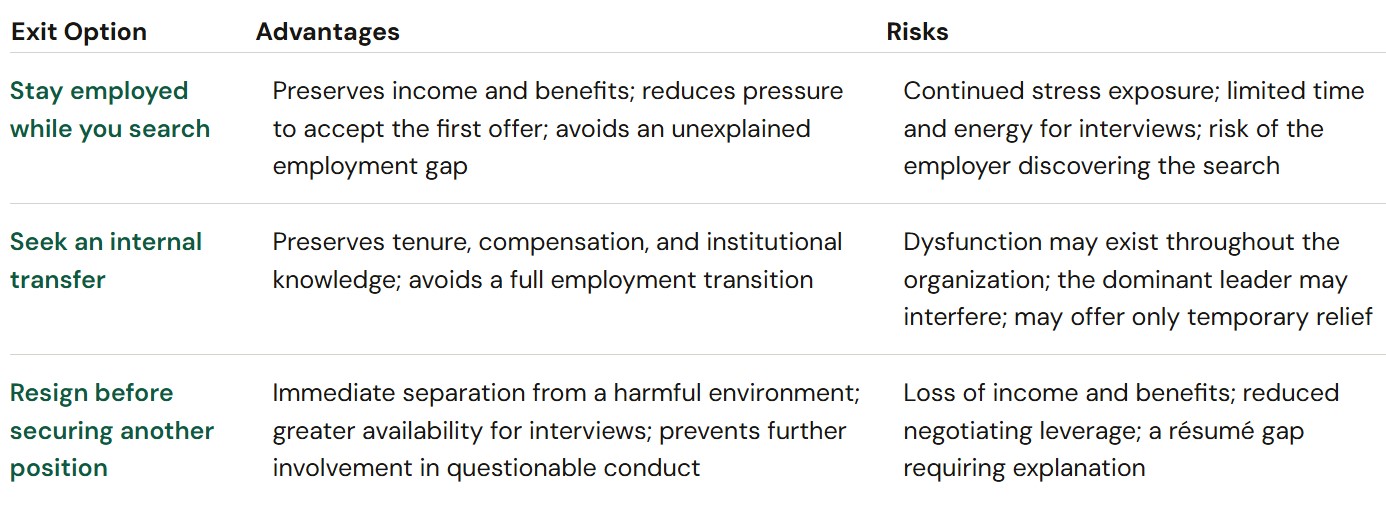
Step 4: Choose the Right Exit Strategy

There is no single correct way to leave. Your choice should reflect your health, finances, career risk, family obligations, and realistic alternatives.
Step 5: Control the Narrative of Your Departure
Staying employed while you search is usually the most financially conservative approach. Calling that “quiet quitting” misses the point. The better standard is professional containment: do the job properly, stop subsidizing dysfunction with unlimited personal sacrifice, and build your next opportunity in parallel.
If legal rights, discrimination, retaliation, harassment, unpaid compensation, safety, licensing, or contract obligations may be involved, consult a qualified professional. Don’t rely on workplace rumor or general internet commentary for guidance on those matters.
Prospective employers will ask why you want to leave. That question is not an invitation to describe everything wrong with your current employer, even when your criticisms are completely accurate. Justified grievances can sound like poor judgment when they become too personal, too detailed, or too negative.
Don’t say: “Management is toxic, no one knows what they’re doing, and the owner changes direction every day.”
Say instead: “I’ve learned a great deal in my current role, and I’m looking for an organization with clearer long-term priorities, more collaborative decision-making, and stronger opportunities for professional growth.”
Another strong answer: “I’m ready for a role where I can contribute at a higher level, own clearly defined objectives, and continue growing within a stable organization.”
Keep the answer truthful, brief, and forward-looking. You’re not concealing reality. You’re demonstrating professional judgment.
article continues after advertisement

Step 6: Interview the Employer, Not Just the Role
Many applicants focus entirely on being selected. Experienced professionals also evaluate whether the employer deserves to be selected. Ask pointed questions:
- Why is this position available?
- How long did the previous person stay in the role?
- What does success look like in the first year?
- How are priorities established and communicated?
- How often do major priorities change?
- What authority comes with the position’s responsibilities?
- How does the organization respond when employees challenge an assumption?
- How are strong performers prepared for advancement?
- How would the team describe the manager’s leadership style?
Don’t just listen to the words. Notice whether the answers are specific, consistent, and supported by examples. Evasive answers, contradictory explanations, high turnover, vague authority, unrealistic expectations, and heavy emphasis on “loyalty” without any visible evidence of employee development are all reasons to keep looking.
A Practical 30-Day Exit-Readiness Plan
Week 1: Stabilize. Set firm work boundaries. Document material instructions and accomplishments. Review your finances. Avoid emotional confrontations or impulsive decisions about resigning.
Week 2: Reposition. Update your résumé and professional profile. Identify target roles and skill gaps. Prepare accomplishment examples with measurable results. Build a private list of references and contacts.
Week 3: Reconnect. Contact trusted former colleagues and industry contacts. Research prospective employers. Speak discreetly with suitable recruiters. Begin selective applications.
Week 4: Execute. Practice your explanation for leaving. Prepare questions for prospective employers. Evaluate any offers against leadership quality, stability, authority, growth potential, and compensation. Plan a professional transition that protects your relationships and your reputation.
Don’t Let Loyalty Become Self-Abandonment

Loyalty is admirable when it is mutual and attached to a worthy mission. It becomes destructive when it requires you to sacrifice your health, judgment, professional growth, or future employability for an organization that has no intention of improving.
You don’t owe any employer permanent access to your energy because it once gave you an opportunity. Employment is an exchange of value. Both parties should benefit from that exchange.
Do your work honorably. Fulfill your legitimate commitments. Protect confidential information. Leave professionally, without bitterness. But leave when the evidence makes clear that staying no longer builds your future.
A paycheck can keep you in a role long after the role has stopped advancing your career. Income pays today’s bills. Professional growth protects tomorrow’s options.
Your goal is not simply to escape a bad employer. It is to move toward better leadership, greater responsibility, and a future where your effort increases your value instead of only increasing your exhaustion. Don’t spend years proving you can survive in a place where you were never meant to grow.

Dan Harkey
Educator & Private Money Real Estate Lending Consultant
[email protected] 949 533 8315
www.danharkey.com