Retirement doesn’t have to mean stepping away from building wealth, and for a growing number of seniors, house flipping has become an appealing second act. It draws on skills many people have spent decades developing, budgeting, negotiating, project management, patience, and turns them into a hands-on business with real financial upside. The learning curve is real, but age is far less of a barrier than most people assume.
House flipping for seniors means buying undervalued properties, renovating them strategically, and reselling for a profit, using retirement savings, home equity, or partnerships to fund the work. Many seniors are well suited to this business because they often have more capital, patience, and negotiating experience than younger first-time investors. Success comes down to realistic budgeting, a reliable contractor network, and choosing projects that match your actual physical capacity.
article continues after advertisement
The short version
Seniors often have financial and negotiating advantages that offset physical limitations.
Budgeting accurately for renovation costs prevents the most common flipping losses.
Building a contractor and inspection team matters more than doing labor yourself.
Starting with one manageable project beats overextending on multiple properties at once.
Advantages seniors bring to house flipping
Existing home equity or retirement savings that can fund a down payment without high-interest loans.
Decades of negotiating experience from major life purchases and career decisions.
More flexible schedules, allowing time for careful vetting instead of rushed decisions.
Established local networks, including contractors, lenders, and real estate agents built over years in one area.
Patience to wait for the right property instead of chasing every listing.
A getting-started checklist for new senior flippers
Set a firm total budget, including a 15 to 20 percent buffer for surprises
Get pre-approved or confirm your funding source, comparingsmall business loan options if you’re not funding the deal from savings alone
Build a short list of licensed, insured contractors before you need one
Choose a starter property that needs cosmetic work, not structural rebuilding
Line up a home inspector and a real estate agent familiar with investment sales
Renovation costs are where most first flips go wrong. Reviewingmajor home repair costs before making an offer helps set realistic expectations for what a fixer-upper will actually require. Systems like HVAC often carry hidden costs too, and if you want a sense of typical replacement part pricing, you canget the gist here before assuming a system just needs a quick patch.
Financing paths worth comparing
Financing option
Best for
Consideration
Home equity loan or HELOC
Owners with significant equity
Lower rates, but puts your home at risk
Cash from savings or IRA
Seniors avoiding debt entirely
Reduces liquidity for other needs
Partnership with a younger investor
Splitting labor and capital
Requires clear profit-sharing terms
Hard money or fix and flip loans
Fast-moving deals
Higher interest, shorter repayment windows
Whichever path you lean toward, lenders will weigh your creditworthiness heavily, so it’s worth understandingcredit score factors before you apply, since a few targeted fixes can meaningfully improve the rate you’re offered.
Frequently asked questions
Is house flipping realistic for someone in their 60s or 70s? Yes, especially when the physical renovation work is contracted out rather than done personally. Age matters far less than having accurate budgeting and a dependable contractor team in place.
Should seniors consider formal business education before flipping houses? It’s not required, but understanding basic business fundamentals helps with budgeting, contracts, and taxes. For those wanting a structured foundation, you cansee the details on business degree programs built around working adults.
How much money do you need to start flipping houses? It varies widely by market, but many first flips require enough for a down payment plus a renovation budget of 10 to 20 percent of the purchase price. Reviewingpost-retirement business financing options can help clarify what’s realistic based on your existing assets.
What’s the biggest mistake first-time flippers make? Underestimating renovation costs and timelines is the most common issue, often because of unexpected system failures like plumbing or HVAC. Building in a generous buffer and getting a thorough inspection upfront prevents most of these surprises.
article continues after advertisement
Final thought
House flipping rewards exactly the kind of patience, budgeting discipline, and negotiating experience many seniors have spent a lifetime building. Starting small, building a reliable team, and researching real estate investing basics before your first purchase sets the foundation for a sustainable second career. Consider scouting one property in your area this month just to see what’s realistically available.
Thomas Hodge
Thomas Hodge created FloodSafety.info to help people better prepare for floods and other disasters that come with heavy rainfall.
https://www.realestateinvestormagazines.com/wp-content/uploads/2026/09/seniors.jpg4001000dulcehttp://www.realestateinvestormagazines.com/wp-content/uploads/2013/04/logo.pngdulce2026-09-17 01:51:122026-09-17 01:52:36House Flipping for Seniors: A Practical Way to Start Later in Life
New research shows broader targets, more sophisticated tactics and growing need for layered title-industry defenses
Washington, D.C., September 14, 2026 — The American Land Title Association (ALTA), the national trade association of the land title insurance industry, today released new research showing seller impersonation fraud has become more widespread and frequent, while criminals are broadening their targets and using increasingly sophisticated tactics to carry out these schemes.
ALTA’s 2026 Seller Impersonation Fraud study found that 59% of firms reported at least one seller impersonation fraud attempt in the prior calendar year, more than double the 28% reported in ALTA’s 2024 survey. The share reporting at least one attempt in the month prior to the survey also rose sharply, from 19% to 45%, while the share reporting three or more attempts increased from 4% to 23%.
Seller impersonation fraud occurs when a criminal impersonates a property owner to illegally sell commercial or residential property. The study surveyed 245 title insurance professionals across 40 states, the District of Columbia and the U.S. Virgin Islands.
“The study highlights the critical role title professionals play in protecting property rights and preserving confidence in real estate transactions,” said ALTA Chief Strategy, Communications & Innovation Officer Elizabeth Blosser. “In an environment where criminals are becoming more sophisticated, vigilance, expertise and layered defenses remain among the industry’s most effective tools. Every day, title companies combine technology, industry expertise and rigorous verification processes to identify suspicious activity and stop fraud before consumers are harmed.”
article continues after advertisement
The findings confirm what title professionals have known for years: seller impersonation fraud is becoming more common, more sophisticated and more difficult to detect. “Criminals are investing time and resources to exploit weaknesses in real estate transactions, which means our industry must remain equally committed to strengthening safeguards that protect property owners and consumers,” said Blosser.
The research shows criminals are expanding both their targets and tactics. Vacant land remains the top target, but vacation homes, rental properties, agricultural land and primary residences all increased as targets compared with the 2024 survey.
Technology is also changing the fraud playbook. 87% of respondents rated spoofed contact information as at least somewhat common, while 58% said the same of deepfake image or voice technology.
When schemes succeed, the financial consequences can be substantial. One in four firms reporting an attempt also reported a paid claim related to seller impersonation fraud. Among firms reporting a claim and disclosing average costs, half reported costs above $100,000.
article continues after advertisement
Title professionals also are strengthening their defenses. 94% of firms reported using multiple tools they consider helpful for detecting seller impersonation fraud, averaging 5.3 fraud-detection tools per firm. These include identity verification, direct seller contact, multifactor authentication and approved notaries.
The findings underscore the increasingly important role title professionals play as a frontline defense for consumers and property owners. As criminals adapt, title companies are layering identity verification, authentication and professional expertise to identify suspicious activity and stop fraudulent transactions before consumers are harmed.
The full ALTA Critical Issues Study: Seller Impersonation Fraud is available here.
About ALTA
The American Land Title Association, founded in 1907, represents an industry comprised of more than 17,000 title insurance companies operating across the nation, with over 90% being small businesses.
https://www.realestateinvestormagazines.com/wp-content/uploads/2026/09/fraud.jpg4001000dulcehttp://www.realestateinvestormagazines.com/wp-content/uploads/2013/04/logo.pngdulce2026-09-15 09:29:382026-09-15 09:30:42ALTA Study Finds Seller Impersonation Fraud Attempts More Than Double
How Warranty Protections, Title Risk, and Grantor Liability Determine Which Deed Type Belongs in Your Transaction
By Dan Harkey
Every real estate professional has seen it: a transaction that should have closed smoothly gets derailed because someone, years earlier, used the wrong deed. Not a fraudulent deed, not a forged one. Just the wrong instrument for what the parties actually intended. Understanding the difference between a grant deed and a quitclaim deed is not a technicality reserved for title attorneys. It is a practical skill that affects every conveyance, every financing review, and every future sale.
article continues after advertisement
The Core Distinction
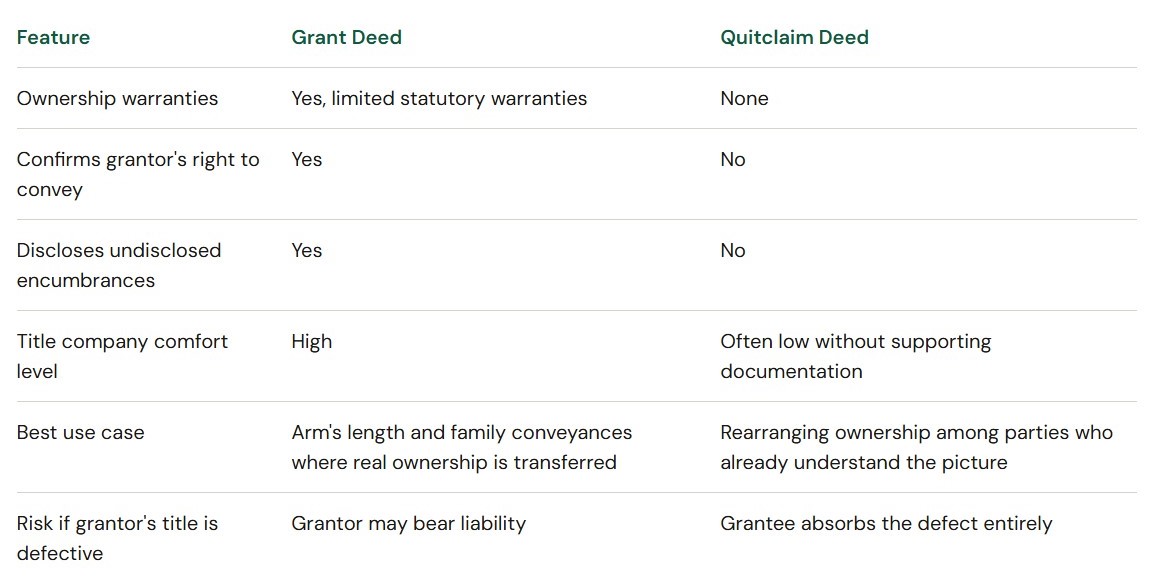
A grant deed transfers ownership with representations. The grantor is affirming three things: the property has not previously been conveyed to another party, no undisclosed encumbrances exist, and the grantor possesses a genuine ownership interest being transferred.
A quitclaim deed does none of that. It says, in effect: whatever interest I may have, if any, I relinquish to you. The interest conveyed could be partial, defective, disputed, or nonexistent. The grantee receives exactly what the grantor held, which may be nothing at all.
“A quitclaim deed transfers uncertainty. A grant deed transfers ownership.”
That distinction is not academic. It becomes critically important when title defects surface, competing ownership claims arise, undisclosed liens emerge, probate disputes develop, or a lender’s underwriter begins reviewing the chain of title.
Why Title Companies Treat Quitclaim Deeds as a Warning Sign
Title companies are in the business of establishing a clear, unbroken chain of ownership. When a quitclaim deed appears in that chain, an underwriter’s first instinct is to ask why. Was there a dispute? Was ownership uncertain? Was someone attempting to cure a defect quietly? Was there a hidden competing claim?
“Every unexplained quitclaim deed becomes a title underwriter’s homework assignment.”
The underwriter’s job is to eliminate uncertainty before issuing a policy. A quitclaim deed frequently introduces uncertainty rather than resolving it. As a result, title companies routinely require additional affidavits, supporting conveyance documents, probate records, divorce judgments, trust certifications, and prior deeds before a policy can be issued. The transaction slows until every question is answered.
When Quitclaim Deeds Are Actually the Right Tool
Quitclaim deeds do have legitimate uses, and in the right circumstances they are perfectly appropriate. The key is that they work best when ownership is already understood by all parties and is merely being rearranged, not genuinely transferred.
Divorce property transfers: One spouse relinquishes any ownership claim to the other.
Family ownership adjustments: Parents add children to title or remove family members from it.
Trust transfers: Property moves into or out of a revocable living trust controlled by the same individual.
LLC contributions: Real estate is transferred into an entity controlled by the same owner.
Corrective deeds: Minor clerical errors such as misspelled names are corrected in the record.
In these situations, the parties generally know each other well, the ownership picture is understood on both sides, and no one is relying on title warranties to make their decision.
Five Situations Where a Grant Deed Would Have Been the Better Choice
Parent Transfers Rental Property to Child
A parent transfers a rental property valued at $900,000 to a son by quitclaim deed. Years later, the son attempts to refinance. The lender questions why the transfer was made by quitclaim rather than a grant deed and requires additional documentation to establish the chain of ownership. A grant deed would have provided a cleaner record from the beginning.
Better choice: Grant deed. The transfer was a true conveyance of ownership, not merely a relinquishment of an uncertain claim.
Investor Transfers Property Into an LLC
An investor owns a commercial property individually and transfers it into a newly formed LLC using a quitclaim deed. Several years later, when the property is sold, the title company requires proof that the LLC properly acquired ownership because the quitclaim deed provided no ownership warranties. A grant deed would have created a far stronger ownership record.
Better choice: Grant deed. The investor actually owned the property and was conveying that ownership into the entity.
Adding a Spouse After Marriage
A homeowner marries and adds the spouse to the title using a quitclaim deed. During a future sale, questions arise regarding ownership percentages and vesting history. The title company requests additional documentation before it will insure the transaction. A grant deed would have established a cleaner transfer of ownership rights at the time of the addition.
Better choice: Grant deed. Ownership was affirmatively being conveyed to another individual, not merely disclaimed.
“Whenever ownership is expanding, grant deeds generally outperform quitclaim deeds.”
Sibling Inheritance Distribution
Three siblings inherit property through probate. One sibling transfers his one-third interest to another sibling using a quitclaim deed. Years later, a title review raises questions about the probate distribution and the ownership chain. A grant deed would have documented the specific conveyance of a defined ownership interest far more clearly.
Better choice: Grant deed. Ownership interests were definitively transferred between parties with identifiable stakes.
Business Partners Restructure Ownership
Two partners own an office building. One sells his ownership interest to the other and, to save legal fees, they use a quitclaim deed. A prospective lender later requires extensive documentation because the conveyance lacks assurances of ownership. The financing process stalls.
Better choice: Grant deed. This was a true sale of ownership interests, and the document used should have reflected that reality.
“The cheapest document often becomes the most expensive document later.”
The Risk Most Property Owners Never See Coming
Many people assume that signing a quitclaim deed is itself proof of ownership. It is not. A quitclaim deed only transfers whatever rights the grantor actually possesses. If those rights are defective, incomplete, disputed, or nonexistent, the grantee inherits the problem in full.
“A quitclaim deed cannot transfer certainty that the grantor never possessed.”
This distinction becomes acute in probate disputes, bankruptcy proceedings, divorce litigation, partnership breakups, trust contests, and fraud investigations. In each of those contexts, the quality of the underlying deed determines how quickly and cleanly the matter can be resolved.
Grant Deed vs. Quitclaim Deed at a Glance
The Professional Standard
Experienced real estate attorneys, title officers, escrow professionals, and underwriters generally prefer grant deeds whenever an actual conveyance of ownership is intended. Quitclaim deeds remain useful instruments, but they should be deployed narrowly and with a clear purpose in mind.
The question should never be whether a quitclaim deed can be used. The better question is what problem the transaction is solving and whether a grant deed would accomplish the same goal with less future risk. Most of the time, the answer is yes.
“The quality of a title chain is measured during stress, not during transfer.”
article continues after advertisement
Key Takeaways
Quitclaim deeds transfer claims. Grant deeds transfer ownership.
Title companies routinely scrutinize quitclaim deeds and frequently require additional documentation before insuring a transaction.
Family transfers, LLC contributions, and co-owner buyouts are often better documented with grant deeds than quitclaims.
A quitclaim deed may solve today’s paperwork problem while creating tomorrow’s title problem.
Conveyance and relinquishment are not the same legal act, and using the wrong instrument has real consequences.
https://www.realestateinvestormagazines.com/wp-content/uploads/2026/09/grant-vs-quitclaim-deed.jpg4001000dulcehttp://www.realestateinvestormagazines.com/wp-content/uploads/2013/04/logo.pngdulce2026-09-08 06:19:372026-09-08 06:20:46Grant Deed vs. Quitclaim Deed: Key Differences Every Real Estate Professional Should Know
Few places in the world have seen homes appreciate in value over the past 70 years as Orange County, California. For example, the nominal median home price in Orange County increased by somewhere between 6,000% and 7,900% between 1956 and 2026, as per sources like Zillow.
By mid-2026, the median home value for Orange County homes was in the $1.22 to $1.41 million price range, according to sources like Redfin.
It’s been said that the three most important factors related to home value trends are tied to “location, location, and location.” There are few places more beautiful in the world than the incredibly scenic Orange County region where I grew up and lived for most of my life.
The closer that a city is to the Pacific Ocean, the higher the property value. The six cities in Orange County that are located adjacent to the Pacific Ocean are as follows from north to south: Seal Beach, Huntington Beach, Newport Beach, Laguna Beach, Dana Point, and San Clemente.
The three most populous cities in Orange County are Anaheim, Santa Ana, and Irvine, with each city having a population surpassing 300,000.
The combined land and water area for Orange County is listed as being 948 square miles. Of those total 948 square miles, 799 square miles are on land, while 157 square miles are water (lakes, rivers, etc.).
The most densely-populated metropolitan area in the U.S. is the Los Angeles-Long Beach-Anaheim region, with almost 7,500 people per square mile, as per the US Census and Wikipedia.
article continues after advertisement
The Origins and Evolution of Orange County
1956: A newer suburban home in Orange County was priced as low as $15,000 to $20,000, partly depending on the proximity to the nearby Pacific Ocean coastal region. The opening of Disneyland in Anaheim one year earlier in 1955 shifted this local economy to a more global economy.
There were approximately 490,000 residents who lived in Orange County back in 1956. Farmland regions filled with orange groves (hence the Orange County name origins) began to turn more into suburban neighborhoods. Garden Grove, Costa Mesa, Anaheim, and other regions later were incorporated as cities and rapidly expanded over the next fifty years.
1970: Median county home prices were roughly $30,000, which was about three times the median household income at the time.
1980: Orange County home prices varied between $95,000 and $110,000, according to sources like the Los Angeles Times. Starting in this 1980 year near interest rate peaks, such as the US Prime Rate reaching 21.5% in December 1980, California’s statewide home prices started to decouple from the national average and rise at a much faster pace.
1990: Homes reached almost a $230,000 value range in Orange County during this late 1980s and early 1990s home price boom before later starting to fall in value in the mid-1990s. Southern California was especially hit hard by falling home values in the early to mid-1990s as the Savings and Loan Crisis worsened across the nation.
2000: Orange County homes reached the $240,000 to $260,000 pre-bubble baseline before later exploding in value, due to massive rate cuts by the Federal Reserve drove short-term rates down to almost zero for several years, while the 10-year Treasury yield and corresponding 30-year fixed mortgage rates also fell at a rapid pace.
2010: Following the massive housing crash that hit California especially hard with a statewide percentage loss average of -41.7% between peak 2007 and 2012 or 2013, Orange County home prices settled back down in the $450,000 to $500,000 price range.
2020: After several years of record low mortgage rates, home prices in Orange County were in the $790,000 to $950,000 range, as per sources like the Los Angeles Almanac.
2026: Fifty years later here in 2026, there are almost 3.2 million residents in Orange County. Median home prices also reach the $1.2 to $1.4 million price range.
Many prime oceanfront or beachfront coastal homes in Huntington Harbour, Newport Beach, and Laguna Beach can vary from $3 million up to $110+ million. For example, a cliffside mansion in Laguna Beach’s incredibly beautiful Emerald Bay community sold for the highest price ever in Orange County at a staggering $110 million dollar sales price.
Top 10 Employers by Workforce Size in Orange County
The median household income in Orange County in 2026 surpassed $116,000, as per the US Census Bureau. Just over 50 years earlier in 1955 when the US Census kept national records, the median household income was listed at $4,400 per year.
1. The Walt Disney Company Company – 34,000 employees 2. University of California, Irvine (UCI) – 26,000 employees 3. Providence South Division – 25,000 employees 4. Kaiser Permanente 5. Allied Universal – 7,200 employees 6. MemorialCare – 6,700 employees 7. Boeing Company 8. First American Financial Corporation 9. The Irvine Company 10. Edwards Lifesciences Sources: Orange County Business Council and Orange County Business Journal
Orange County Spotlight City: Huntington Beach
Now, let’s focus on my hometown of Huntington Beach (aka “Surf City, US”) where I lived for much of my life.
1950s to 1970s (Post-War Housing Boom): The late 1950s marked the beginning of the shift from larger urban regions like downtown Los Angeles to newer suburban family-friendly communities such as those found in areas like beautiful Huntington Beach. In 1956, the population there was about 6,000 to 8,000 people.
The median home prices fluctuated between $12,000 and $18,000 back in 1956. New home development there peaked in 1973 as neighborhoods began to rise up out of once empty fields. Popular architectural styles in Huntington Beach were mid-century modern ranches and single-story homes with open carports, low-pitched roofs, and larger outdoor yards and living spaces.
By the late 1970s, home values for tract homes were priced between $40,000 and $60,000.
1980s to 1990s (Custom Homes and Master-Planning Designs): Fancier developments began to increase in my old Huntington Harbour neighborhood. Later, larger master-planned communities near downtown Huntington Beach, such as the SeaCliff Golf Course community, became quite popular as home prices really began to rapidly rise in both locations.
2000s to 2010s (Great Recession, Bust, and Rebound): Home values in Huntington Beach hit the $825,000 price range in early 2007, according to the Orange County Register. By Q4 of 2007 near the previous housing bubble peak, median home prices reached $875,000 to $879,000.
After the housing bubble popped (2008 to 2012), median home prices in Huntington Beach fell to between $475,000 and $635,000, according to DataQuick.
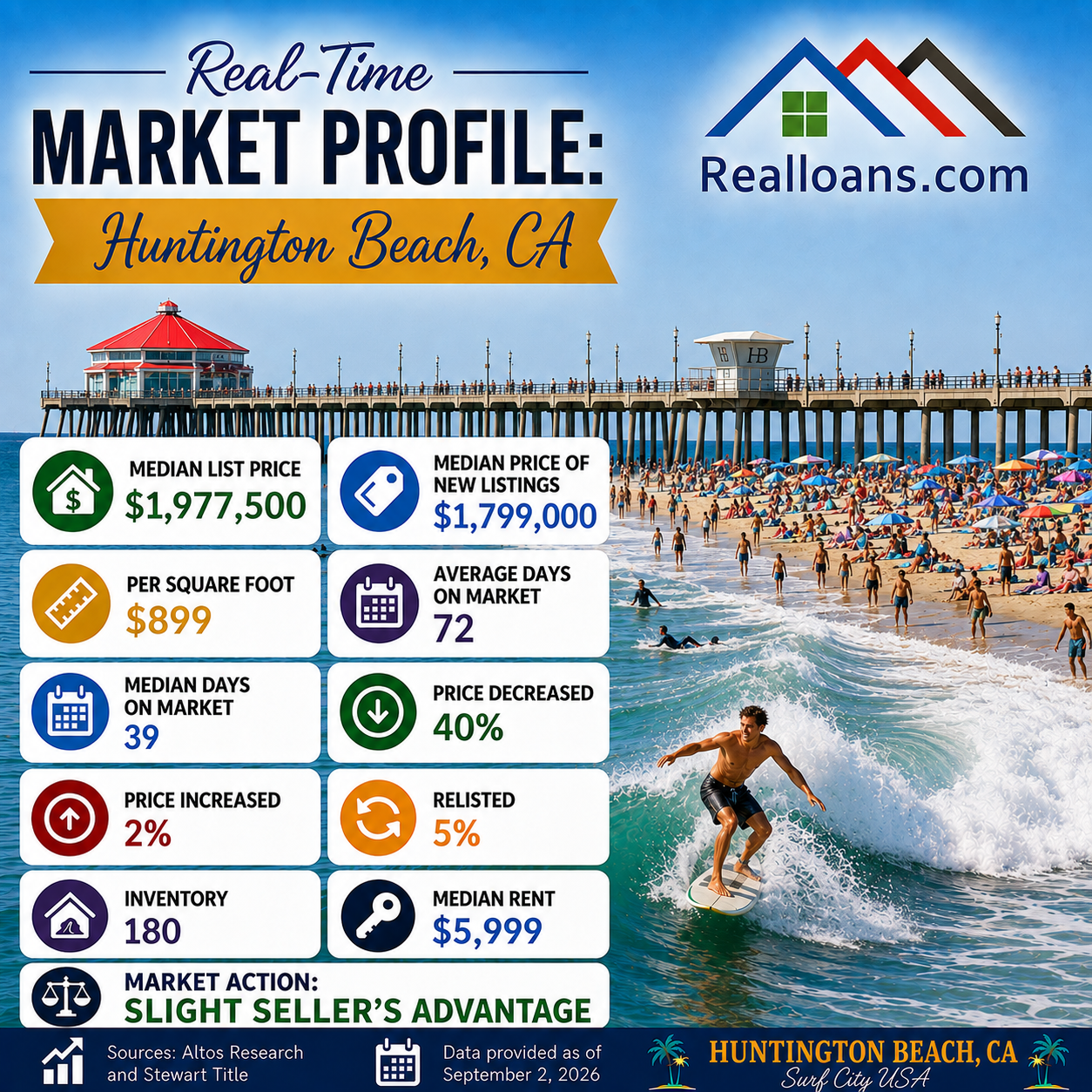
2026: The population of Huntington Beach as of this year is closer to 190,000 people. As of September 2, 2026, the most recent home value trends are as follows in my digital post created below:
Orange County, CA: The Epitome of Suburbia
Suburbia’s Evolution: The 1950s
The decade of the 1950s began with a desire by many Americans to achieve the ideal lifestyle of suburban home ownership with a white picket fence and all, as I shared in past articles about the evolution of suburbia.
Many Americans were still saddened by the devastation of fighting wars in the 1940s. The threat of the possible Korean War also caused concerns and stress in the 1950s. In addition, the fear of nuclear warfare caused many Americans to seek peace and safety within the comforts of their new suburban homes.
Easier Credit Access and Better Commuting Options
The increased availability of credit from banks, thrift and loans, and other lenders helped suburbia grow in the 1950s. The introduction of credit cards (or “charge plates”) began in February of 1950 by a man named Frank X. McNamara. He ran a small New York loan company. Mr. McNamara came up with the novel idea of offering a single credit card to many different people.
His credit card/charge plate was named “The Diners Club” card. The card was later accepted at department stores, restaurants, and a few hotels. American Express and Carte Blanche soon acquired Diners Club, and the expansion of consumer credit took off from there.
The introduction of credit cards helped restaurants and small businesses increase their sales tremendously in the 1950s. With the ready supply of new credit, Americans began visiting more restaurants, traveling, and spending money at shopping malls (first opened in 1956).
The 1956 year was the same year when President Dwight D. Eisenhower helped push through the approval of the Interstate Highway Act. The new bill funded the construction of over 46,000 miles of new roads, with more than $130 billion of federal money. The new roads helped car, truck, and suburban home sales increase dramatically throughout the nation.
McDonald’s, Disneyland, and Hollywood
The 1950s was also the decade that gave us the introduction of the national franchised business. Ray Kroc, a successful milk shake mixer salesman, was impressed with his customers’ The McDonald Brothers Self Service Restaurant in San Bernardino, California. Ray Kroc was amazed by the efficiency of their automated food serving system as well as with the high number of food sales at their restaurant. Mr. Kroc made an agreement with McDonald’s to franchise their restaurant business nationwide.
Hollywood began to get in on the act of promoting the perfect American lifestyles with hit television shows like Father Knows Best, Leave It To Beaver, and Ozzie and Harriet. As more and more television viewers watched these television shows, more Americans tried to emulate these shows by moving out to suburbia to find their own version of the “white picket fence” home.
Walt Disney purchased 160 acres of orange groves in Anaheim in the early 1950s, and began the construction of the ideal place to visit – Disneyland. Television, movies, and theme parks began to focus on entertaining people as a way to distract them from the daily pressures of life.
As shared earlier, Anaheim is currently the most populous city in Orange County with more than 340,000 residents. Disneyland also continues to be the #1 largest workforce employer in Orange County.
article continues after advertisement
From Levittown to Orange County
The high fertility rates after World War II helped fuel the suburban housing boom as larger families needed larger suburban homes. America’s fertility rate peaked at 3.77 children per married household in 1957. The suburban location provided them with a home, garden, car, and the model American family lifestyle as seen on television.
The overall U.S. suburban population increased from almost 27 percent in 1950 to anywhere between 55% and 65% today, according to Pew Research.
Homeownership rates increased from 43 percent in 1940 to about 65% in 2026. The increased number of home mortgages, credit cards, roads, freeways, jobs, the size of families, and the overall U.S. population all led to the demand for more suburban communities around the nation.
Suburban communities began in the northeast with places like Levittown, NY and Allentown, PA. Franchised businesses, theme parks, movies and television shows, which glorified the suburban lifestyle, began or were created in Southern California.
As the 1950s progressed, these suburban regions had significant impacts on other regions throughout America. More cities and states began to take on the look of the best of the lifestyles first seen in Orange County.
The 1950s should be looked at as the decade that helped form the modern prosperous American society. Americans in the 1950s experienced the Korean War, the expansion of franchised businesses, the evolution of television, movies, theme parks, rock and roll music, rebelling teenage youth, and the space race with the other “Superpower” in the world – the Soviet Union.
Suburbia in the 1950s offered people the American Dream as well as a sanctuary from the daily pressures of life. Suburbia’s roots really began in the 1950s, and would continue to evolve over the next 70 years.
Since the 1950s, more and more regions across the nation and world have tried to duplicate the suburban family lifestyle that was first perfected in Orange County. Yet, they’re not as fortunate to have the beautiful scenery and incredible weather throughout the year. This is partly why demand for real estate in the prime Orange County location should continue to outperform other regions across the nation.
Rick Tobin has worked in the real estate, financial, investment, and writing fields for the past 30+ years. He’s held eight (8) different real estate, securities, and mortgage brokerage licenses to date and is a graduate of the University of Southern California.
Rick provides creative residential and commercial mortgage solutions for clients across the nation. He’s also written college textbooks and real estate licensing courses in most states for the two largest real estate publishers in the nation; the oldest real estate school in California; and the first online real estate school in California.
Please join my So-Cal Real Estate Investors group that meets at Canyon Lake Golf & Country Club, Shoreline Yacht Club in Long Beach, and online: So-Cal Real Estate Investors.
https://www.realestateinvestormagazines.com/wp-content/uploads/2026/09/Orange-County.jpg4001000dulcehttp://www.realestateinvestormagazines.com/wp-content/uploads/2013/04/logo.pngdulce2026-09-05 06:04:562026-09-05 22:27:42Seventy Years of Housing Growth in Orange County, California
Cucharas Ranch Acquisition Designed to Protect Working Lands, Grasslands and Wildlife from Surge in Data Center, Wind and Solar Development
Denver, CO (August 2026) – The Nature Conservancy advances efforts to protect working ranches across the state while conserving natural resources with the purchase of the 30,000-acre Cucharas Ranch. The Mirr Ranch Group facilitated the sale.
Located near Walsenburg in southern Colorado, Cucharas Ranch encompasses rolling native grasslands interspersed with seasonal creeks and is part of one of the nation’s most significant protected prairie landscapes. Across the region, conscientious stewardship by private landowners sustains productive ranch operations while providing important wildlife habitat for elk, mule deer, pronghorn, wild turkey, and numerous grassland bird species.
The ranch also contributes to TNC’s Southern High Plains Initiative, a collaborative effort to work with communities, partners and landowners across five states to protect native grasslands, one of North America’s most threatened ecosystems.
“At The Nature Conservancy, our goal is not to own these ranches forever, but to ensure the natural habitats are protected while being able to remain a productive part of the local agricultural community and economy,” said Matt Moorhead, Conservation Business & Partnership Development Advisor for The Nature Conservancy in Colorado. “We partner with ranchers, agricultural and conservation organizations, and public agencies to protect the grasslands, wildlife habitat, and agricultural heritage that define southeast Colorado. Sometimes that means temporarily acquiring a ranch, securing its long-term conservation future, and returning it to private ownership. Our goal is that Cucharas Ranch will be an example of how conservation and ranching can work hand in hand to benefit both people and nature for generations to come.”
article continues after advertisement
“The Cucharas Ranch sale was gratifying, as both the buyer’s and seller’s goals were to permanently protect the property from the surge in data center, wind, and solar development that is impacting our prairie ecosystems,” said Jeff Hubbard, Executive Vice President at Mirr Ranch Group.
Since 1966, TNC has cultivated partnerships with landowners, local communities, conservation districts, agricultural organizations, and public agencies to protect the lands and waters to benefit people and nature.
The Mirr Ranch Group team of Jeff Hubbard, Pat Lancaster, and Willy Strazza represented Cucharas Ranch in the transaction. For more information about Mirr Ranch Group, visit www.MirrRanchGroup.com.
About The Nature Conservancy in Colorado
Since 1966, The Nature Conservancy in Colorado has helped conserve more than 1.6 million acres of land and over 1,300 miles of rivers statewide. Our work restores forests and rivers, protects iconic species and connected grasslands, and advances a conservation‑aligned energy transition. We collaborate with Tribal Nations, community leaders, policymakers, land managers and other partners to deliver durable, science‑based solutions that support a livable climate, healthy communities and thriving nature across Colorado.
As climate change intensifies and biodiversity faces unprecedented threats, we are working across borders to meet this extraordinary moment, advancing innovative conservation solutions throughout the West—from Eastern Colorado grasslands to the Sagebrush Sea and Western Dry Forests, and across the Colorado River Basin.
https://www.realestateinvestormagazines.com/wp-content/uploads/2026/09/ranch.jpg4001000dulcehttp://www.realestateinvestormagazines.com/wp-content/uploads/2013/04/logo.pngdulce2026-09-04 05:09:332026-09-04 05:09:53Ranch Sale Protects Against Data Center Development in Colorado
Elizabeth Taylor, Max Weinberg & Mark Zuckerberg made real estate news in August. Top 10 Celebrity Real Estate News is featured atTopTenRealEstateDeals.com.
Captain America Lists LA Home – Moving To East Coast Chris Evans, the star of Captain America, has found a buyer for his expansive Los Angeles home, barely two months after he put it back on the market as he moved back to the East Coast. In May 2025, the 45-year-old actor listed the house for $6.99 million. He delisted it last November after it didn’t find a buyer. Chris relisted the home in June with a fresh set of photos and a revised asking price of $6.39 million. The final sale price has not been published.
Prince Harry & Meghan Likely To List Montecito Mansion As Prince Harry, Meghan Markle and their kids prepare to move back to Britain, they claim that they will be keeping their Montecito mansion. However, a source in the Santa Barbara luxury real estate market told the New York Post that there “have been rumblings” the couple will sell the property, adding that “every broker wants that listing.”
While the prince was getting about $800,000 a year from the Duchy of Cornwall during his time as a working prince, and he still has deals with Netflix and Spotify reported to be worth millions of dollars, the Montecito home’s mortgage and tax payments alone run about $600,000 per year. Enough to make any royal couple think twice about selling.
Walt Disney’s Homes Collection House Beautiful has a look at Walt Disney’s homes, including Walt Disney’s storybook home in Los Feliz, the Palm Springs home he sold to help fund the down payment for Disneyland, and his Holmby Hills home with a miniature railroad in the backyard.
King-of-His-Castle Mark Zuckerberg Buys a Fairy-Tale Castle The fifth-richest person on the planet, Mark Zuckerberg, is now officially in charge of his own castle. Strancally Castle, a massive three-story Gothic Revival building in County Waterford, Ireland, on the south coast of the country, now belongs to the Meta CEO and his wife, Priscilla Chan. According to a statement from Zuckerberg’s spokesperson, Brian Baker, “Mark and his family are excited to continue caring for this historic home and look forward to spending time in Ireland, where Meta maintains its international headquarters.”
Strancally Castle was constructed around 1830 and has a view of the Blackwater River, is about 440 acres in size and 16,000 square feet in size. The Irish Times, which first reported the transaction, estimates the house sold for between €20 million and €30 million (US$23.3 million and US$35 million).
article continues after advertisement
Historic White Plains Home of the Dolly Sisters One of the month’s most interesting home listing is a White Plains, New York, estate with a story rooted in the golden age of American entertainment. Originally constructed in 1924 as a summer home for the Dolly Sisters, famed Hungarian-born twins who were among the biggest stars of Broadway and vaudeville in the 1910s and ‘20s, the 1.12-acre estate was built in the style of the Newport “Cottages,” the grand summer retreats favored by society’s elite, and the original details are well intact.
The 6,254-square-foot home has seven bedrooms, wide-plank floors, detailed woodwork, and windows that are original to the sisters, alongside coffered ceilings, grand fireplaces, an impressive central staircase, and a porte-cochère once large enough to accommodate a horse-drawn carriage. The home is listed for $2.795 million with Stacey Pinkas and John Oliveria of Douglas Elliman.
Max Weinberg Drums Up Sale In Just a Few Days The longtime drummer for Bruce Springsteen’s E Street Band, Max Weinberg, sold his two plots of land on the Intracoastal in Palm Beach in just a couple of days for $13 million. Measuring about 325 feet of waterfront, it is one of the last empty pieces of Intracoastal land in the Palm Beaches.
Elizabeth Taylor’s Longtime Home Lives On Despite rumors that the longtime Bel-Air home of Elizabeth Taylor was going to be demolished, builder Ardie Tavangarian plans to restore the home, including the large room where she kept her fabled jewelry in velvet-lined cases. Tavangarian is planning to add a large addition that will blend with and connect to the existing home. He plans to keep the Elizabeth Taylor home, including the master bedroom, bath, and beauty center, largely as Elizabeth left them. Taylor bought the home from Frank Sinatra’s first wife and lived there from the 1980s until her death in 2011.
Fess Parker & Julia Child’s Santa Barbara Mansion The Santa Barbara home where Fess Parker, star of Daniel Boone and Davy Crockett, lived and where Julia Child shot her 1980s PBS cooking series Dinner at Julia’s is for sale, asking $21.95 million. The estate has five bedrooms, a tennis court, a pool, rose gardens, and a citrus allée. The property is called Four Oaks because of the four mature oak trees on the property.
article continues after advertisement
Aaron Rodgers Leaving New Jersey Two months after signing a new contract with the Pittsburgh Steelers, where he played last season, NFL great Aaron Rodgers has listed his New Jersey mansion with postcard views of the Manhattan skyline for $15 million. The 10,000-square-foot home is located on a 2.4-acre wooded lot and includes eight bedrooms, a custom chef’s kitchen, polished white flooring, and hardwood cabinets and staircases. Rodgers bought the home in 2023 for $9.5 million when he was playing for the New York Jets.
Victoria’s Secret Angel’s NYC Home Victoria’s Secret Angel Martha Hunt’s NYC home is available for $3.75 million. Highlighted in Architectural Digest, the 1,707-square-foot home on a private cobblestone street includes two bedrooms, three full baths, custom built-ins, a walk-in closet, and a separate seating area. Situated in the center of NE Tribeca on a private cobblestone street, the residence is in a boutique condominium with a fitness center, playroom, bike storage, and a rooftop terrace with a swimming pool. It is listed with Taylor Middleton from Douglas Elliman.
https://www.realestateinvestormagazines.com/wp-content/uploads/2026/09/celebrity-real-estate-news.jpg4001000dulcehttp://www.realestateinvestormagazines.com/wp-content/uploads/2013/04/logo.pngdulce2026-09-02 03:09:342026-09-02 03:10:19August’s Top 10 Celebrity Real Estate News
I want to personally introduce you to Tom Wilson and the team at Wilson Investment Properties. I’ve known Tom for 20+ years and during that time he’s built a reputation for being straightforward, disciplined, and genuinely aligned with his investors — he and his team invest their own capital in every deal they bring to market.
I don’t make introductions like this often. I’m making this one because I trust how Tom operates, and I think you will too.
Best regards, Linda Pliagas
A Rare Opportunity in Today’s Real Estate Market
These are estimated returns only.
Dear Fellow Investor,
We are excited to share an exceptional investment opportunity that we believe checks every box—a proven market, a proven product, an experienced development team, and some of the most compelling construction economics we have seen anywhere in the United States.
We’ve made the full webinar recording available for you to watch at your convenience.
Whether you’re considering your next passive real estate investment or simply want to learn more about the opportunity, we invite you to watch the recording.
If you’d like to discuss the investment or have any questions, we’d be happy to schedule a call.
We look forward to hearing from you. Warm regards,
Tom K. Wilson Founder, Wilson Investment Properties wilsoninvest.com
WHY THIS DEAL STANDS OUT
This is not a typical ground-up construction deal. Equinox on Lincoln Phase 2 is a de-risked expansion of a community that has already been built, leased, and proven in the real market. Here is what makes it exceptional:
https://www.realestateinvestormagazines.com/wp-content/uploads/2026/08/opportunity.jpg4001000dulcehttp://www.realestateinvestormagazines.com/wp-content/uploads/2013/04/logo.pngdulce2026-08-31 06:43:392026-08-31 06:44:47A Rare Opportunity in Today’s Real Estate Market
How FICO Scoring Models Assess Default Risk—and What Real Estate and Finance Professionals Need to Know to Help Clients Qualify
The gap between a 580 credit score and an 800 credit score can cost a borrower tens of thousands of dollars over the life of a loan. Most people accept that as a fact without understanding what actually produces those numbers, or what they can do about it.
Credit scores do not measure income. They do not measure wealth. They measure one thing: whether you are likely to repay obligations exactly as agreed. That is a narrower question than most borrowers realize, and the answer to it shapes the cost of every dollar you borrow.
article continues after advertisement
What a Credit Score Actually Is
A FICO score generally ranges from 300 to 850. It is not a judgment of character. It is a risk model. Higher scores signal lower perceived default risk. Lower scores create friction in the form of higher pricing, more required documentation, stricter conditions, and more denials.
The score reflects five categories of credit behavior. Payment history and credit utilization together represent roughly 65% of the total score. The remaining three factors carry real weight, but those two are where most borrowers win or lose.
Credit scores are not built by borrowing money. They are built by managing obligations predictably.
What Your Score Costs You in Practice
Stronger scores commonly produce lower mortgage rates, better credit card terms, quicker loan approvals, higher credit limits, lower required deposits, and stronger rental qualification odds. Low scores produce the opposite. Borrowers with stronger scores typically secure capital faster, at lower cost, and with fewer conditions attached.
Approval is binary. Pricing is where credit scores extract the real cost.
These ranges are guides, not guarantees. Final pricing still depends on the lender, loan type, collateral quality, and the full credit profile.
The Five Factors That Drive Your Score
1. Payment History (35% of FICO): The Trust Record
Payment history is the largest single factor in a FICO score. Every lender starts with one question: did you pay others on time? Scoring models examine the count of late payments, the severity of each delinquency, how recently delinquencies occurred, any pattern of missed payments, collection activity, charged-off accounts, foreclosures, and bankruptcies.
A recent 90-day delinquency hurts far more than an old, isolated late payment. Scoring models do more than count errors. They detect patterns.
Many borrowers assume that paying eventually is sufficient. Credit scoring does not work that way. The gap between 29 days late and 30 days late can matter because many creditors only report delinquencies after the 30-day threshold is crossed. Timing is not a technicality. It is part of the record.
Credit scores preserve the record of promises kept and promises broken.
2. Amounts Owed and Credit Utilization (30% of FICO): The Leverage Test
Payment history shows whether you pay on time. Utilization shows how heavily you rely on available credit. The formula is straightforward: divide your current balance by your credit limit. On a $100,000 combined credit limit with $15,000 in balances, utilization is 15%.
A borrower can pay every bill on time and still see their score decline because of excessive utilization. Scoring models also review each card individually. One maxed-out card can hurt a score even when the overall utilization looks acceptable.
High utilization warns of financial pressure before default appears.
3. Length of Credit History (15% of FICO): The Track Record Factor
Lenders trust proven patterns more than recent optimism. A borrower with fifteen years of disciplined credit behavior creates less uncertainty than one with six months of history. Scoring models evaluate the age of the oldest account, the age of the newest account, the average account age, and the time since recent account activity.
Longer histories give lenders more predictive evidence. That is why closing old accounts can damage a score. It removes historical evidence that the model was using. Opening several new credit lines at once can also lower a score, even with zero balances, because the average account age drops immediately.
4. Credit Mix (10% of FICO): Managing Different Debt Types
Not all debt works the same way. Credit cards, mortgages, auto loans, and installment debts each require different management habits. Scoring models give some credit to borrowers who demonstrate the ability to handle multiple categories of debt, including revolving accounts such as credit cards and lines of credit, and installment accounts such as mortgages, auto loans, student loans, and personal loans.
The benefit is real but limited. No borrower should take on unnecessary debt just to improve their credit mix. The goal is proven competence, not a longer list of accounts.
5. New Credit and Inquiries (10% of FICO): Borrowing Velocity
A sudden surge in borrowing activity can signal financial stress. Scoring models evaluate hard inquiries, recently opened accounts, the velocity of account openings, and the time since the last inquiry. One inquiry rarely causes serious harm. Ten inquiries within sixty days can.
There is an important exception: mortgage and auto rate-shopping inquiries are often grouped by scoring models when submitted within a limited window, which reduces their impact on the score.
Healthy borrowers seek capital strategically. Distressed borrowers seek it urgently.
article continues after advertisement
How the Algorithm Actually Works
Most consumers assume every borrower is compared against every other borrower. Modern scoring does not work that way. The system first places the borrower into a risk category, often called a scorecard or scoring bucket. Common examples include thin credit file, mature credit file, recent bankruptcy filing, derogatory history file, and established prime borrower file. The algorithm then compares that borrower’s performance against peers in the same category.
A 10% utilization ratio may score differently inside a distressed scorecard than inside a mature prime scorecard. The system measures relative risk among comparable borrowers, not against the full population.
That structure matters because it means your score reflects where you stand within your peer group, not just what you have done in isolation.
Where to Start
The five categories do not carry equal weight, so improvement efforts should not treat them equally. Payment history and utilization are where most of the score lives. Start there. Preserve older accounts rather than closing them. Limit unnecessary inquiries. Use credit deliberately, not reactively.
Poor credit shows its real price when capital is needed most. The borrowers who manage obligations predictably, across time and across different debt types, are the ones the system is designed to reward.
Capital flows toward consistency.
Enterprise references are located in FICO Scores and related Dan Harkey materials.
https://www.realestateinvestormagazines.com/wp-content/uploads/2026/08/credit-score.jpg4001000dulcehttp://www.realestateinvestormagazines.com/wp-content/uploads/2013/04/logo.pngdulce2026-08-31 05:02:272026-08-31 05:03:48Credit Scores Explained: The Five Factors That Determine Your Borrowing Power
Costa Mesa, Calif. — Realty411 is bringing its News, Trends & Strategies Summit to Costa Mesa on Saturday, September 26, 2026, offering real estate investors, entrepreneurs, agents, lenders, business owners, and wealth builders a full day of education, networking, market insights, and actionable investment strategies.
DUE TO POPULAR DEMAND — THE EVENT HAS BEEN EXTENDED!
To accommodate the tremendous interest from attendees, Realty411 has extended the event schedule, giving guests even more time to learn, connect, and network.
Event Schedule:
Doors Open: 8:30 AM Program Begins: 9:00 AM Event Concludes: 6:00 PM
Admission and parking are FREE.
The one-day Summit will feature experienced real estate investors, educators, market professionals, lenders, entrepreneurs, and industry experts sharing practical information designed to help attendees better understand today’s real estate environment and identify opportunities in an ever-changing market.
With hundreds of investors already registered, Realty411 expects a strong turnout for this complimentary educational event.
A Real Estate Education Company Built on Experience
Founded in 2007 by Linda Pliagas, Realty411 has grown into a nationwide real estate education and media company dedicated to connecting investors with information, resources, experienced professionals, and valuable networking opportunities.
Over the past 19 years, Realty411 has welcomed nearly 20,000 guests to educational conferences and networking events across 15 states and has built a community of more than 1.3 million visitors who read Realty411’s digital publications and educational content.
But the story behind Realty411 begins long before the company was founded.
Pliagas first built her career in journalism, developing a passion for researching information, asking questions, interviewing experts, and sharing knowledge that could benefit others. After entering the real estate industry and becoming a licensed real estate professional, she recognized an opportunity to combine her journalism background with real-world real estate experience.
article continues after advertisement
Today, Pliagas brings together her background as a journalist, licensed real estate agent with 18 years of experience, entrepreneur, and real estate investor to lead Realty411.
Along with her husband, Pliagas has owned investment properties in five states, giving her firsthand experience with different markets, investment approaches, and the challenges investors face.
“After years in journalism, I realized that education has the power to transform lives,” said Linda Pliagas, Founder and Publisher of Realty411. “When I entered the real estate industry, I wanted to create a publication that brought together experienced professionals willing to openly share their knowledge. Realty411 was founded on the belief that informed investors make stronger decisions, and that education is one of the best investments anyone can make.”
From Journalism to Real Estate Education
Throughout her publishing career, Pliagas has interviewed and featured hundreds of real estate professionals, investors, lenders, attorneys, tax specialists, entrepreneurs, and other industry experts.
Those conversations have helped make Realty411 a resource where investors can learn directly from professionals with experience in the field.
The company’s commitment to education extends beyond its publications and into its live events, where attendees have the opportunity to meet speakers and fellow investors face-to-face.
“Our goal isn’t simply to host another real estate event,” Pliagas said. “It’s to create a welcoming environment where people can learn from experienced professionals, ask meaningful questions, build lasting relationships, and leave inspired to take the next step toward achieving their financial goals.”
More Than an Event — It’s About the Connections
For nearly two decades, Realty411 has focused on bringing people together.
That philosophy has been reflected in feedback from attendees and in interviews about the company.
In an interview with Ground Level Consulting, Pliagas discussed Realty411’s mission and the importance of providing investors with access to education, resources, and connections.
Attendees have similarly highlighted the networking and educational value of Realty411 events. One investor described the Expo as a place where she had “learned so much” while making valuable new connections.
Another Realty411 attendee praised the organization for helping investors connect with “honest people in the real estate industry.”
These relationships are an important part of what Realty411 seeks to create at every event: an environment where investors can exchange ideas, meet potential business partners, learn from experienced professionals, and expand their networks.
What Attendees Can Expect
The September 26 Summit will feature a full day of presentations, market updates, educational discussions, networking, and strategies covering today’s most important real estate topics.
Attendees can expect insights into:
Current real estate market trends
Investment opportunities and strategies
Market updates from experienced professionals
Financing and lending
Wealth-building strategies
Business development
Real-world investing experiences
Networking with investors and industry professionals
The event is designed for new and experienced investors alike, as well as agents, brokers, private lenders, entrepreneurs, property managers, business owners, and anyone interested in building wealth through real estate.
The latest edition of Realty411 will also be available at the event, along with previous editions featuring interviews, educational articles, market information, strategies, and resources for real estate investors.
A Family Legacy of Entrepreneurship
Realty411 is proudly based in Santa Barbara County, where Pliagas’s family owns and operates the area’s oldest clock restoration shop, HRS Clocks in iconic downtown Solvang.
That family business has provided another important influence on Pliagas’s approach to entrepreneurship — emphasizing craftsmanship, attention to detail, and exceptional customer service.
Those same principles have helped shape Realty411’s commitment to serving its readers, attendees, advertisers, speakers, and the broader real estate community.
article continues after advertisement
Event Details
Realty411’s News, Trends & Strategies Summit
Saturday, September 26, 2026
Doors Open: 8:30 AM Event Begins: 9:00 AM Event Ends: 6:00 PM
Crowne Plaza Costa Mesa Orange County 3131 Bristol Street Costa Mesa, CA 92626
Located near John Wayne Airport, the venue offers FREE onsite self-parking, with additional overflow parking available nearby.
Admission is FREE.
Realty411 encourages attendees to arrive early for the best seating and to take full advantage of the networking opportunities available throughout the day.
Founded in 2007, Realty411 is an independent real estate media and education company dedicated to educating and empowering investors through magazines, digital publications, educational conferences, interviews, and networking events.
https://www.realestateinvestormagazines.com/wp-content/uploads/2026/08/Costa-Mesa-event-2.jpg4001000dulcehttp://www.realestateinvestormagazines.com/wp-content/uploads/2013/04/logo.pngdulce2026-08-27 05:46:012026-08-27 06:57:58Realty411 Announces Extended Hours for “News, Trends & Strategies” Summit in Costa Mesa on September 26
Costa Mesa, Calif. — Realty411 proudly invites real estate investors, agents, entrepreneurs, business owners, and anyone interested in building wealth through real estate to attend Realty411’s News, Trends & Strategies Summit on Saturday, September 26, in Costa Mesa, California.
The one-day educational event will bring together experienced investors, market analysts, real estate professionals, lenders, entrepreneurs, and industry experts to share practical strategies, timely market insights, and actionable ideas designed to help attendees make informed investment decisions in today’s evolving real estate market.
Founded in 2007 by Linda Pliagas, Realty411 has become a trusted educational resource for investors nationwide. During the past 19 years, Realty411 has welcomed nearly 20,000 guests to educational conferences and networking events held across 15 states while reaching nearly 1.4 million visitors to their main website, Realty411.
What makes Realty411 unique is the story behind its founder.
Before entering real estate, Linda enjoyed a successful career in journalism, where she developed a passion for researching facts, asking thoughtful questions, and delivering meaningful information that empowers readers. After becoming a licensed real estate professional, she realized there was a tremendous need for trustworthy, experience-based education for investors.
Today, Linda combines the skills of a journalist with the knowledge gained from 18 years as a licensed real estate agent, her experience as an accredited investor, entrepreneur, publisher, and her family’s own investment journey. Together with her husband, she has owned investment properties in five states, giving her firsthand insight into multiple real estate markets and investment strategies.
article continues after advertisement
In addition to publishing Realty411, Linda comes from a family deeply rooted in entrepreneurship. Her family owns and operates the oldest clock restoration shop in Santa Barbara County, HRS Clocks, where Realty411 is proudly based. The family’s longstanding commitment to craftsmanship and customer service has inspired Linda’s dedication to helping others succeed through education.
“After years in journalism, I realized that education has the power to transform lives,” said Linda Pliagas, founder of Realty411.com. “When I entered the real estate industry, I wanted to create a platform that brought together experienced professionals willing to openly share their knowledge. Realty411 was founded on the belief that informed investors make stronger decisions, and that education is one of the best investments anyone can make.”
Throughout her publishing career, Linda has interviewed and featured hundreds of real estate professionals, investors, lenders, attorneys, tax specialists, and entrepreneurs, preserving their knowledge so others can benefit from their experience. That commitment to education continues to define every issue of Realty411 and every event the company hosts.
“Our goal isn’t simply to host another real estate event,” Pliagas added. “It’s to create a welcoming environment where people can learn from experienced professionals, ask meaningful questions, build lasting relationships, and leave inspired to take the next step toward achieving their financial goals.”
Attendees can expect a full day of educational presentations, networking opportunities, market updates, and discussions covering today’s most important real estate news, trends, and investment strategies. Whether someone is purchasing their first investment property or expanding a seasoned portfolio, the Summit offers valuable insights for investors at every stage. In addition, guests can network and connect with company leaders from throughout the region, the state, and the nation.
Southern California — Orange County in particular — remains one of the nation’s most dynamic real estate markets, making Costa Mesa the perfect setting for professionals and investors to gather, exchange ideas, and discover new opportunities.
For registration and event information, visit Realty411.com. Or, click directly on the event landing page: https://Realty411.com/2026-summit/
article continues after advertisement
About Realty411
Founded in 2007, Realty411 is an independent real estate media company dedicated to educating and empowering investors through magazines, digital publications, educational conferences, and networking events. Under the leadership of journalist, licensed real estate agent, accredited investor, entrepreneur, and publisher Linda Pliagas, Realty411 has connected thousands of investors with respected industry experts, helping readers and event attendees gain practical knowledge, valuable connections, and greater confidence in their real estate journeys.
Media Contact: Linda Pliagas Founder & Publisher, Realty411 Realty411.com
https://www.realestateinvestormagazines.com/wp-content/uploads/2026/08/Costa-Mesa-event.jpg4001000dulcehttp://www.realestateinvestormagazines.com/wp-content/uploads/2013/04/logo.pngdulce2026-08-27 03:01:162026-08-27 03:02:49Realty411 Presents “News, Trends & Strategies” Summit on September 26 in Costa Mesa





























.jpg)
.jpg)