

Posts

Short-Term Rentals and DSCR Loans

Image from Pexels

By Rick Tobin

Over the past several years, most short-term and long-term rental property owners created the bulk of their wealth from the annual equity gains related to buying and holding their properties as values increased anywhere between 10% to 40% per year. In California alone back in 2021, it was reported that the average home statewide increased in value $11,000 per month or $132,000 for the entire year. If so, I doubt that many Airbnb or VRBO hosts collected more than $132,000 in gross or net rent profits.

Image from Pixabay

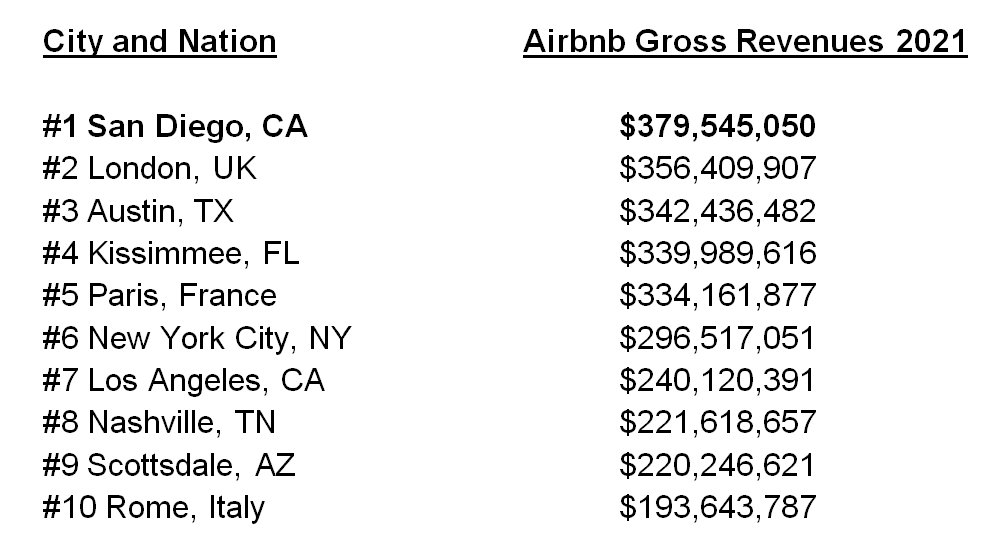
Did you know that San Diego, California was ranked as the #1 for having the highest gross revenues of any Airbnb region in the world in 2021? Please see the complete Top 10 list of the highest grossing rentals in the world later in this article.

Let’s look next at just some of the short-term rental listing companies which assist vacation rental property owners with the leasing of their properties:

  • Airbnb
  • VRBO (Vacation Rental By Owner)
  • Booking.com
  • TripAdvisor
  • Expedia
  • HomeToGo
  • Tripping
  • Homestay.com
  • Atraveo
  • OneFineStay

The prominent travel booking company named Expedia purchased VRBO back in December 2015. As a result, Expedia continues to be one of the most dominant short-term rental companies in the world.

As per published Airbnb data, here are the Top 10 states for average annual host or property owners earnings for 2021:

  1. Hawaii: $73,247
  2. Tennessee: $67,510
  3. Arizona: $60,448
  4. Colorado: $58,108
  5. California: $54,461
  6. Florida: $53,209
  7. South Carolina: $49,641
  8. Utah: $48,568
  9. Oregon: $42,964
  10. Alabama: $41,937

Image from Pixabay

If a rental property owner confides in you that he or she collected $50,000+ in gross income from Airbnb last year, this number may only represent a small percentage of their overall total revenue collected from both short-term and long-term tenants (30 days+) because they may have multiple income stream options by way of VRBO, Booking.com, or other companies that help supply them with consistent tenants. This is especially true when the property is located in a populous metropolitan region or a prime vacation getaway area like those found in San Diego, Santa Barbara, or Miami.

No Income Verification Loans for Rentals

Most real estate investors usually need third-party mortgage financing to purchase one or more rental properties even if they are very wealthy themselves. Many years ago, it was quite challenging to qualify for a rental property because you were asked to provide two years’ worth of tax returns, a detailed profit-and-loss statement, and the mortgage underwriters would only give you credit for 75% of your gross monthly rents when attempting to qualify or deny your loan request. This 75% number was due to the fact that lenders assumed that you had property management fees, vacancy rates above 0% throughout the year, and operating expenses for repairs.

As a result, that $2,000 gross rent turned into just $1,500 (75%) and many investors were later denied because few lenders wanted to lend on a rental property with negative monthly cash flow if the proposed monthly mortgage payment (principal, interest, property taxes, insurance, and homeowners association fees, if applicable) was $1,501 or higher.

Image from Pexels

Today, many investors are qualifying to purchase short-term and long-term rentals by way of non-QM or DSCR (Debt Service Coverage Ratio) programs which don’t require borrower applicants’ tax returns, W-2s, or other formal income documents to qualify. Now, some lending programs take the closest look at the subject property before determining if the rental property can at least break-even at a 1.0 DSCR number where 100% of the gross monthly rents are at least equal to the proposed mortgage payment. In these underwriting scenarios, 100% of the gross rents are used to qualify instead of just 75% like was more the norm in years past.

For a DSCR loan, it allows borrower applicants to use the market rent (actual or future, in some cases) of the property to qualify rather than the borrower’s business income. This is especially beneficial for self-employed business owners or investors who have a lot of tax write-offs and minimal net income shown on their tax returns.

Some of these DSCR program highlights include:

  • 640+ FICO
  • Up to 80% LTV
  • Available on investment properties only
  • Finance up to 20 properties
  • Loan amounts up to $2M per property

Some of my other lender programs allow negative cash-flow for rental properties up to 70% LTV for cash-out or purchase transactions while not requiring any additional income from the borrower applicant.

Airbnb Statistic

Image from Pexels

Because Airbnb is the biggest name in the short-term rental business sector, let’s review some of these shocking numbers that confirm how successful this investment property model has been for Airbnb corporate and for individual hosts or property owners.

Airbnb History

  • An average of six guests every single second check into an Airbnb listing.
  • Airbnb listings represent 19% of the total demand for lodging in the US.
  • Over 150 million people have booked over one billion nightly stays.
  • The average US Airbnb occupancy rate is 48%.
  • The average stay is 4.3 nights.

2021 Data

  • The global Average Daily Rate (ADR) was $137 per night in 2021 as compared to $110/night in 2020.
  • California properties had a much higher nightly average of $258 per night.
  • In December 2021, there were 12.7 million listings worldwide.
  • There were 2,249,434 listings in the US in 2021.
  • 356.9 million nights were booked on Airbnb in 2021.

Highest Gross Revenues Worldwide for Airbnb Properties

Image from Pixabay

Surprisingly, these populous metropolitan regions such as Los Angeles, San Francisco, New York City, Paris, London, or Hong Kong weren’t ranked #1 for being the most profitable Airbnb region in the world with the highest gross revenues. No, the honor for the most profitable Airbnb region in the world in 2021 was San Diego, California.
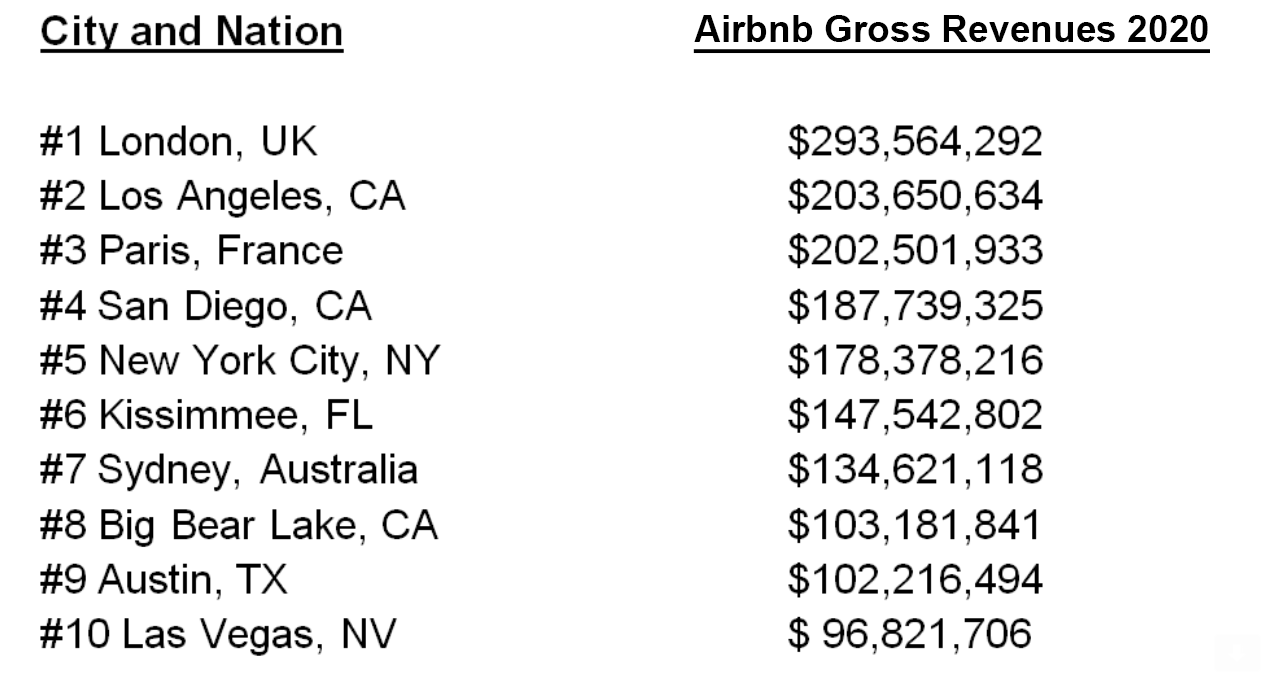
In 2020, seven of the Top 10 highest gross revenues for Airbnb properties were all in the US. One region that stands out is Big Bear, California, which is the best-known mountain resort community in Southern California. Listed below are the 2020 gross revenue numbers for the Top 10 regions in the world:
Compounding Wealth With Equity Gains

There are many individual or family investors across the nation who have acquired 5, 10, 15, or 20+ short-term rental properties. The bulk of their family’s net worth doesn’t usually come from the net annual rental income. No, the family’s net worth is compounding each year with double-digit appreciation rates like we’ve all seen for several years now.

To better understand how the acquisition of multiple rental properties is more likely to create the bulk of your net worth, let’s take a look at a fictional California property owner who saw each of his rental homes appreciate $11,000 per month or $132,000 for the entire year in 2021:
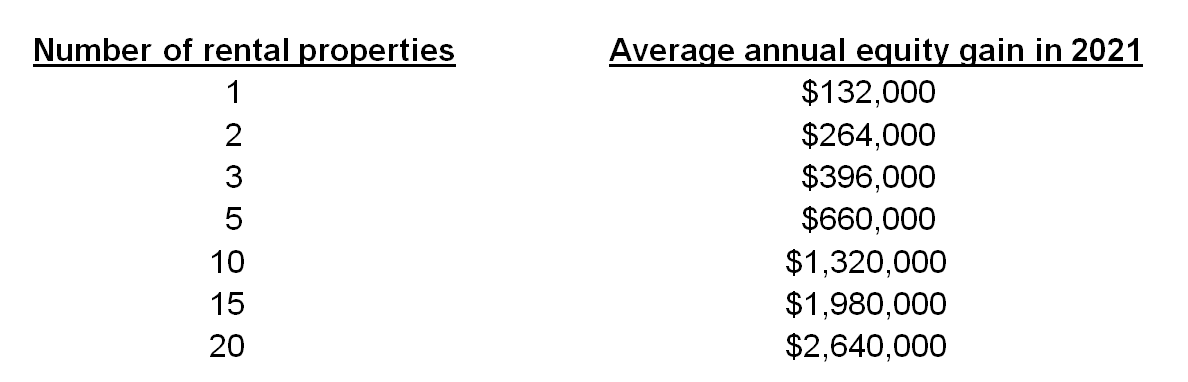
Investors can apply any excess net rental income each year to paying off their mortgage faster. With consistent annual rents, a 30-year mortgage or a shorter-term 5-year or 7-year interest-only mortgage with much lower monthly payments than the best 30-year fully amortizing rates can be paid off much faster as more principal is paid off with extra payments.

The sooner that your homes are free and clear, the earlier you can retire and live off of the monthly cash flow while not touching your equity gains. A fairly consistent plan of buying and holding short-term and/or long-term rental properties is a prime example of letting your money work hard for you instead of the other way around.

Rick Tobin

Rick Tobin has a diversified background in both the real estate and securities fields for the past 30+ years. He has held seven (7) different real estate and securities brokerage licenses to date, and is a graduate of the University of Southern California. Rick has an extensive background in the financing of residential and commercial properties around the U.S with debt, equity, and mezzanine money. His funding sources have included banks, life insurance companies, REITs (Real Estate Investment Trusts), equity funds, and foreign money sources. You can visit Rick Tobin at RealLoans.com for more details.


Learn live and in real-time with Realty411. Be sure to register for our next virtual and in-person events. For all the details, please visit Realty411.com or our Eventbrite landing page, CLICK HERE.


The Non-Owner, No Income (NONI) Loan Solution

Image from Pexels

By Rick Tobin

Are all loans second to NONI (Non-Owner, No Income) for cash flow purposes? Does your investment property give you a positive annual cash flow with or without significant vacancy rates, repairs, nonpayment of rents due to tenant moratoriums or other reasons, and costly management expenses? How many investment property owners are stuck with high 7% to 10%+ private money or an expensive 30-year fixed mortgage that creates negative monthly cash flow? The NONI interest-only loan or fully amortizing loan with 7, 10, 30, and 40-year fixed terms is an exceptional financial choice.

NONI Interest-Only Loans

First off, can you afford your monthly mortgage payment? Without positive cash flow and the ability to pay your mortgage payments on time, your investment properties may be at risk for future forbearance, loan modification, or distressed sale situations where you could later lose your positive equity in a future foreclosure. The combination of positive cash flow and compounding equity gains should be the primary goal for investors instead of having unaffordable mortgage payments.

Here’s some eye-opening NONI loan products highlights that keep customers coming back for more NONI products, especially if the investor owns 2, 5, 10, or 20+ rental properties:

  • Starting interest-only rates as low as 3.875%*
  • Designed for business purpose 1-4 unit residential loans in most states
  • No income or employment collected on the loan application
  • Loan amounts to $3.5 million for non-owner properties
  • No 4506-T, tax returns, W-2s or pay stubs
  • Qualification is based on property cash-flow, NOT borrower income
  • First time investors allowed
  • Multipurpose LLC allowed
  • Unlimited cash-out up to 75% LTV
  • As little as 0 months reserves (use cash out for reserve qualifications)
  • NONI doesn’t care how many properties a borrower owns
  • The lower I/O payment (when I/O option is chosen) is used when calculating DSCR and cash reserves
  • 85% LTV available for purchase and rate/term transactions (680+ FICO)
  • Rental income is taken from an existing lease or the rent survey from the appraisal and compared to the mortgage payment to determine debt coverage ratio. (all program guidelines and rates subject to change and qualification)

For traditional loan programs, many lenders will take 75% of your gross rents to qualify for a new mortgage loan because the lender assumes that you have vacancies, repairs, and property management fees. For easy math, a rental property with $1,000 per month in gross income is underwritten as if it were $750 per month and another pricier property with $10,000 per month in rental income is analyzed as if it were $7,500 per month.

Image from Pixabay

For NONI, on the other hand, you can qualify at 1.0 DSCR (Debt Service Coverage Ratio) or break-even levels. For example, your rental home averages $2,000 per month, so your newly proposed mortgage payment (including property taxes, insurance, and homeowners association fees, if applicable) must be equal or lower to that same gross rental income. As a result, it’s much easier to qualify for a NONI loan product than any other residential mortgage loan that I know of today.

30-Year Fixed vs. 10-Year Interest-Only

A 30-year mortgage payment doesn’t usually begin to pay down any significant amount of loan principal until after the 7th year. The average mortgage borrower keeps their loan for nearly 7 years, so an interest-only loan product can be a much more solid choice today for many borrowers.

Let’s compare the fully amortizing 30-year fixed payment with a 10-year interest-only payment with cash-out options to see the difference for the same 3.875%* rate:

Loan amount: $250,000
30-year fixed rate payment: $1,175.59/mo. (principal and interest)
10-year fixed interest-only: $807.29/mo.

Loan amount: $500,000
30-year fixed rate payment: $2,351.19/mo. (principal and interest)
10-year fixed interest-only: $1,614.58/mo.

Loan amount: $750,000
30-year fixed rate payment: $3,526.78/mo. (principal and interest)
10-year fixed interest-only: $2,421.88/mo.

Loan amount: $1,000,000
30-year fixed rate payment: $4,702.37/mo. (principal and interest)
10-year fixed interest-only: $3,229.17/mo.

Loan amount: $2,000,000
30-year fixed rate payment: $9,404.74/mo. (principal and interest)
10-year fixed interest-only: $6,458.33/mo.

Loan amount: $3,000,000
30-year fixed rate payment: $14,107.11/mo. (principal and interest)
10-year fixed interest-only: $9,687.50/mo.

*APRs from 4.79%: The 10-year fixed loan converts to an adjustable for the remaining 20 or 30 years with 30-year and possible 40-year loan term options. There are also 30-year and 40-year fixed interest-only loan programs at higher rates (all rates and programs subject to change)

Increasing Inflation and Rates, Decreasing Dollar Value

The more money that is created together between the US Treasury and Federal Reserve, the lower the purchasing power. Inflation can severely damage the purchasing power of the dollar while generally benefiting real estate assets.

US M1 Money Supply (February 2020): $4 trillion
US M1 Money Supply (March 2020 – October 2021): From $4 to $20 trillion

Image from Pixabay

Or, 80% of today’s M1 Money Supply, or an additional $16 trillion dollars in circulation, was created within just 22 months (March 2020 to October 2021).

Most Americans create the bulk of their family’s net worth from the ownership of real estate, not hiding cash under their mattress or holding stocks or bonds. Inflation is also a hidden form of taxation. One of the best ways to offset weaker dollars is to buy and hold real estate as a hedge against rising inflation while also generating monthly cash flow.

Today’s younger investors may not remember 10% to 20% fixed mortgage rates from years past. If your rental properties are losing money at a 3% or 4% fixed rate today, then any future properties purchased with higher rates will lose even more money unless you select a much more affordable interest-only loan product.

Let’s take a look next the average published 30-year fixed rate for owner-occupants who qualify with full income and asset documentation by decade:

● 12.7% in the 1980s
● 8.12% in the 1990s
● 6.29% in the 2000s
● 4.09% in the 2010s

The common link between each of these decades was that perceived inflation risks were usually a core reason why the Federal Reserve increased interest rates in order to quash inflation. Today’s published inflation rates are at 40-year highs. Yet, they are still underreported and are actually much higher as partly noted by annual used car prices rising almost 48% in just 12 months near the end of 2021.

Doubling Asset Values

If you keep the old Rule of 72 (how long it takes to double an asset value by the annual gain or interest return projections) in mind with rising inflation trends continuing to boost housing prices, you will clearly see the potential to boost your net worth. For example, a home doubles in value based upon the gains such as a 7.2% annual increase that will take 10 years for the home to double in value (72 / 7.2% = 10 years).

Image from Pixabay

Between November 2020 and November 2021, it was reported that the average home price, including distressed properties, increased more than 18%. If that home price gain trend continued at the same annual pace, the average home price could double in value every 4 years (72 / 18 = 4 years). In many pricey coastal regions, homes have appreciated 30% to 35%+ per year over the past few years. As a result, many investors have seen their home values double in just two or three years.

As rates are more likely to increase than decrease in the future, the interest-only loan products that can be fixed for 7, 10, 30, or 40 years make more sense from a cash flow and peace of mind standpoint.

While NONI keeps your payments low, your net worth may be boosted sky high as the soaring inflation trends continue and properties may double or triple in value!

Rick Tobin

Rick Tobin has a diversified background in both the real estate and securities fields for the past 30+ years. He has held seven (7) different real estate and securities brokerage licenses to date, and is a graduate of the University of Southern California. Rick has an extensive background in the financing of residential and commercial properties around the U.S with debt, equity, and mezzanine money. His funding sources have included banks, life insurance companies, REITs (Real Estate Investment Trusts), equity funds, and foreign money sources. You can visit Rick Tobin at RealLoans.com for more details.


Learn live and in real-time with Realty411. Be sure to register for our next virtual and in-person events. For all the details, please visit Realty411.com or our Eventbrite landing page, CLICK HERE.

Forbearance Bailouts and Refinances

Image from Pexels

By Rick Tobin

The 2020 and 2021 years have been two of the most unusual time periods in world history, especially for the real estate sector. For example, millions or tens of millions of homeowners and tenants have been severely delinquent with their mortgage and rent payments while unemployment numbers rose incredibly high. However, home values have absolutely skyrocketed to all-time record high annual percentages and prices.

How is it possible for us to see record delinquencies with or without approved forbearance (“no mortgage payments paid and the lender agrees not to foreclose”) or loan modification agreements in place and record price growth at the exact same time? Don’t these two opposing situations contradict one another in a cognitive dissonance sort of way? In past years, record mortgage delinquency numbers would typically cause declining property values nearby because these home delinquencies or foreclosures would become the latest lower sales comparable for the neighboring homes.

The true irony of record delinquency numbers is that most homeowners created much more equity in their properties by just sitting there and not making any mortgage payments. As reported by CoreLogic’s Homeowner Equity Report, the total US homeowners’ annual equity grew $2.9 trillion between the second quarters of 2020 and 2021 with an average individual mortgage borrower’s gain of $51,500 in just one year. A deferral of 12 months’ worth of $2,000 per month payments that totaled $24,000 would still be less than half of the new equity gains.

Image from Pexels

In this article, you will learn about how you can refinance out of a forbearance or loan modification plan instead of losing all of your equity in a future foreclosure sale. For most American families, the bulk of their net worth originates from the equity in their owner-occupied residential property (single-family home, condominium, townhouse, duplex, triplex, or fourplex), so this topic point is quite relevant to millions of people today.

Let’s review next some of the most mind-blowing delinquency data that’s been published here in 2021:

$833 Billion in Unpaid Mortgage Balances

  • An estimated 15 million people lived in households that owed more than $20 billion in unpaid rent as of July 2021.
  • 7.43 million rental property units were not current.
  • 5.95 million owner-occupied housing units weren’t current.
  • 8.71 million lived in owner-occupied homes where the homeowners have little or no confidence in their ability to pay their mortgage.
  • 12.71 million lived in rental properties where the heads of household had little or no confidence in their ability to pay their rent.
  • Serious mortgage delinquencies were up 20% in July from June and were the highest recorded since 2010.
  • By mid-August 2021, 3.9 million homeowners were in active forbearance, which represented 7.4% of all mortgages nationwide and $833 billion in total unpaid principal.
  • An estimated 11.6% of all FHA and VA loans were in active forbearance.

Sources: U.S. Census Bureau and Black Knight Mortgage Monitor

How Hyperinflation Creates Wealth

Most people should know by now that historically low mortgage rates for borrowers is one of the main reasons why real estate values have boomed since 2013, depending upon the region. The vast majority of homeowners need third-party loans to buy their properties. Over the past decade, a very high percentage of homebuyers purchased their homes with 0% to 3.5% down payments with or without their own personal funds for loan programs like FHA, VA, or conforming that allowed gifted funds from family or seller credits.

Image from Pixabay

Historically, 7-year to 10-year boom cycles for real estate have been the norm. Yet, we haven’t seen significant price drops in a major metropolitan region, state, or across the nation. Do we still have at least another few years of potential double-digit home appreciation growth in our future or not?

Few investments have been a better hedge against inflation than real estate. On an annualized basis, home values generally increase in value on average at least as high as the published annual rates of inflation. The Federal Reserve must continue to keep rates artificially low or they may risk causing the housing bubble to pop.

The Federal Reserve’s ongoing policy of Quantitative Easing (create more money to boost asset values related to housing and stocks, especially) and their lesser-known Operation Twist policy (the simultaneous buying and selling of long-term and short-term bonds to artificially drive down mortgage rates) that they seem to turn on and off as needed with or without notifying the general public. With record high government debt levels today, the Fed has really no choice but to keep pushing inflation higher because one of their biggest fears is massive asset deflation like seen in Japan in the early 1990s after their own Quantitative Easing program failed miserably.

Rising inflation trends for various consumer goods and services like food, clothing, cars, and gasoline are not usually viewed favorably. However, rising home values tied to meteoric inflation trends are welcomed by homeowners who see their home values rise $50,000 to $100,000+ in a year.

Year-over-year inflation trends for August 2021:

  • Used vehicle prices: +31.9%
  • Energy costs: +25%
  • Southern California home prices: +22.1%*
  • National home prices: +19.7% (a new annual US record)*
  • Export prices: +16.8%
  • Apparel / clothing: +15.52%
  • Import prices: +9.0%

*July year-over-year housing price trends

Sources: U.S. Bureau of Labor Statistics, CoreLogic, and California Association of Realtors

Forbearance and Loan Modification Refinance Solutions

A homeowner who hasn’t made a mortgage payment in several months, a year, or almost two years probably has a few options to exit out of this dire financial situation. First, they can sell the home and lease another property if their credit scores aren’t too negatively impacted.

In September 2021, multifamily apartment units reached an all-time record high of $1,558 which was an all-time record annual 11.4% increase, according to Yardi Matrix. For single-family home rentals, the monthly rents are normally much higher in the $2,000 to $5,000+ per month range, depending upon how close they are to an ocean or prime metropolitan region.

Image from Pixabay

Or, the homeowner can attempt to save their home and end their existing approved or unapproved forbearance (“no payment, no foreclosure”) or loan modification situation, and refinance with a new loan that may allow cash out, a lower rate, and better monthly payments. The mortgage companies or lenders that will consider refinancing a mortgage which is severely delinquent are likely to request that the homeowner exit out their forbearance agreement, make a few payments, and then complete the new refinance closing.

Oftentimes, a homeowner who has been in forbearance cannot provide tax returns or more formal income verification. As a result, more lenders today may consider qualifying the borrower applicant with anywhere between zero and 24 months’ worth of bank deposits while closely analyzing the averaged bank deposits. In some cases, a government-backed mortgage product may allow an almost “No Doc” loan program with a financial hardship letter that may reduce the monthly principal and interest amounts by 25%, as recently announced by the Federal Housing Finance Agency (FHFA) and the Federal Housing Administration (FHA).

For more details in regards to these new financial solutions to exit out of forbearance and loan modification programs, refinance, and save your home, please visit my website at www.realloans.com.


Rick Tobin

Rick Tobin has a diversified background in both the real estate and securities fields for the past 30+ years. He has held seven (7) different real estate and securities brokerage licenses to date, and is a graduate of the University of Southern California. Rick has an extensive background in the financing of residential and commercial properties around the U.S with debt, equity, and mezzanine money. His funding sources have included banks, life insurance companies, REITs (Real Estate Investment Trusts), equity funds, and foreign money sources. You can visit Rick Tobin at RealLoans.com for more details.


Learn live and in real-time with Realty411. Be sure to register for our next virtual and in-person events. For all the details, please visit Realty411.com or our Eventbrite landing page, CLICK HERE.