

MARK…. MY WORDS – A PRIVATE MONEY MORTGAGE BROKER’S DIARY OF DIFFICULT DEALS (Part 2)
By Mark Robbins, J.D.
CHASE BANK AND THE SOLO 401K
Another loan that stands out on my personal list of accomplishments was a non-recourse loan for an investor who owned a 32-unit apartment building in Los Angeles that he had purchased with his Solo 401(k) some years earlier. The property was worth about $4 million at that time, in 2011. He needed to refinance a non-recourse loan of approximately $1.4 million to cover his debt and loan expenses.
The issue at that time was that there weren’t many, if any, non-recourse commercial lenders for multifamily properties owned in a retirement account. One lender I knew who handled non-recourse multifamily property loans in general (for your average investor) was Chase Bank. I communicated my client’s situation to their loan origination department and was initially turned down because they said they didn’t issue these loans for properties held in a 401(k). The typical nature of a 401(k) means there are other employees who might be involved in the ownership, which makes it too complicated to issue a mortgage.
However, once they realized the ownership was through a Solo 401(k), they reconsidered the transaction. It took a good three months to get the loan approved through the bank’s legal department. I was told this was the first time Chase Bank had approved a multifamily loan for a Solo 401(k), and, as far as I know, they never approved another one.
On top of that, I got my client an interest rate of 4.5% for five years. My client called me almost five years later to thank me again for getting him that loan and told me he had paid it off. His building was free and clear and worth a lot more money! Chalk one up for the small investor, thanks to LRG’s persistence and resourcefulness!
article continues after advertisement

Moving on, finding business is always challenging. I listed my company with a number of IRA custodian firms as a broker for non-recourse loans, as previously mentioned, so I did get referrals from time to time that way. These loans tended to be small and usually were limited to one-to-four-unit properties. The previously described loan was the largest non-recourse loan I had ever done until 2025, when I completed one for a client who owned 45 homes in his IRA. Therefore, those loan types tended to be much smaller, typically in the $50,000 to $200,000 range. I was grateful that I developed this specialty. I was the only broker in the U.S. for a while doing them. It provided a good, steady income stream for the first seven or so years they were available before they became more common and were offered by as many as a half-dozen non-recourse lenders or specialty firms.
Throughout my two decades in commercial real estate financing, a difficult residential loan request has seemed to find me every once in a while. This has just been a pattern that I’ve embraced since it still falls squarely within the category of helping people solve their real estate financing challenges. Here’s one of those unique situations.
100% FINANCING FOR A RESIDENTIAL PURCHASE?

LRG had a client in 2012 who rented one unit of a duplex in San Francisco for eighteen years. The duplex was owned by the son of the woman who lived in the other unit. Over nearly two decades, this couple helped the older woman with many chores on numerous occasions. When the woman passed away, the young couple asked the son if they could buy the property.
The son lived in Japan and was sympathetic to the couple’s desire to own the property. The challenge was that the couple didn’t have any money for a down payment to purchase it. The son was so grateful to LRG’s clients for helping his mother all those years they lived there that he reduced the price of the property from one million dollars to six hundred thousand dollars.
LRG was able to engage a private lender who was willing to accept the owner’s reduced sales price of six hundred thousand dollars for the couple. The lender, in turn, provided a six-hundred-thousand-dollar loan to enable the clients to complete the purchase of the San Francisco duplex. This 100% financing arrangement is an extremely rare occurrence in the world of residential lending. It certainly wasn’t a loan that a bank would have approved. Hence, another unique problem solved by LRG!
article continues after advertisement

PACIFICA LAND LOAN
In 2013, I was referred a land loan by another commercial mortgage broker I knew from prior dealings. She had no interest in handling this type of loan. The client was one of two partners who owned valuable acreage in Pacifica, CA, just south of San Francisco. The property consisted of about sixty acres bordering Highway One on the east side of the road. This was a good thing since they wouldn’t have to deal with the Coastal Commission regarding its development.
Their plan was to develop fifteen one-acre lots on the highest part of the property overlooking the Pacific Ocean and build fifteen executive-style homes of approximately four thousand square feet each. The clients also planned to donate the remaining acreage to the Golden Gate National Recreation Area (GGNRA) and receive a substantial tax write-off.
The challenge was more than twofold. First, when the clients purchased the land, the sellers carried back a loan of approximately one million two hundred thousand dollars. The elderly sellers wanted to be repaid and divest themselves of this burden. They were threatening to foreclose. My clients had only a limited amount of time to obtain a new loan, or the sellers would take the property back and sell it.
Second, if that wasn’t enough of a challenge, the property was not fully entitled or permitted by the county for the construction of the executive homes.
This deal taught me how to finance land loans. I went on to finance several of them over the following decade, but finding financing for this project was quite an exercise in overcoming rejection and the negative attitudes many lenders had toward land loans in general. I was simply too stubborn to give up.
After working on the loan for two to three months, I came across another broker who knew a private lender I wasn’t aware of. That’s one thing about this business. There’s always another possible lender out there that you don’t know about or haven’t found yet, and it can turn out to be the right lender for the deal.
The lender my associate introduced turned out to provide the solution we needed. The client had also pursued several financing options on his own, to no avail, and they were running out of time. The situation had become desperate if they were going to pay off the sellers and keep the land for development.
The result was a loan with some very harsh terms: an interest rate of 15% and 8 points—5 points to the lender and 3 points to my company. The lender provided a loan of one million three hundred fifty thousand dollars. This paid off the sellers and helped cover all closing costs.
It was another hard-fought battle that ended successfully. It almost didn’t happen, but everything came together in the end. Once again, the personal satisfaction of helping my clients salvage this property was something that’s hard to put a price on, not to mention completing a very difficult loan transaction that no one else had been able to accomplish. We also earned a fair fee for the work we had done.
19 HOMES IN MILWAUKEE

Another unique situation found its way to my desk. The client who was referred to me owned nineteen houses in Milwaukee, Wisconsin. They were under the threat of foreclosure if he didn’t pay off the original sellers who had carried back the financing when he purchased the properties.
LRG obtained a $700,000 loan through a private lender in Georgia, which paid off the existing debt and the real estate taxes owed. Suffice it to say, LRG saved the day.
This was one of the few transactions in which the client couldn’t afford to pay LRG’s fee at the close of escrow. There wasn’t enough money to pay the two percentage points the client had agreed to pay at the outset when requesting the loan. The client was an honorable man. He was grateful for what LRG was able to accomplish for him and appreciated the diligence it took to secure the loan. He paid the fee over the course of one month after the close of escrow until it was paid in full.
As the reader can tell, these real estate transactions are unique and demand a great deal of persistence to find a solution. I can say from my many years of experience dealing with all types of specialized real estate transactions that, for every successful escrow closing, there are ten or more deals that don’t make it. Not only do those disappointing deals fail to reach the funding stage, but they’re also wrought with frustrations and disappointments too numerous to count.
At the end of the day, all we can do is be satisfied with the home runs we hit, not the strikeouts we experience. The strikeouts, hopefully, make you stronger and more adept at succeeding in what you do and how you do it.
Meet Mark Robbins
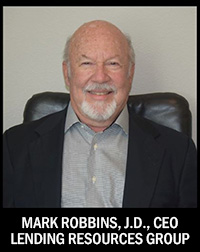
Mark Robbins has pioneered non-recourse financing for IRA investors since leveraged financing became available to the public through a small bank in the Midwest in 2004. Since that time only a few select banks even offer these loans. He has established and maintained relationships with these lenders over the past twenty years.
Mark has obtained non-recourse loans, per IRS regulations, for numerous real estate investors in more than 30 states including Hawaii. Mark is a preferred provider for many of the IRA servicing companies including the Equity Trust Company, uDirect IRA, the Provident Trust Group, Entrust and many other IRA custodial and administrative providers for clients who require non-recourse financing for their IRA funded real estate investments.
Mark graduated from New York University in Bronx, New York with a B.A. in History and Western State College of Law in Fullerton, California with a Juris Doctorate (J.D.). Mark is an entrepreneur and has operated several different businesses over the past forty years including a division of a major commodities investment firm, his own hi-tech executive search company and presently a commercial real estate mortgage brokerage company known as Lending Resources Group Inc. that he founded in 2007.
He has been a real estate investor and developer having designed and built four homes since 1982. He became a mortgage banker in 2002 with Bank of America and went on to work for CTX Mortgage, a division of the home building company, Centex Corp., in Dallas. Mark was recruited to start an in-house mortgage division for a popular townhome development company in San Francisco in 2006. That firm dissolved in the wake of the financial crisis in 2007=2008. During his tenure in mortgage banking, Mark has generated more than $120 million in residential and commercial mortgages for homeowners and investors nationwide.
If you have any questions about how to invest your IRA in real estate, please contact Mark at 415-309-1803 or by email: [email protected]. You can also reference his website at: www.lendingresourcesgroup.com.