

Why More Homeowners Are Facing Unaffordable Payments
By Rick Tobin
In recent times, the media has focused on how much higher the 30-year fixed mortgage rate average is today than on the other monthly payment obligations that go along with property ownership.
Ironically, the only rate or payment that might be fixed and stable is the 30-year fixed mortgage rate payment that’s fixed at 3%, 4%, 5%, 6%, or closer to 7.5% today.
For budget planning purposes, it is much easier for homeowners to set aside the exact same monthly amount for their principal and interest payment for their 30-year fixed rate mortgage. However, the rapidly rising insurance, property tax, and homeowners insurance (HOA) payments (if applicable) might be twice as high as a few years ago. Additionally, utilities and maintenance costs for repairs may be much higher today than in previous years.
Let’s take a closer look below at what is happening to potentially cause much higher HOA, insurance, and property tax payments so that many of you better understand why your monthly house payments are possibly the highest that you’ve ever paid to date.
article continues after advertisement

Homeowners Association Trends
More than 1-in-3 US residents, or upwards of 78 million Americans, live in some type of residential housing (homes, condos, townhomes, etc.) with a homeowners association, as per TrueHOA.
The vast majority of new residential home developments being built have an HOA connected to these newly built communities. Some estimates claim that as high as 81% of new homes sold have an HOA, according to sources like the Foundation For Community Association Research.
An increasing number of HOAs across the nation are becoming financially insolvent, partly as a result of their own skyrocketing insurance payments for the entire HOA community. If so, this is a reason why so many homeowners are seeing much higher HOA fees or receiving outrageous special assessments.
New HOA Reserve Requirements

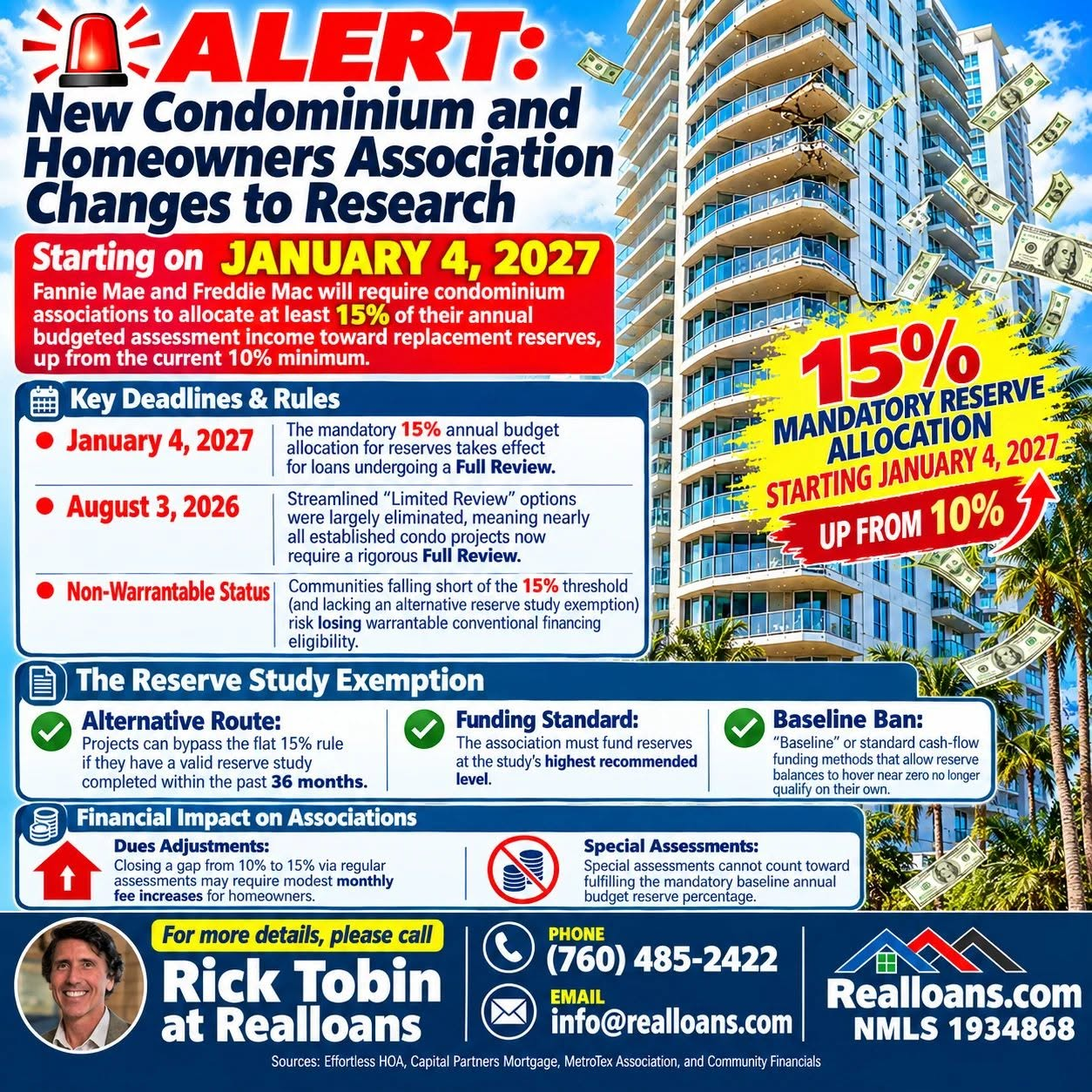
On January 4, 2027, Fannie Mae and Freddie Mac (two largest mortgage servicing companies in the nation) will require that HOAs boost their reserve requirements from the current 10% up to 15% of their annual assessment income. This will be quite challenging for many struggling HOAs, sadly.
If the HOA reserves don’t meet the new minimum 15% threshold, fewer lenders will be able to fund loans in these communities. This is especially true for potentially losing access to the more affordable conforming or conventional 30-year fixed mortgages purchased in the secondary market by Fannie Mae and Freddie Mac. If this happens, more borrowers may need to find more expensive non-conventional loans or even private money loan sources.
If so, it may negatively impact future home or condominium sale trends within affected HOAs.
Here’s a more detailed summary of these HOA reserve requirement changes from multiple sources that are compiled below:
Starting January 4, 2027, Fannie Mae and Freddie Mac will require condominium associations to allocate at least 15% of their annual budgeted assessment income toward replacement reserves, up from the current 10% minimum.
📅Key Deadlines & Rules
- ✅January 4, 2027: The mandatory 15% annual budget allocation for reserves takes effect for loans undergoing a Full Review.
- ✅August 3, 2026: Streamlined “Limited Review” options were largely eliminated, meaning nearly all established condo projects now require a rigorous Full Review.
- ⚠️Non-Warrantable Status: Communities falling short of the 15% threshold (and lacking an alternative reserve study exemption) risk losing warrantable conventional financing eligibility.
💡The Reserve Study Exemption
- 🔎Alternative Route: Projects can bypass the flat 15% rule if they have a valid reserve study completed within the past 36 months.
- ⚠️Funding Standard: The association must fund reserves at the study’s highest recommended level.
- ❌Baseline Ban: “Baseline” or standard cash-flow funding methods that allow reserve balances to hover near zero no longer qualify on their own.
📉Financial Impact on Associations
- 📊Dues Adjustments: Closing a gap from 10% to 15% via regular assessments may require modest monthly fee increases for homeowners.
- 📌Special Assessments: Special assessments cannot count toward fulfilling the mandatory baseline annual budget reserve percentage.”
Sources: Effortless HOA, Capital Partners Mortgage, MetroTex Association, Community Financials, and Google Generative
Recent Massive California Condo HOA Assessment Examples
In Torrance, California located within Los Angeles County, the homeowners association (HOA) for a 499-unit condominium complex recently approved a multimillion-dollar emergency assessment to repair major defects in the common area region. This amounts to a $49,000 special assessment fee for each of the 499 condominium unit owners.
The primary reasons why the HOA board had to move so quickly and approve this $49,000 assessment per unit was to cover deferred maintenance, soaring new insurance premiums and upgrade demands made by the insurance company, and strict new California state safety mandates.
Some of this work that must be completed includes a $13 million dollar overhaul of the building’s podium, which is the lower base section of a multi-story building that supports taller condominium towers or other structures built on it.
If the podium base for any type of building structure ever collapsed, there could be significant loss of lives if the above-ground condo structures imploded as well.
Further south from Torrance in San Clemente down in Orange County, homeowners at the Vilamoura condominium complex in Rancho San Clemente were recently hit with a shocking $26,000 emergency special assessment per unit for urgent roof replacements.
Here’s a more concise summary of this San Clemente HOA assessment situation:
⚠️ The Situation at Vilamoura
- The Cost: Each of the 198 units faces a $26,000 bill totaling a multi-million dollar project.
- The Reason: The HOA cited emergency roof repairs and a broader $5.2 million infrastructure and fire-suppression project.
- Payment Options: Owners were told to pay in full, split into two payments, or pay roughly $2,000 per month for six months followed by $400 monthly installments.
- The Conflict: Residents launched a board recall effort, claiming the roof deterioration was known deferred maintenance rather than a sudden emergency.
- The Legal Reality: Legal experts note that under California law, homeowners generally must pay special assessments while fighting them, as withholding payment can lead to liens and foreclosure.
Sources: ABC7, Yahoo, and Google
High-Rise Condominium Tower Risks

HOA and insurance payments often tend to rise together. Many times, the insurance companies insuring the condominium association and common area demands that certain items be repaired or they will stop insuring the entire HOA. As a result, the HOA may have to assess individual property owners to pay for these improvements required by the insurance company.
There’s really no state that has been negatively impacted the most by serious HOA and insurance issues than the state of Florida. California, Texas, and many other states are also getting hit hard as well by these same issues, but not as badly as Florida yet.
The implosion of the Champlain Towers in Surfside, Florida (Miami-Dade) back in 2021 was a catalyst to set off a chain reaction that is adversely affecting high-rise towers in Florida and even across the nation to this day.
The legal outcome of the Champlain Towers collapse story was the SB 4-D legislation, which passed in 2022, that requires all owners of condominiums older than 30 years to hire outside engineering and/or architects to thoroughly inspect these properties no later than December 31, 2024.
These inspections were or will be used to ensure that the usually financially insolvent HOAs have enough funds to cover the repairs or they must rapidly increase the monthly HOA payments that could be increased by several hundred or thousands of dollars per month.
Local, state, or federal agencies may have the power or legal right to fine or assess apartment building landlords or individual high-rise condominium owners with $100,000 to $300,000+ retrofit requirements per unit to modernize balconies, air conditioning and heating systems, appliances, windows, and other property features while insurance costs skyrocket.
Then, these older and more spacious affordable building units may be replaced with new smaller and more costly “smart” buildings that rent for $10 to $20+ per square foot (or up to $4,000/month for a 200 square foot unit) while closely following the newly restrictive high-density zoning laws.
If so, there will be an increasing number of motivated sellers who wish to avoid these new HOA assessments and “green living” requirements, especially if their own homeowners insurance company cancels their policies due to the perceived risks.
A homeowner with a mortgage who loses all access to insurance will then later have a mortgage default trigger and subsequent foreclosure filing, sadly.
For more details, please read my article entitled Weather Extremes, Homes, and Insurance Risks.

The Unfair FAIR Plan
The California FAIR (Fair Access to Insurance Requirements) Plan is a state-mandated insurance pool that isn’t funded or managed by the state, ironically.
The FAIR Plan is described as the “insurer of last resort” for California property owners who are canceled or not approved by private insurance companies due to perceived risks with their homes or locations.
The FAIR Plan is a private association funded and managed by all licensed property and casualty insurers in the state of California, while sharing risks proportionally.
Approximately one-in-seven California homeowner policies are no longer written directly by a standard private carrier. However, these same homeowners who have to seek more costly FAIR Plan insurance policies continue to pay the privately-pooled insurance companies indirectly through the FAIR Plan.
The more expensive FAIR Plan covers just basic insurance protection related to fire, lightning, internal explosion, and smoke.
Sadly, many property owners are required to seek out a second type of supplemental insurance policy that may be described as a Difference in Conditions (DIC) wrap policy to cover the gaps in insurance, which protects both the homeowners and their lender.
This month on October 15, 2026, the average statewide FAIR Plan insurance policy is scheduled to increase by another 29.1%, sadly.
Increasing Property Taxes

Property tax and homeowners insurance payments have risen so much in many U.S. regions that the monthly property tax and homeowners payments can both be as high as an average mortgage payment. It’s truly a pity that the monthly PITI (Principal, Interest, Taxes, and Insurance) payments have reached unaffordable levels for so many homeowners across the nation.
As I shared in an article from last year in October 2025 that’s entitled Rising Property Taxes and Insurance: A Growing Concern for Homeowners, just this combination of taxes and insurance rapidly increasing in monthly payments is inspiring some people to sell their homes.
An analysis by Lending Tree that was published and updated in May 2025 found the median property taxes across the nation rose by an average of 10.4% between 2021 and 2023.
Whether or not a homeowner owns their property with or without a mortgage, they must continue to pay at least their property tax payments or risk losing the residential or commercial property to a future foreclosure tax sale.
By comparison, the decision to hold a homeowners or landlord insurance property on a free and clear property is solely up to the property owner who is willing to take the risk associated with fires, floods, and other damaging events. Many landlords today with free-and-clear properties may also have negative cash flow, so they stop paying for insurance.
article continues after advertisement

Property Tax Trends
Let’s take a closer look at what was gathered, analyzed, and shared by both Lending Tree and the Tax Foundation as it relates to property tax and homeownership trends through 2023:
- U.S. homeowners paid a median property tax payment of $2,969 annually, or about $247 per month.
- Homeowners without a mortgage can select insurance policies with lower coverage limit amounts because they don’t have to also protect a mortgage lender on the same policy. As a result, the annual premium amounts are usually lower for homes with no mortgage debt.
- Homeowners without a mortgage for their free-and-clear properties paid a median of $2,474 in annual property taxes, while those with a mortgage paid almost $869 more per year at a median of $3,343.

The Staggering Total Combined Housing and Life Expenses
My best advice to property owners is to sit down in a quiet room and write down your actual budget for your home, condominium, townhome, duplex, triplex, fourplex, or other type of residential or commercial property.
Please include your monthly mortgage payment if it’s not a free-and-clear property and how much you actually pay for insurance, property taxes, and HOA fees (if applicable) along with utilities (electric, gas, water, trash, internet, etc.).
If your expenses far exceed your income, then should you consider selling your property?
If you don’t want to move, do you have enough equity to qualify for a cash-out mortgage to pay off some of your other consumer debts like car, credit card, student loans, or business loans as well as to help cover your housing costs?
If you or your spouse are over the age of 62, does a reverse mortgage with no monthly payments make more sense?
For many people, the most common first reaction to a scary or negative situation that’s especially related to financial challenges is denial.
What we avoid in life controls us, so we must attack it head-on for the pain and fear to dissipate. For financial planning, the “attacking it head-on” reaction starts with writing down your monthly budget to best determine what you should do to reduce your expenses and increase your peace of mind.
For a free monthly budget analysis that includes your total housing payments and other consumer debts in addition to a review of your overall blended debt rates actually paid, please contact me today.
For more details, here’s my What’s Your Blended Debt Rate? article.


Rick Tobin has worked in the real estate, financial, investment, and writing fields for the past 30+ years. He’s held eight (8) different real estate, securities, and mortgage brokerage licenses to date and is a graduate of the University of Southern California.
Rick provides creative residential and commercial mortgage solutions for clients across the nation. He’s also written college textbooks and real estate licensing courses in most states for the two largest real estate publishers in the nation; the oldest real estate school in California; and the first online real estate school in California.
Please visit his website at Realloans.com for financing options, join his investment group at So-Cal Real Estate Investors, and follow his new So-Cal Real Estate TV channel for more details.
Rick Tobin
Realloans (Real Estate Loans)
https://realloans.com/
Phone or Text: (760) 485 – 2422
NMLS 1934868
Equal Housing Opportunity / Equal Housing Lender
To quickly apply online: Loan Application
For our real estate course: Learn Real Estate
Please follow our new real estate channel (watch on television, computers, and phones): So-Cal Real Estate TV
Our Facebook business pages: Realloans, Inside Los Angeles, Inside Pacific Palisades, Inside Long Beach, Inside Huntington Beach, Inside Orange County, Inside La Jolla, Inside San Diego, Inside Lake Elsinore, Inside Temecula Valley, Inside Coachella Valley, and So-Cal Real Estate Investors.
Here are some of my articles: The Fall of 2025 and Rise of New Opportunities, The Intersection of Declining Home Sales and Creative Marketing, Are Lower Rates on the Horizon?, Weather Extremes, Homes, and Insurance Risks, The California Gold Rush Boom, and Are You Focused on Commercial Real Estate?
Please join my So-Cal Real Estate Investors group that meets at Canyon Lake Golf & Country Club, Shoreline Yacht Club in Long Beach, and online: So-Cal Real Estate Investors.