Studio KHORA examines how contemporary architecture is evolving beyond Desert Modernism through innovative, sustainable, and site-responsive design in Palm Springs.
Beyond Desert Modernism
Palm Springs has long been associated with architectural certainty.
What became known as the Palm Springs School of Architecture emerged from a dialogue between modernism and the desert, transforming climate, landscape, and light into architectural language.
Yet every architectural language eventually encounters its own repetition.
The question is no longer how to preserve an idea.
The question is how to continue it.
This challenge increasingly defines the work of Palm Springs Architects today. The most compelling Contemporary Architecture does not imitate the desert. It interprets it. Landscape is not a backdrop but an active participant in the experience of space.
For Studio KHORA, the desert remains a site of inquiry.
article continues after advertisement
The Glass House, envisioned for Palm Springs, explores a relationship between transparency, light, and environment. Rather than separating architecture from landscape, the design imagines the desert itself as part of the architecture. Sustainable systems, environmental responsiveness, and spatial openness are conceived as integral components of the project rather than additions to it.
The role of Palm Springs Architects is therefore changing.
Architecture no longer seeks merely to occupy the desert.
It seeks to enter into dialogue with it.
At Studio KHORA, Contemporary Houses are conceived through this dialogue, creating residences that are innovative, sustainable, and deeply connected to place.
For those seeking distinction, architecture begins where repetition ends.
https://www.realestateinvestormagazines.com/wp-content/uploads/2026/07/Screenshot-2026-07-10-110924.jpg9061833dulcehttps://www.realestateinvestormagazines.com/wp-content/uploads/2013/04/logo.pngdulce2026-07-10 04:04:262026-07-10 04:04:31Studio KHORA Explores the Future of Contemporary Architecture in Palm Springs
Did you know that approximately 25 million people, or 63% of California’s 40 million residents, live in the 10 counties located in Southern California (San Luis Obispo, Kern, Santa Barbara, Ventura, Los Angeles, Orange, San Diego, Riverside, San Bernardino, and Imperial)?
San Bernardino County is the largest county in the nation by land size that spans over 20,100 square miles. Los Angeles County is the most populous county in the nation, with more than 10 million residents.
There are few places more beautiful in the entire world than the Southern California region. It’s been said that the three most important factors that cause home prices to rise are due to “location, location, and location.” California’s historic price boom over the past 55+ years is more proof why as it will be shared next with more details.
article continues after advertisement
The Extreme Dollar & California Home Seesaw Ride
As the dollar’s purchasing power falls, home values tend to rise. Most of the dollar’s decline in value took place during the 55-year time period that followed President Nixon’s removal of the dollar from the gold standard starting in 1971.
The purchasing power of the dollar has fallen by -87% between 1971 and 2026. $100 in 1971 fell to an equivalent purchasing power in these years: 1981 ($45), 1991 ($30), 2001 ($23), 2011 ($18), 2021 ($15), and 2026 ($13). What you could purchase for $100 in 1971 is now similar to what you can buy for $13 in 2026.
Because real estate is an exceptional hedge against inflation and an imploding dollar somewhat like an inverse seesaw, California median home prices increased by a whopping +3,361% during the same time period between 1971 and 2026.
By Q2 2026, the statewide California median single-family home price reached $930,260, as per various sources like CAR (California Association of Realtors) and NBC. When compared to the historical statewide median price of $26,880 in 1971, California home prices rose a staggering +3,361% higher, while representing a home price increase of about $903,380.
To put these numbers into better perspective, if you adjust 1971’s home prices for cumulative national inflation over the same time period, which is roughly 833%, a comparable home would’ve cost somewhere between $250,000 and $270,000 today. Yet, the actual appreciation of California home prices far outpaces general inflation at a pace of 2,528% higher (3,361% – 833%) between 1971 and 2026.
As such, California truly is the “Golden State” in more ways than one.
California’s Safer Gated Communities
California and Florida were the two states that created the master-planned home communities behind gates starting with the Temple Terrace, Florida community, which was America’s first master-planned golf course community built in 1925. Shortly thereafter, Rancho Santa Fe in San Diego County followed in 1927 here in Southern California.
Gated golf course communities were later truly perfected in Riverside County, California out in the Greater Palm Springs or Coachella Valley region starting with the opening of the Thunderbird County Club in Rancho Mirage in 1951.
Did you know the popular Ford Thunderbird car was named after this country club because the Ford Chairman at the time named Ernest Breech was a golf club member? Thunderbird Country Club was also the credited birthplace of another form of transportation called the motorized golf cart.
Famous celebrity residents and members at Thunderbird included Lucille Ball and Desi Arnaz, Bing Crosby, Bob Hope, Frank Sinatra, Dean Martin, Clark Gable, Gerald and Betty Ford, and Perry Como.
Later, gated communities were built all across Coachella Valley that were designed around golf courses, tennis courts, and small lakes.
Both celebrities and non-celebrities began to truly appreciate the privacy and feelings of safety that gated communities offered them.
article continues after advertisement
California’s Very Few Gated Cities
Most gated communities are just very large HOAs (Homeowners Association) or POAs (Property Owners Association filled with homes and vacant lots) instead of actual separately gated cities. However, there are a few exceptions to this rule.
Technically, there may only be three gated cities in California as follows:
1. Canyon Lake (Riverside County): It’s the largest gated California city, right between Lake Elsinore and Menifee, with their own beautiful lake, golf course, fire department, and soon-to-be brand-new police department that’s scheduled to open up for business in August 2026, following their ribbon-cutting event on Friday, July 31st at 4 pm PST at the Canyon Lake Towne Center.
2. Hidden Hills (Los Angeles County): An entirely gated, incorporated city in the Santa Monica Mountains that’s best known for horse trails, lack of streetlights, and celebrity residents.
3. Rolling Hills (Los Angeles County): It’s located on the beautiful Palos Verdes Peninsula, just north of Long Beach and San Pedro. Every single property there is zoned as a ranch with mandatory horse trails.
Other regions often mistaken as “gated cities” include Coto de Caza in Orange County, which is technically a Census-Designated Place (CDP) rather than an incorporated gated city, and Bradbury Estates in Los Angeles County that’s partially gated.
Because many coastal Southern California homes are priced in the millions, a larger number of residents are moving to the Inland Empire (Western Riverside County, especially) instead of packing up and moving out of state hundreds or thousands of miles away from family and friends. To learn more details, this is a very interesting 8-minute video: Why Everyone is Moving to the Inland Empire.
So-Cal City Spotlight: Canyon Lake (“A Bit of Paradise”)
Let’s first learn why Canyon Lake is attracting so many new residents and businesses from the President and CEO of the Canyon Lake Chamber of Commerce named Johnny Pineda:
“Canyon Lake continues to stand out as one of Southern California’s most desirable communities because it offers far more than beautiful homes, it offers an exceptional lifestyle. Buyers are drawn to its private lake, resort-style amenities, strong sense of community, and convenient access to surrounding employment centers, making it an attractive place to live, invest, and raise a family.
For business owners, Canyon Lake provides a loyal, engaged customer base and a Chamber of Commerce committed to fostering economic growth through meaningful partnerships and community involvement. It’s a community where quality of life and long-term value go hand in hand.”
The Origins and Evolution of Canyon Lake
Canyon Lake was first established back in 1968. The original architect for Canyon Lake designed it after my old hometown of Huntington Harbour.
Lots could be purchased as low as $5,000 to $10,000 as my family knows firsthand because my father purchased a $5,000 lot so that we could pull our ski boat from Huntington Beach to Canyon Lake and water ski there.
Let’s take a closer look at how this region grew in size over the past 58 years:
* Late 1960s to 1970s (Development): The Kaiser Land Development Company began developing and marketing the area as a country estate and recreational destination. Vacant lots started to sell at prices between $14,000 to $25,000 during the 1970s and beyond.
* 1980s to 1990s (Growth): As both the I-15 highway corridor and Inland Empire expanded, Canyon Lake transformed from a vacation destination into a primary commuter hub. By the mid-to-late 1980s, single-family homes were selling somewhere within the $130,000 to $230,000 price range.
* The 2000s Boom & Crash: Home values really started to appreciate in Canyon Lake just like most of the rest of California between 2002 and 2006 or 2007 near the previous housing market peak. The median home price broke the $300,000 mark by 2003 and later peaked near $425,000 in 2005. Subsequent to the housing bust meltdown following 2008, prices fell nearly 50% back into the $200,000 price range by 2009 to 2011. California home prices fell -41.7% from peak-to-trough between 2008 and 2012, so Canyon Lake’s losses were worse than median statewide losses.
* 2012 – 2019 (Recovery): The housing market began to stabilize before later shooting skyward throughout the 2010s years. By 2018, the Canyon Lake median home sales price reached almost $414,000.
* 2020 – 2026 (Pandemic & Record Low Rate Surge): Home prices began to really increase as more coastal Southern California residents, who could no longer afford multi-million dollar fixer uppers by the beach, discovered Canyon Lake and moved out here in large numbers. Canyon Lake median home prices fluctuated between $750,000 and to more than $900,000. Some new home listing prices today for large waterfront homes are in the $4 to $5 million dollar price range.
Canyon Lake effectively offers affordable waterfront living in Riverside County that’s within a 1-hour to 1.5-hour driving distance for residents to places like Huntington Beach, Newport Beach, Laguna Beach, Los Angeles, San Diego, and to the Palm Springs region east of Canyon Lake.
Canyon Lake was just ranked #2 on the 8 Best Lake Towns in the U.S. for Retirees list in June 2026 by Travel and Leisure.
The adjacent Canyon Hills master-planned community, which first broke ground in 2001, is another very nice community that has almost the same number of 11,000 to 12,000 residents as Canyon Lake.
While being more affordable than Canyon Lake and located in the city of Lake Elsinore (largest freshwater lake in Southern California), most of the Canyon Hills homes are newer and development continues onward to this day. Canyon Hills has also been the fastest-growing home development community in Riverside County over the past 25 years.
On the other side of Canyon Lake is the city of Menifee with upwards of 125,000 residents, which was just ranked as the only “boom town” located in Southern California by SmartAsset because of their +29% growth rate over the past five years.
Thanks to the old real estate theory known as the principle of progression, the higher-priced waterfront homes in Canyon Lake are helping the adjacent home values in Canyon Hills and Menifee move higher due to being so close to this prime location with multi-million dollar homes.
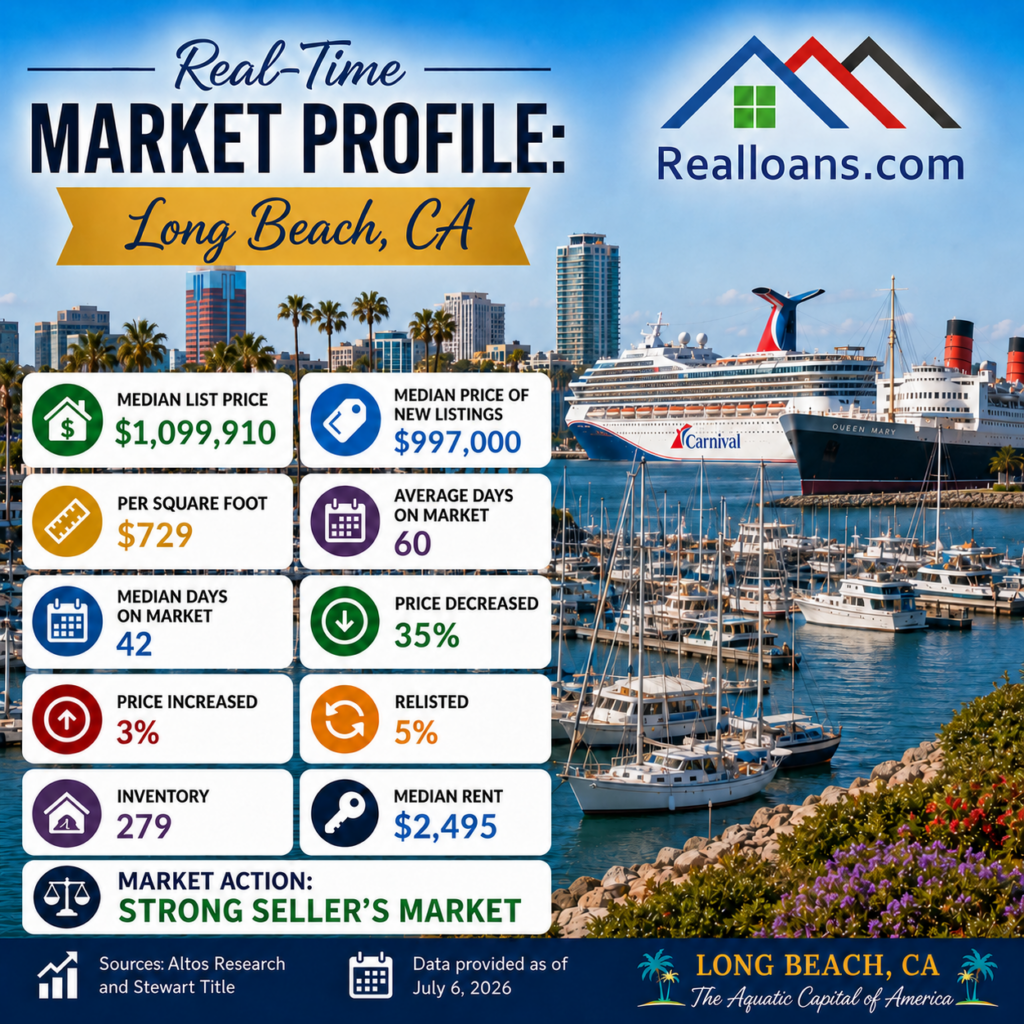
So-Cal City Spotlight: Long Beach (“Aquatic Capital of America”)
Could Long Beach be considered as the most “affordable unaffordable beach city” in Southern California? How can this seemingly contradictory “affordable unaffordable” oxymoron be true at the exact same time?
Let’s take a closer look at the amazing city of Long Beach:
The Top 4 Most Unaffordable Housing Regions in the World
The Top 4 Least Affordable Housing Regions in the World (home price-to-household income ratio) are all located in California:
1. San Jose 2. Los Angeles 3. Long Beach (2nd largest city in Los Angeles County after the City of Los Angeles and 7th largest in the state) 4. San Diego Source: Remitly
The Top 7 largest California cities are: 1. Los Angeles, 2. San Diego, 3. San Jose, 4. San Francisco, 5. Fresno, 6. Sacramento, and 7. Long Beach.
The most densely-populated area in America is in the Los Angeles-Long Beach-Anaheim metropolitan region, with more than 13 million residents.
Long Beach’s Household Income
While Long Beach is one of the most beautiful regions in the world with a very diverse economy, their home prices are somewhat reasonable as compared with nearby coastal regions in Seal Beach, Huntington Beach, Newport Beach, and Palos Verdes.
This is partly because the median household income range in Long Beach is somewhere within the $87,000 to $91,000 range for one, two, or more worker occupants in the same household.
This is a core reason why Long Beach was listed as the #3 most unaffordable housing regions in the entire world on a home price-to-household income ratio basis.
Long Beach and San Pedro (both described as the Port of Los Angeles) are the shipping port capitals here in America. In early 2026, Long Beach processed more shipped goods than any other port in North America.
Long Beach will host at least 11 different sporting events in 2028 when the Los Angeles Olympics takes place. As a result, new construction continues onward at a rapid pace with venues such as the Long Beach Amphitheater (largest waterfront venue on the West Coast with an 11,000 person capacity) that just opened in June 2026, which is right adjacent to the historic Queen Mary ship.
Quality of Life, Prime Locations, and Massive Home Price Gains
Southern California residents benefit from living in one of the most scenic locations on the planet, right adjacent to the world’s largest body of water called the Pacific Ocean. Yet, they also can grab their snow skis or snowboards and drive up to Big Bear Mountain in San Bernardino County on the same day when they surfed a wave earlier in the morning by the Huntington Beach Pier.
Some of the most amazing golf courses in the nation are located in Southern California, especially in the Newport Coast at Pelican Hills, Torrey Pines in La Jolla, Riviera Country Club in Pacific Palisades, Canyon Lake Golf & Country Club, or at more than 100 different golf courses in the Coachella Valley (Palm Springs, Palm Desert, Rancho Mirage, La Quinta, etc.).
I’m not sure that any other home region in America had a better +3,361% home price gain between 1971 and 2026 than Southern California. Even if there were a region with a more impressive home price percentage gain, it’s highly doubtful that their year-round climate and quality of life were better than in Southern California.
To learn more details about the benefits of living and investing in Southern California, please join my So-Cal Real Estate Club where we primarily meet in Canyon Lake, Long Beach, and online.
Rick Tobin has worked in the real estate, financial, investment, and writing fields for the past 30+ years. He’s held eight (8) different real estate, securities, and mortgage brokerage licenses to date and is a graduate of the University of Southern California.
Rick provides creative residential and commercial mortgage solutions for clients across the nation. He’s also written college textbooks and real estate licensing courses in most states for the two largest real estate publishers in the nation; the oldest real estate school in California; and the first online real estate school in California.
Please join my So-Cal Real Estate Investors group that meets at Canyon Lake Golf & Country Club, Shoreline Yacht Club in Long Beach, and online: So-Cal Real Estate Investors.
https://www.realestateinvestormagazines.com/wp-content/uploads/2026/07/Canyon-Lake-and-Long-Beach.jpg4001000dulcehttps://www.realestateinvestormagazines.com/wp-content/uploads/2013/04/logo.pngdulce2026-07-07 04:51:162026-07-08 00:43:31Southern California’s Historic Housing Boom: Canyon Lake & Long Beach Spotlights
Please review this important message from our sponsor.
Join Us for Our Next LIVE Webinar!
Hello Realty411 Member,
Did you know that 90% of the world’s millionaires built their fortunes through real estate?
But there’s a specific “secret” within real estate that the wealthiest families have used for generations to stay on top — and it’s called Land Banking.
My friend and trusted land banking expert, Marcella Silva, is hosting a special webinar called “The Basis of All Wealth” and we’d love for you to join in.
article continues after advertisement
She is going to dive into:
Why land is the ultimate inflation-proof asset.
Why the demand for land is skyrocketing due to current economic trends and emerging technologies.
Discover where and why we invest–gain insider knowledge on booming areas from the industry’s best.
Discover how land banking can be your secret weapon for long-term wealth creation and portfolio diversification.
The beauty of a real estate asset that has “No Tenants, No Toilets, and No Termites.”
Can’t make it live? Register anyway and you’ll get a replay.
They aren’t making any more of the critical asset everyone and everything uses — and the window to get in front of the next wave of growth won’t stay open forever.
Since 2007, Realty411.com has assisted top companies expand their visibility and grow their business. Contact us for a complimentary marketing session: CLICK HERE.
https://www.realestateinvestormagazines.com/wp-content/uploads/2026/07/live-webinar.jpg4001000dulcehttps://www.realestateinvestormagazines.com/wp-content/uploads/2013/04/logo.pngdulce2026-07-03 03:18:522026-07-16 02:00:19A Secret the Wealthiest Families Have Used for Generations
Under the leadership of Anderson Hallas Architects, the design approach will place sustainability at the forefront of the new facility
Submitted by Paul Suter
Westminster, CO (June 2026) – 360 Engineering, a full-service mechanical engineering firm working on projects of all sizes in Colorado and across the U.S., is proud to announce that it is part of a team delivering a new 32,743 square foot courthouse to the City of Westminster. The new facility, which is being designed under the leadership of Anderson Hallas Architects with FCI Constructors serving as the construction manager and general contractor, will replace the existing structure which is more than 60 years old and is no longer suited for modern courthouse operations.
The new courthouse is being built on the same site as the existing courthouse while the existing courthouse remains in full operation.
“We greatly appreciate our partnership with Anderson Hallas Architects as their team will place sustainability at the forefront of the design approach while achieving a LEED Gold certification,” said Lexie Zimmerman, PE, Director of Operations for 360 Engineering.
The contractual goal is LEED Silver, and through thoughtful design, equipment prioritization, and an effective partnership with FCI Constructors the project will achieve a LEED Gold designation along with achieving a stretch goal of net zero with the building and site mounted photovoltaics.
Once the design phase began, under the lead of Anderson Hallas Architects, 360 Engineering evaluated multiple mechanical system options to meet the building’s sustainability, operational, budgetary, and maintenance goals. Following the evaluation, the city selected the multi-zone heat pump rooftop unit system. This system offers the lowest first cost, reduced indoor space requirements, simplified maintenance, and lower building noise levels. In addition, it enables an all-electric building design with no reliance on natural gas.
article continues after advertisement
After the major mechanical system was selected, the mechanical and plumbing systems were designed to serve the courtrooms, jury selection areas, holding cells, and administrative spaces throughout the facility. 360 Engineering worked closely with the construction team to ensure a smooth, efficient construction process, including an early long-lead procurement of mechanical systems to streamline the construction schedule.
More information regarding 360 Engineering is available at www. 360eng.com
https://www.realestateinvestormagazines.com/wp-content/uploads/2026/07/court1.jpg4001000dulcehttps://www.realestateinvestormagazines.com/wp-content/uploads/2013/04/logo.pngdulce2026-07-01 04:32:112026-07-01 04:34:50360 Engineering is Part of the Team Bringing New Courthouse to the City of Westminster
As many of you know, being self-employed is not an easy task by any stretch of the imagination. I have certainly worked for both small independent companies as well as large corporations throughout my various careers. I’ve worked for the Bank of America’s of the world as well as private real estate development companies and smaller private mortgage companies. I’ve seen both sides of the employment spectrum. Every experience has its own set of positives and negatives. I eventually decided it was best to pursue my career as a mortgage consultant on my own terms.
article continues after advertisement
It’s been a very challenging endeavor to navigate the world of real estate financing in the private sector as opposed to the more conservative world of conventional banking. I chose the commercial real estate marketplace for two main reasons. I enjoyed the variety of each unique transaction. Whether I was helping a client finance a small apartment building or purchase a retail shopping center, the challenge was never the same. Secondly, financing mortgages strictly for home purchases or refinances involved too much of the same thing repeatedly.
Lending Resources Group Incorporated was born in late 2007 and licensed by the State of California in May 2008, just before the “Crash,” now known as the Great Recession of 2008. It seems like my career path has been dictated by the ups and downs of our economy over the past four decades. Ever since I graduated from law school and sought a job in the financial industry, I have run the gauntlet of the financial markets’ highs and lows.
GAS STATIONS?
When I was starting out with my own corporation in 2008 under the name Lending Resources Group Inc., I needed to find a source of leads for people who needed my services. I found a company that sold leads, so I subscribed to its service.
One of those leads was an individual who owned Shell gas stations. He wanted to purchase two more stations that were up for sale. After three months, I found a lender that approved a $2 million loan to meet his request. Unfortunately, the client had a heart attack. The good news was that he survived; the bad news was that he had to turn the loan down because his doctor told him he needed to reduce the stress in his life and, therefore, shouldn’t buy any more gas stations. Ugh! What can you do? Absolutely nothing—you just move on.
I had another client approved for a loan to purchase a gas station in Los Angeles, but that came at the same time the stock market crashed and banks were hit very hard in September 2008. Many had to close. One of the banks that closed was the one that had approved this gas station loan. So there I was again, working hard but not earning much of a living due to the investor’s health problems as well as world-changing events.
Disappointing? Yes, but that’s life. Those events didn’t deter me from my goal of building a lasting commercial mortgage financing business. Now that I’m writing this, it’s been a challenging task to chronicle my early days of starting my own mortgage company. After all, that was nearly twenty years ago. I didn’t keep a diary of the deals I was working on. Suffice it to say, I took whatever came along and used my know-how to find solutions. My memory still serves me very well, allowing me to recollect some of the more memorable loan situations I faced.
I was barely scraping by, especially with the onset of the Great Recession. I was lucky in one respect. Since the banks were hit so hard by the economic downturn and because I had a sizable mortgage on my primary residence, they left me alone. This bought me the time I needed to build up my business and, in the interim, see what solutions the banks were going to develop, if any, to assist borrowers like myself. I eventually did receive a workout solution for my home mortgage. I was able to straighten out my financial affairs and stabilize our living situation while building my new business.
NON-RECOURSE LOANS
Business was hard to come by, considering we were in a recession just as I was trying to get my company off the launching pad. Somehow, I was eking out a living. I was very motivated to help people achieve their real estate financing goals. One steady stream of income I developed was specializing in helping investors obtain non-recourse loans (loans without a personal guarantee) when purchasing real estate with their IRAs, trusts, or Solo 401(k)s.
Back in 2004, three years before I started Lending Resources Group, I was introduced to the Founder and Chairman of Pensco Trust in San Francisco. Pensco was one of the largest IRA custodian companies in the U.S. It later became Pacific Premier Trust and moved to Denver when the Chairman retired. This was during the time I was working as a mortgage broker for CTX Mortgage, a division of the Centex homebuilding company based in Dallas, Texas.
The Chairman suggested I investigate this type of mortgage because no one in the U.S. was offering it at that time. Four months after that meeting, a small bank in the Midwest introduced a non-recourse mortgage loan program for people who wanted to invest their retirement funds in real estate and needed a mortgage to complete the financing. This allowed investors to purchase one-to-four-unit properties with their IRA retirement funds without personally guaranteeing the loans. This was required by the Internal Revenue Service because the retirement funds had not yet been taxed. The IRS did not want its tax interest in those funds involved in any transaction that required a personal guarantee. If the investor needed to access those funds in the future, the IRS would then receive its taxable share.
Prior to 2004, if someone wanted to invest retirement funds in real estate, they had to pay all cash. There was no such thing as a non-recourse mortgage for residential real estate investing before 2004. As a result of this new product, I slowly began to find clients, mostly through referrals and word of mouth, while working for CTX Mortgage and working hand in hand with Pensco. They were a great source of referrals for me. By the time I started my own mortgage company, I was becoming better known for being able to arrange these specialty loans. That has continued to this day. These loans have provided a helpful supplement to the main portion of my commercial mortgage business.
article continues after advertisement
BURBANK BUILDING – MONTH TO MONTH LEASES
Getting to the heart of what I have dealt with over the past twenty years is best described through some of the more unique situations I’ve had the opportunity to be part of.
In my constant search for business, I found another client who was having trouble refinancing his property, an office building. He needed to pay off his existing loan and obtain enough money to make much-needed renovations to the building. The property was located in Burbank, CA, and comprised thirty small office units. The client needed $3.5 million to pay off his current debt and obtain an additional $500,000 to make improvements. I remember searching high and low for a lender for this client but constantly running into rejections because the tenants were on month-to-month leases. No lender I found was willing to lend that much money without the assurance that the tenants would maintain longer-term leases.
The positives of this transaction included having a motivated client who wanted a new loan. He also had good credit and a solid income as a certified public accountant (CPA). Moreover, most of his tenants had been in the building for many years, and occupancy was consistently at 90%, even though the leases were only month to month.
In my dogged pursuit of a loan for this client, I found a reputable brokerage firm in Los Angeles that had connections with several private banks. These were the kinds of connections I couldn’t possibly have had, having been in the private money business for only three years at that point. The year was 2011, and coincidentally, I had to be in Burbank for a family celebration. I also scheduled a visit with my client to further strengthen our relationship.
The affiliate brokerage firm’s private bank ultimately provided the loan my client needed. We co-brokered the transaction. It turned out to be my first five-figure paycheck since starting the company. More importantly, it gave me the great satisfaction of overcoming a very challenging loan request and helping this client achieve his goal of refinancing his office building—something no one before me had been able to accomplish. It was a true feeling of accomplishment!
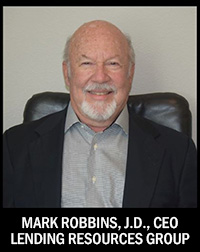
Meet Mark Robbins
Mark Robbins has pioneered non-recourse financing for IRA investors since leveraged financing became available to the public through a small bank in the Midwest in 2004. Since that time only a few select banks even offer these loans. He has established and maintained relationships with these lenders over the past twenty years.
Mark has obtained non-recourse loans, per IRS regulations, for numerous real estate investors in more than 30 states including Hawaii. Mark is a preferred provider for many of the IRA servicing companies including the Equity Trust Company, uDirect IRA, the Provident Trust Group, Entrust and many other IRA custodial and administrative providers for clients who require non-recourse financing for their IRA funded real estate investments.
Mark graduated from New York University in Bronx, New York with a B.A. in History and Western State College of Law in Fullerton, California with a Juris Doctorate (J.D.). Mark is an entrepreneur and has operated several different businesses over the past forty years including a division of a major commodities investment firm, his own hi-tech executive search company and presently a commercial real estate mortgage brokerage company known as Lending Resources Group Inc. that he founded in 2007.
He has been a real estate investor and developer having designed and built four homes since 1982. He became a mortgage banker in 2002 with Bank of America and went on to work for CTX Mortgage, a division of the home building company, Centex Corp., in Dallas. Mark was recruited to start an in-house mortgage division for a popular townhome development company in San Francisco in 2006. That firm dissolved in the wake of the financial crisis in 2007=2008. During his tenure in mortgage banking, Mark has generated more than $120 million in residential and commercial mortgages for homeowners and investors nationwide.
If you have any questions about how to invest your IRA in real estate, please contact Mark at 415-309-1803 or by email: [email protected]. You can also reference his website at: www.lendingresourcesgroup.com.
https://www.realestateinvestormagazines.com/wp-content/uploads/2026/06/mortgage.jpg4001000dulcehttps://www.realestateinvestormagazines.com/wp-content/uploads/2013/04/logo.pngdulce2026-06-27 04:18:002026-07-11 05:34:15MARK…. MY WORDS – A PRIVATE MONEY MORTGAGE BROKER’S DIARY OF DIFFICULT DEALS (Part 1)
A co-hosted event with the Beverly Hills Bar Association (BHBA), the Across Borders Alliance of Lawyers (ABAL) Conference 2026 will take place at Shutters on the Beach in Santa Monica on June 27, from 9 a.m. to 6 p.m., and convene legal professionals from India, Italy, Japan, Mexico, Singapore, the U.K., and the U.S.
article continues after advertisement
“We are so excited to bring this amazing group of esteemed judges, lawyers, solicitors, and barristers, from around the world to Los Angeles,” said Provinziano, who is president elect of the BHBA and is co-hosting the event with Aina Khan, O.B.E., a world-renowned family law specialist and founder of the ABAL. “Because Los Angeles is a gateway to the world, and our family law matters are increasingly international in scope, I look forward to learning from the best in this field.”
The day-long event features a series of panels and speakers addressing complex international legal challenges, including:
• Strategies for the rapid resolution of international child abduction cases
• Tracing assets across borders in high-net-worth divorces
• Navigating the intersection of culture and religion within foreign legal systems
• Managing cross-border disputes involving Iran amidst the current conflict
Provinziano is a fellow of the International Academy of Family Lawyers, a worldwide association of specialists, and the founder of the Los Angeles-based firm Provinziano & Associates.
“Families are increasingly international, which means family disputes are too,” Provinziano added. “It’s no longer enough for a lawyer to just know how to handle their own country’s laws; they must also be prepared to work across borders.”
The full conference agenda, including a list of speakers and session topics, is avaialable here.
About Provinziano & Associates Provinziano & Associates is a Los Angeles-based law firm specializing in high-net-worth divorces, family law, domestic violence cases, restraining orders, child custody disputes, child support, grandparents’ rights, and prenuptial agreements. Serving both Los Angeles and Orange County, its legal team has extensive experience in the complex area court system, helping to ensure the best outcome for clients facing one of the most challenging times in their lives. Founder Alphonse Provinziano and his team of attorneys are highly sought after for their expertise in managing high-stakes divorces and their thorough understanding of complex financial issues. To learn more, visit: https://provinziano.com.
https://www.realestateinvestormagazines.com/wp-content/uploads/2026/06/family-law.jpg4001000dulcehttps://www.realestateinvestormagazines.com/wp-content/uploads/2013/04/logo.pngdulce2026-06-26 06:20:402026-06-26 06:20:46Veteran California Attorney Alphonse Provinziano Co-Hosts First L.A. Conference on International Family Law
As we cross into the peak summer buying season, the mainstream media is working overtime to capture your attention with sensational, anxiety-inducing economic headlines. But when you drill past the clickbait and look at what is actually happening under the hood, the data tells a much more stable—and encouraging—story for everyday home buyers.
Fruits of preparation & Smart Buying – Call us. Call now. Let’s separate the noise from the facts.
1. The Economy: Is AI Actually Carrying the U.S.?
The media wants you to believe artificial intelligence is single-handedly fueling the American economic engine. The truth? Very little of Q1’s revised 1.6% GDP growth (down from the initial 2% estimate) came from AI.
While big tech companies spent massively on data centers in the first quarter, much of that high-end equipment and chip inventory is imported. Because imports are subtracted from GDP, the surge of investment in AI was largely a wash—canceled out by the influx of imported AI equipment. The economy is doing okay, but it isn’t relying on AI alone. Furthermore, that spending spree is hitting a cost wall: electronic component prices have soared 19.1% year-over-year, communications gear is up 13.2%, and computer prices rose 8.2%. The tech sector is learning that the physical hardware behind the cloud is becoming incredibly expensive to sustain. Don’t let market speculators cause uncertainty—stay focused, stay grounded, and stay better prepared.
2. Inflation: “Soaring” or Steady?
The Headline:“War and tariffs fuel resurgent inflation, sending Fed’s preferred gauge soaring!”
The Reality: The Personal Consumption Expenditures (PCE) index—the Fed’s actual preferred gauge—came in lighter than expectations at 3.8% headline and 3.5% core year-over-year. Outside of shelter costs taking a brief, artificial two-month data hit (due to no report the previous month), these readings are remarkably calm. Calling a couple of tenths of a percent shift “soaring” is pure hyperbole.
Meanwhile, demand is cooling in sections of the real world: durable goods orders disappointed with a 1.1% drop, and the personal savings rate is taking it on the chin as families use savings and tax refunds to offset the stubborn, daily hammer of fuel prices.
3. Interest Rates & The Fed: A Clearer Lens on Inflation
With recent minor inflation upticks, some talking heads are warning of imminent rate hikes. To echo noted economist Elliot Eisenberg: “Talk of Fed rate hikes is insane. Home prices and rents—which make up over 33% of the Consumer Price Index (CPI)—are cooling. Wage growth continues to soften, and tariff-driven distortions will work through the system by winter.”
Furthermore, shifting perspectives at the central bank are bringing a more balanced lens to the real economy: the Dallas Fed’s Trimmed Mean PCE.
While official Core PCE currently stands at 3.3%, the Dallas Fed’s Trimmed Mean measure is running much closer to the target at 2.3%. By throwing out the most extreme monthly outliers—removing the highest 31% of price increases and the lowest 24% of price declines—this calculation filters out temporary distortions caused by factors like geopolitical energy shocks or investment spending surges. This provides a much clearer view of underlying, persistent inflation trends. Focusing on this trimmed mean measure strengthens a mathematically sound case for interest rate cuts once temporary global disruptions fade.
article continues after advertisement
4. The Labor Market: A Housing Win-Win
While earlier indicators hinted at extreme softening, the latest data shows a steadier underlying momentum. The private sector ADP report for May showed an increase of 122,000 jobs, signaling broad-based, healthy momentum across sectors. The headline Bureau of Labor Statistics (BLS) nonfarm payroll report delivered a major surprise, coming in at +172,000 jobs—shattering the market estimate of 85,000. More importantly, the previous two months’ data were revised upward by a combined 100,000 jobs. The unemployment rate held flat at 4.3% with an incremental decline, while underemployment (U-6) eased a tenth of a point as well.
How many jobs does the U.S. economy actually need to create each year right now? With a sub-replacement fertility rate and shifting net immigration baselines, macro analyst Jim Bianco postulates the answer may be closer to zero, with current U.S. expansion heavily driven by productivity (roughly 92% of growth) rather than raw headcount growth (8%).
Here is the win-win for housing: If job growth stays robust and continues to beat estimates, consumer purchasing power remains high. If headcount numbers stall while productivity takes the wheel, corporate strength remains insulated and the economy avoids a hard landing. Either way, housing demand has a rock-solid floor.
5. Consumer Debt: The Household Clean-Up
Consumers are actively adjusting their habits to manage high interest rates. Federal Reserve data reveals that credit card debt saw a pullback in the first quarter, meaning families are relying a bit less on cards to pay for daily life. Instead, they are aggressively focusing on paying down balances with sky-high APRs, which averaged a lofty 21.5% in the first quarter and are poised to stay there for a while.
Meanwhile, debt categories like mortgages, auto loans, and home equity lines of credit moved higher. While credit card and auto delinquency rates remain elevated, they flattened out in the first quarter of this year. The one outlier bearing close watch? Student loan delinquencies, which saw a sizable jump up to 10.3%.
– Loan Spotlight: The “Wealth Builder” First-Lien HELOC
To match these changing dynamics, we are highlighting a powerful financial tool designed for buyers and homeowners looking for maximum cash-flow efficiency.
Our Wealth Builder program is a specialized standalone first mortgage structured as an all-in-one Home Equity Line of Credit (HELOC). It completely replaces your traditional 30-year fixed loan and functions as your new financial operating system:
• Your Mortgage IS Your Bank Account: When you open this loan, you get a new, fully integrated checking account through the lender. Your direct deposits, paychecks, and income flow straight into this new account. • The Power of the Nightly Sweep: Every single night, the idle money sitting in your checking account is automatically “swept” onto your mortgage balance. Because mortgage interest accrues daily, this nightly drop in principal immediately reduces the daily interest you owe. • Make Idle Income Work: We rarely spend our money the exact day it hits our account. Why let it sit idle in a standard bank earning zero when it can actively drive down your debt? When you need to pay bills, write checks, or make purchases, you do it directly out of this account against your line of credit. This is ideal for disciplined savers, self-employed business owners with variable cash flow, or anyone whose income sits idle in a checking account for weeks at a time before bills are paid. • Streamlined & Fast: Because this program sits outside traditional rigid compliance tracks, it features a simplified fee sheet and no mandatory waiting periods to close. • High Capacity: Available for primary residences, second homes, and investment properties with loan limits scaling up to $3,500,000.
Need a unique, interesting loan program? Always check with us. If you find yourself in need of special financing, have a friend who doesn’t quite fit into the conventional box, or hold crypto and want lenders willing to consider its value—Call today.
article continues after advertisement
The Silver Lining for Residential Real Estate
Despite the broader economic crosscurrents, the structural reality of housing hasn’t changed: we remain fundamentally under-built on housing units. The major surprise of the month comes from Cotality’s Home Price Insights report. National home values rose 0.4% in April, putting them up 0.3% year-over-year. While the year-to-date pace points to a modest 2.4% for the full year, Cotality is explicitly bullish that things will pick up. They are forecasting a 0.9% jump for May and have upgraded their year-ahead appreciation projections to 5.3% (up from 5.1% in their previous report).
Underneath that national average, look at how beautifully stable the market is performing:
• Flat & Predictable Pricing: The Single-Family Residence (SFR) median listing price has trended wonderfully flat since the third week of January, while median days on the market has actually ticked slightly lower in that same timeframe. • The Inventory Deficit: Inventory levels remain extremely tight, with 35 states showing lower housing inventory than pre-pandemic levels. • The Migration Paradox: Interestingly, the states seeing the highest percentages of inventory growth compared to pre-COVID baselines are the exact states experiencing the highest rates of positive in-migration. Before you buy, let’s drill down into your local markets to see how they compare to the general trend. We can help.
Market Metric
Current Status
Real-World Takeaway
Q1 GDP (2nd Look)
Revised down to 1.6%
Softening caused by tech import drags and high mid-March oil prices.
Strips out wild outliers; signals core inflation is near target.
Avg. Credit Card APR
Lofty 21.5%
Highlights why consumers are rapidly paying down high-interest cards.
What This Means For You — The Bottom Line
Each of us is on a unique path to homeownership. Note this key to success: early work secures a better range of options and control of timing when it comes to buying and financing a new home. Make this month your month to prepare. We can show you how to buy now and still enjoy future rate cuts.
What makes Mike Ryan special is in what we do. Our work begins and ends with you. We meet each person where they are, offering effective guidance leading to solid, stable, and actionable options. “Preparation and Patience” wins.
Call now for our first conversation. Let’s bring together financing options customized specifically for you. We look forward to meeting with you, whether on the phone or face-to-face, to talk through your thoughts and solutions with absolutely no surprises.
Find a financial professional who cares about you as their first priority. Call today or click below to schedule your consultation directly.
Click Here to Book Your Private Strategy Call Explore more financial strategies for this market: • How do the qualifying credit guidelines (like minimum FICO or housing history) for the Wealth Builder HELOC compare to a standard conventional loan?
Be well, be safe, and enjoy your family and friends. Mike RyanResidential & Commercial Lending Strategist Connect with me at:
DRE License # 01090891 NMLS # 295351 408-986-1798 Ph / Voice mail 408-462-1798 Txt / Voice mail Mortgage Broker.. for YOUR Life
P.S. In reading this, who comes to mind in need of trusted, valid information about money and finance? Help us help them. They will be glad you did and thank you.
Michael Ryan Michael Ryan & Associates 4880 Stevens Creek Blvd # 200 San Jose, CA 95129
https://www.realestateinvestormagazines.com/wp-content/uploads/2026/06/real-estate-news.jpg4001000dulcehttps://www.realestateinvestormagazines.com/wp-content/uploads/2013/04/logo.pngdulce2026-06-25 06:10:282026-06-25 06:11:43Your June 2026 Residential Lending News
When a trust sells an appreciated asset, there is often an assumption that a taxable gain automatically arises simply because the sale occurred. Congress, through Subchapter J, approaches the issue differently. Before the tax consequences of a trust transaction can be determined, Congress required that the transaction be characterized under fiduciary accounting principles first. The central question is therefore not merely whether money entered the trust, but what that receipt is, how it is classified, and what consequences follow from that classification.
Congress deliberately incorporated trust-accounting principles into federal tax law through Subchapter J. Federal tax law did not create the fiduciary structure of a trust; it recognized and incorporated it. Internal Revenue Code § 643 (b) provides that trust accounting income is determined under the governing instrument and applicable local law. Congress did not create an independent federal definition of trust accounting income. Treasury Regulation § 1.643(b)-1 preserves this distinction between fiduciary accounting income and taxable income. As a result, fiduciary classification is the starting point for determining the tax consequences of trust transactions.
article continues after advertisement
Under the governing instrument, gains arising from the sale or exchange of trust assets are required to be allocated to corpus rather than income. Corpus, sometimes referred to as principal, consists of the assets held within the trust and administered by the trustee pursuant to the governing instrument. It is the trustee who determines whether a receipt is allocated to corpus or income under the governing instrument and applicable law. The trustee then determines whether assets allocated to corpus remain accumulated within the trust estate, free from current trust-level tax consequences, or become distributable pursuant to the terms of the trust. Only then do the resulting tax consequences flow from that determination under Subchapter J.
When a trust asset is sold, one asset within corpus is exchanged for another asset within corpus. Real estate becomes cash. Cryptocurrency becomes cash. While the form of the asset changes, the asset remains within the trust estate and under the trustee’s fiduciary control. Legal title remains with the trustee, who continues to administer the property pursuant to fiduciary duties imposed by the governing instrument and applicable law. No beneficiary has received a distribution, nor acquired possession or control of the proceeds, obtained constructive receipt, or acquired a present right to compel payment. The trust corpus remains intact notwithstanding the conversion of one asset form into another.
IRC § 643(a)(3) reinforces this framework by providing that gains from the sale or exchange of capital assets are excluded from Distributable Net Income (“DNI”) to the extent they are allocated to corpus and are not paid, credited, or required to be distributed to any beneficiary during the taxable year. DNI serves as the statutory measure of income that may be carried out to a beneficiary for tax purposes. Gains properly allocated to corpus, and excluded from DNI, remain within the trust estate and continue to be administered as corpus until the trustee elects to make a discretionary distribution pursuant to the governing instrument.
article continues after advertisement
This statutory structure reflects a logical sequence. Before the trustee performs the characterization required by § 643(b), it is impossible to determine what constitutes income, what constitutes corpus, what enters DNI, what remains principal, and what—if anything—is distributable to a beneficiary. Those determinations are not incidental; they are fundamental to the operation of Subchapter J. Any attempt to determine trust-level or beneficiary-level tax consequences before completing the fiduciary accounting process would bypass the sequence Congress established in § 643, which directs the fiduciary to determine the character of the receipt before the resulting tax consequences are calculated.
The statute operates in a straightforward order. First, the trustee characterizes the receipt under § 643(b) by allocating it between income and corpus. Second, the trustee determines whether the asset remains accumulated within corpus or becomes distributable under the governing instrument. Third, IRC § 643(a)(3) determines whether gains allocated to corpus are excluded from DNI. Only then can the resulting tax consequences be determined.
Properly understood, the issue is not whether a trust transaction has tax consequences, but when and how those consequences are determined under Subchapter J. Congress intended the fiduciary accounting characterization required by § 643(b) to govern that determination, and the statutory framework reflects that intent. By incorporating the governing instrument and applicable local law into the federal tax framework, Congress placed the trustee’s fiduciary accounting determination at the beginning of the analysis. Until that determination has been made, one cannot know whether a receipt constitutes income or corpus, whether it enters DNI, whether it remains accumulated within the trust estate, or whether it becomes distributable to a beneficiary.
In conclusion, where gains are allocated to corpus pursuant to the governing instrument, and remain within the trust estate, they are excluded from DNI under IRC § 643(a)(3), so long as they are neither paid, credited, or required to be distributed. Therefore, no current trust-level tax consequence arises merely because the underlying asset was sold and the resulting gain was allocated to corpus, excluded from DNI, and retained within the trust estate. The trustee’s determination comes first, not because the trustee supersedes federal law, but because Congress itself directed fiduciary accounting be applied first.
We welcome you to “Schedule Your Free 90-Minute Appointment” with us on the top right-hand corner of any page on our AssetProtectionServices.com website. We look forward to speaking with you, and working with you soon! Thank you~
MEET JAY BUTLER
Jay Butler is the Trustee of Asset Protection Services of America Trust, Manager of State Trustee Services LLC and the former Vice-President of Sales and Marketing for Corporate Support Services of Nevada, Inc. Mr. Butler holds a Bachelor’s Degree of Fine Arts from Boston University.
Jay has provided customized business entity structuring for clients in all 50 states along with some of the most respected names in the industry including the Jay Mitton organization “the father of asset protection” and Real Estate Investor Association seminars. He also appeared in numerous magazine articles in Reality 411, Ca$h-Flow and REI Wealth.
When residing in Zug, Switzerland, Mr. Butler was the Associate Director of “CO-Handelszentrum GmbH” providing Swiss company formation and administration services and executed a full-range of fiduciary responsibilities including client support and international corporate compliance services (KYC, FATCA, AML and FATF).
Jay builds his relationships through consistent attention to detail and reliable support. He has traveled extensively throughout the United States (having visited 49 of the 50 states), explored 40 nations worldwide, and has lived in a total of 7 countries throughout North America, Central America, the Middle East, North Africa and Europe. Jay holds dual citizenship in the United States and Italy and permanently resides with his wife and daughter in Puglia.
Asset Protection Services of America Trust
Jay Butler, Trustee
732 South 6th Street Suite N Las Vegas, Nevada 89101-6948 Office: (775) 461-5255
Mirr Ranch Group, the leading legacy ranch broker in the Western United States, is inviting tours of this luxury ranch and premier equestrian estate
Larkspur, CO (June 2026) – Mirr Ranch Group, the leading ranch broker offering ranch real estate and legacy ranches for sale in the American West, is proud to announce the listing of Ghost Rider Ranch, a premier equestrian estate located in Larkspur, CO. The nearly 460-acre property adjoins over 35,000 acres of protected space, including Greenland Ranch and direct access to the Spruce Mountain Open Space trail network.
“Ghost Rider Ranch is positioned in the heart of the Front Range’s premier equestrian corridor, offering a seamless balance between accessibility to Denver and Colorado Springs and a true western lifestyle,” said Ken Mirr of Mirr Ranch Group, a specialist in legacy ranch sales. “Adjoining 35,000 acres of protected lands, it is a private enclave offering all the amenities of a mountain ranch while delivering a level of privacy, quiet, homes, and facilities rarely found so close to the metro area.”
article continues after advertisement
Some of the many features of Ghost Rider Ranch include:
6,054 sqft main residence with professional landscaping and elevated views
3,265 sqft guest house for guests or staff accommodations
8,400 sqft private barn near the main residence houses a shop, 7 stalls with connected runs, a wash rack, and a manager’s apartment.
16,640 sqft heated indoor arena, 9 stalls with connected runs, a wash rack, tack and locker room, laundry, and a viewing area.
1,200 sqft outdoor arena positioned for optimal use
Both the indoor and the regulation outdoor dressage ring were professionally built by Atwood Equestrian with Pinnacle footing for consistent, year-round performance.
Surrounded by open space in an agricultural setting with meadows, rolling grassy hills, and timbered hillsides
A small creek runs for ¾ of a mile through the western portion of the property
Direct adjacency to large conserved open space holdings with a network of riding, biking, and hiking trails on and off the property
Well-known landmark, Eagle Mountain, is located on the ranch
Stunning Pikes Peak views to the south and views of the Front Range to the north
More information about Mirr Ranch Group, along with contact information regarding the Ghost Rider Ranch listing, is available at www.MirrRanch Group.com.
https://www.realestateinvestormagazines.com/wp-content/uploads/2026/06/horse-ranch.jpg4001000dulcehttps://www.realestateinvestormagazines.com/wp-content/uploads/2013/04/logo.pngdulce2026-06-23 04:49:072026-06-23 05:12:19A Premier Colorado Equestrian Ranch – Ghost Rider Ranch – Now Being Listed for Sale
Join Investors from Across the Country- Learn In Person in Southern California!
Make sure to join us for Realty411’s NEW Summit where the latest knowledge, strategies and information on real estate investing is shared. Realty411’s News, Trends & Strategies Summit is a one-day impactful conference designed to help guests achieve success in real estate and beyond.
Join us on Saturday, September 26th, starting at 10 AM. DOORS OPEN AT 9:30. Be sure to attend this one-day complimentary event featuring timely REI insight, top educators, and active local and out-of-state investors.
Parking and admission are FREE. Real estate investors, agents/brokers, private lenders, entrepreneurs, property managers, wealth builders and business owners…this event is designed just for YOU. This event will be in multiple rooms with a vendor area. Network with real estate exhibitors and connect with company professionals. Our network of like-minded business wants to help YOU succeed.
Realty411’s News, Trends & Strategies Summit is being held at:
CROWNE PLAZA COSTA MESA ORANGE COUNTY 3131 Bristol St, Costa Mesa, CA 92626 The venue is near John Wayne Airport.
Tell your associates, friends & family to register as our VIP GUEST.
A VIP ticket with this SPECIAL LINK includes: coffee/tea, multiple magazines, delicious food, and a private virtual session after the in-person event. This VIP ticket is only available for a LIMITED time — Please reserve your spot now!
Network with Fantastic Companies and Like-Minded Real Estate Investors from throughout California and the Nation at Realty411’s Latest Event!
Join Real Estate Investors, Real Estate Professionals, Wealth-Builders and Entrepreneurs from Throughout California & Out of State in beautiful Costa Mesa.
Our REALTY411.com Summit is where the latest knowledge, strategies, and information on real estate investing is shared. Be sure to reserve your tickets to our latest special event: “Realty411’s News, Trends & Strategies Summit”. This one-day impactful conference is designed to help guests achieve success in real estate investing and beyond.
Be sure to attend this one-day complimentary event featuring timely REI insight, top educators, and active local and out-of-state investors. Friends, join us early for best seating and networking.
Parking and admission are FREE.
Real estate investors, agents/brokers, private lenders, entrepreneurs, property managers, wealth builders and business owners… this event is just for YOU.
If you are serious about personal finance, join us to learn about top markets, success strategies, insider tips, and so much more. The latest edition of Realty411 magazine will be available, as well as past editions, too.
SELF PARKING FOR THIS EVENT IS FREE ONSITE- Plus, there is plenty of parking with overflow parking available nearby.
Since 2007, Realty411.com has assisted top companies expand their visibility and grow their business. Contact us for a complimentary marketing session, CLICK HERE.
https://www.realestateinvestormagazines.com/wp-content/uploads/2026/06/Realty411-Summit-2026.png4001000dulcehttps://www.realestateinvestormagazines.com/wp-content/uploads/2013/04/logo.pngdulce2026-06-23 03:16:532026-07-16 02:00:34Be a VIP Guest at Our In-Person Summit on Sept. 26th in Costa Mesa, Calif.